December - January 1999 Volume 34, Number
6 ISSN: 0017-7393 Number 202
On the
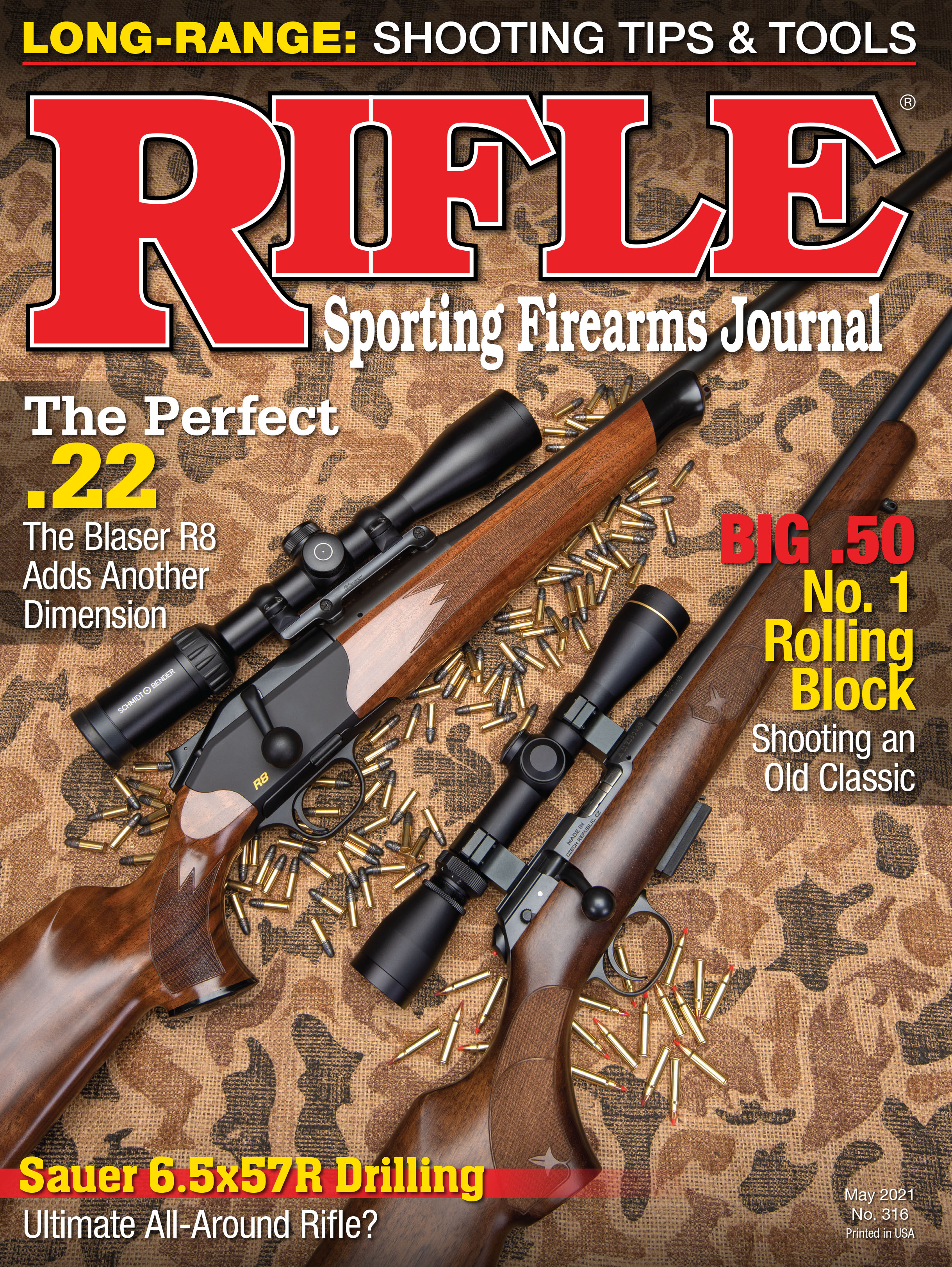
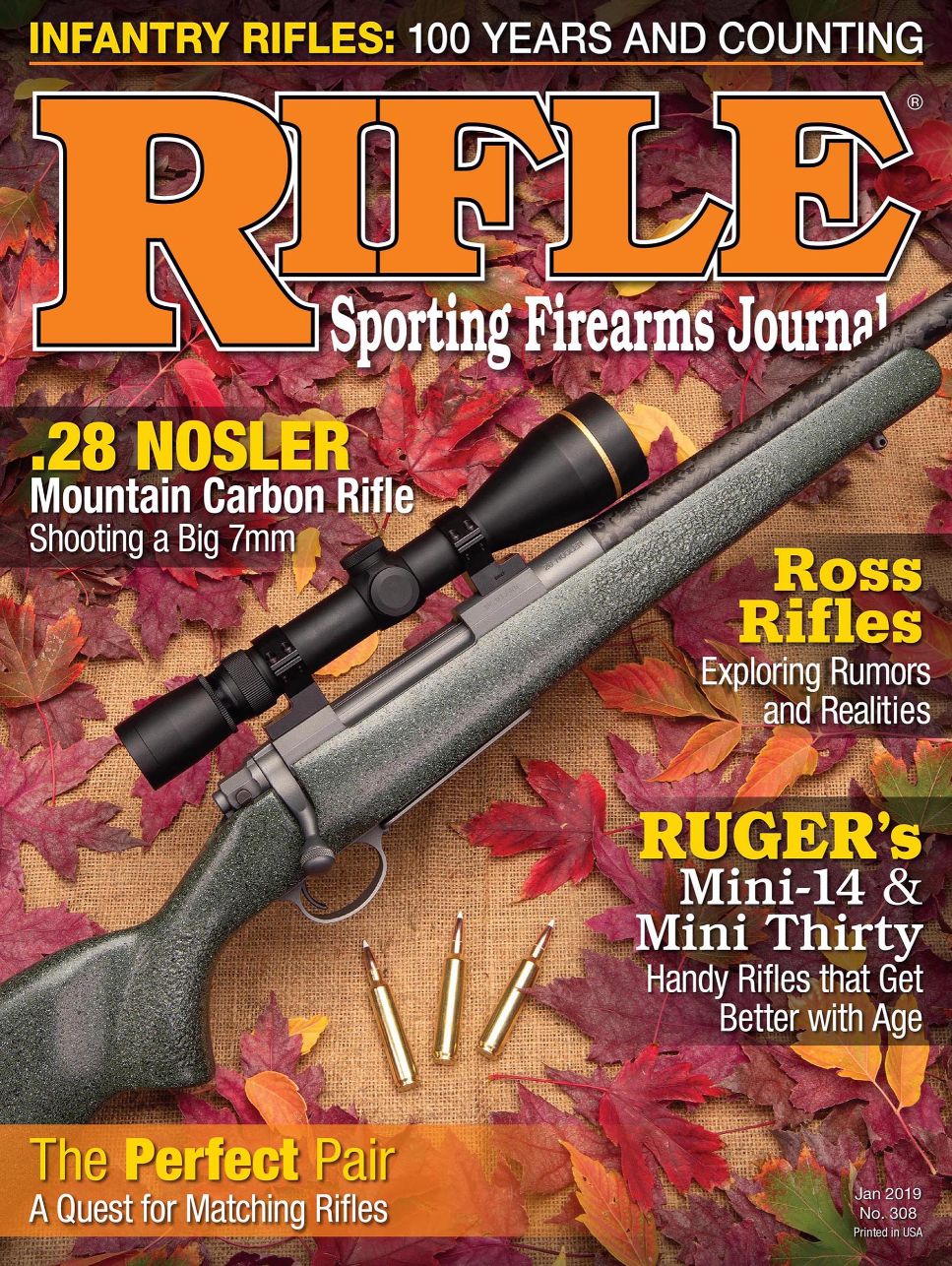
cover... The Lone Star Remington-style rolling block rifle
A
short while back I happened upon the premier issue of Rifle from 1969. It contained an
article about getting an old .50-70 Sharps carbine up and running again. I couldnt
help but smile as I read it because of all the time and trouble it took that writer to
come up with shootable loads. As I remember he had difficulties in finding proper bullet
moulds, brass had to be cobbled from .348 Winchester cases, and there was virtually no
loading information for him to use as guidelines.
How
much things have changed in 30 years! Brass and bullet moulds for the .50-70 Government
are off-the-shelf items now, and the techniques for loading good black-powder ammunition
are fully understood once more. Furthermore, at least one powder supplier, Accurate Arms
Company, prints data for smokeless powder .50-70 loads.
In
my opinion the .50-70 Government is a fascinating cartridge. Although it was official army
issue for only seven years, it made a place for itself in Indian Wars history and was one
of the most used rounds during the great buffalo hunt of the 1870s. It was this countrys
first centerfire primed, metallic-cased military cartridge, combining a 450-grain conical
bullet over 70 grains of black powder. Initial military loads were said to give 1,260 fps
and were put up in copper cases. Although centerfire, they used inside primers and were
not reloadable.
The
first military rifle that was chambered for the .50-70 Government was the Springfield
Model 1866. These were nothing more than Civil War Model 1861 muzzleloading muskets with
the breeches cut away and trapdoor style breechblocks installed. Barrels were
lined down from .58 to .50 caliber but left the full 40 inch length. By 1868 the
Springfield arsenal was making new barrels and receivers but was still relying on leftover
Civil War locks, stocks and other furniture. At this time barrel length was reduced to 32
5/8 inches. This was the Model 1868 and is the most commonly encountered of .50-70 caliber
trapdoor Springfields. Later, there came a slightly modified Model 1870 in
rifle and carbine versions.
Trapdoor
Springfields in .50-70 caliber saw considerable action on the frontier. Soldiers armed
with the new and relatively fast shooting rifles dealt the Sioux and Cheyenne warriors
severe setbacks in both the Wagon Box and Hayfield fights of 1867. Also its a little
known fact that after 1873 when the army was converting to trapdoors in .45-70 caliber, it
often armed its Indian allies with the older .50-70s.
Captain
French of M Troop, 7th Cavalry carried a trapdoor .50-70 infantry rifle (exact model
unknown) with him to the Little Bighorn Battle in 1876. Trapped on the hilltop with the
Reno/Benteen detachments, he is known to have done good work with his .50-70, and its
ramrod came in handy for removing stuck cartridges from his mens .45-70 carbines.
As
with all military cartridge developments, it did not take long for rifle manufacturers to
pick up on the new round. Remington made a considerable number of civilian and military
style rolling blocks in .50-70 Government. One of Remingtons more famous supporters
was George A. Custer also of 7th Cavalry fame. He carried his .50-70 Remington Rolling
Block Sporting Rifle to his death at the Little Bighorn.
By
1867 the Sharps Rifle Company was already converting its percussion carbines to chamber
the .50-70. When the Sharps company began introducing Sporting Rifles with the Model 1869
and then the much more famous Model 1874, the .50-70 was always a chambering option. One
bit of mistaken gun mythology is that the Sharps Big Fifty of legend was the
.50-140. Thats not true because the Sharps Rifle Company never chambered for that
round. Instead the term Big Fifty was used for Sharps .50-70s and .50-90s, and
both rounds were considered fine bison killers.
Those Sharps carbine .50-70 conversions
mentioned above are an interesting story. After the Civil War the federals were left with
about 50,000 Sharps New Model 1859, 1863 and 1865 percussion carbines with bore sizes
ranging from .52 to .54 caliber. (I have an unaltered New Model 1863 that measures exactly
.530 inch across the grooves.) They made a deal with the Sharps Rifle Company to convert
them to .50-70, and collectors refer to these conversions as either Model 1867s or Model
1868s, as determined by minor mechanical differences in the conversion work.
From
the shooters standpoint, however, there are two very important variations: some were
left with their original six-groove Sharps barrels while others were lined with government
supplied three-groove liners. While doing the conversion work, the Sharps Rifle Company
was instructed by the military to leave all carbines with bores under .5225 inch as is.
Those over that diameter were lined. Original bullet diameter for .50-70 Government
military loads was .515 inch, so those carbines left with original six-groove barrels
could be considered loose in terms of bullet fit. I cant say exactly
what diameter the three-groove liners were, due to the difficulty in measuring slugs from
barrels with an odd number of grooves, but can say that my Model 1868 Sharps conversion
shoots okay with .512-inch bullets.
A
couple of friends own and shoot Sharps .50-70 carbines left with the original oversize
six-groove barrels. To get any sort of accuracy they have had to go to hollowbase bullets
cast very soft and, of course, powered by black powder.
Rifling twist rates for .50-70s are also
interesting. Trapdoor Springfields used a 42-inch twist, but the Sharps Rifle Company
started out with a 48-inch twist that was later tightened to one turn in 36 inches.
Remington also used the 42-inch twist but made some .50-70s with very tight 24-inch twist
rates.
Original
factory loads also deserve some mention. As earlier stated 450-grain bullets over 70
grains of black powder was the military standard; however, there were some variations in
civilian loadings. In Winchesters 1899 catalog, they also offered a 425-grain bullet
over the same powder charge. I find it interesting to note that Winchesters
.50/70/450 load used a bullet with one-to-16 (tin-to-lead) temper, but the .50/70/425 loads
bullet had a one-to-20 temper. The Sharps Rifle Company also had some variations in .50-70
loads. In its 1869 catalog are listed a 457-grain grooved bullet and a 500-grain paper
patched version. Presumably the powder charge for both was 70 grains, but that is not
stated. Later the Sharps company changed its loadings to a 425-grain grooved bullet and a
457-grain paper patched design. Both were loaded over 70 grains of black powder.
In
the 15 years since acquiring my first .50-70 trapdoor Springfield, Ive owned or at
least handloaded for and fired virtually every type of 1860s/ 1870s .50-70 rifle made.
Along with those Ive used the modern manufactured replicas such as C. Sharps and
Shiloh Model 1874s and most recently a beautifully crafted rolling block replica by Lone
Star Rifle Company (11231 Rose Rd., Conroe TX 77303). From this work I think some insights
about reloading this cartridge can be passed on.
First
off one needs brass. Of course, .50 Basic cases can be shortened to the 1.75 inch length
needed for .50-70, but I consider that a poor route for two reasons: The .50 Basic cases
by which-ever maker are expensive and nearly half the case is thrown away after making a
.50-70. Second is the case walls are so thick that an expensive inside case neck reamer
will be needed to thin them enough to chamber once a bullet is seated.
It
is far better to just buy ready-to-load .50-70 brass. To my knowledge, right now there are
three sources. One is Dixie Gun Works; the other is Bertram Bullet Company of Australia,
and the third is B.E.L.L. (Brass Extrusion Laboratories Limited is in business again.)
Huntington Die Specialties (PO Box 991, Oroville CA 95965) is a good ordering source for
the latter two brands. I have used all three types with good results, but when my wife
bought the above-mentioned Lone Star rolling block for me, I ordered 100 of the new
B.E.L.L. cases and have been doing all my recent shooting with them.
Next
the .50-70 shooter is going to need bullets. Cast .50-caliber bullet designs are plentiful
nowadays, ranging from about 300 to upwards of 600 grains collectively from the many
makers. However, considering the fairly slow rifling twist rates of most original .50-70
rifles and the rather limited case capacity, I think those in the 400- to 500-grain weight
range are most appropriate. RCBS and Lyman each offer .50-caliber bullet designs nominally
rated at 450 grains. These are 515141 for the former brand and 50-450FN for the latter.
Mine are cast of 1/20 (tin-to-lead) alloy and fall from the moulds at 446 and 471 grains,
respectively.
As
to shape, the Lyman bullet is pretty close to the profile of original government .50-70
bullets, while RCBS chose to make its more of a semiwadcutter. It might not look
authentic, but it sure does a great job on game. I must admit to never yet shooting an
animal with a .50-70 (I have missed a couple of deer with my Sharps carbine!) but did use
the RCBS bullet on both deer and elk from a .50-90 Sharps. It hits hard. Also, Ive
been with friends when they have connected on game with.50-70s, and it seems the impact is considerable despite the exact bullet
shape.
Ive
already mentioned the original size for .50-70 Government was .515 inch. Also Lyman used
to offer .515-inch cast bullet sizing dies, and its older 515141 moulds used to drop
bullets as large as .517 to .518 inch. I have friends who still own such moulds and dies
so I know this is true. Somewhere along the way, however, the reloading tool companies
have seen fit to reduce bullet diameter for .50-70 to about .510 to .512 inch. That latter
figure is the largest Lyman offers as a cast bullet sizing die now, and bullets from both
my current production Lyman and RCBS moulds drop at .513 inch from 1/20 alloy.
This
reduction in bullet diameter specifications by the reloading tool companies is probably
caused by the barrel groove diameters being givento current production .50-70 rifles. All that I am aware of - C.
Sharps, Shiloh Rifle Manufacturing and Lone Star Rifle Company - use .510 inch as their
nominal groove diameter for .50-caliber barrels. Interestingly, both C. Sharps and Lone
Star use Badger barrels with 24-inch twist rates, while Shiloh makes its own with a
36-inch twist.
Both of my original .50-70s (Sharps carbine
and Model 1868 Trapdoor) will group about 4 inches at 100 yards with the .512-inch
bullets, and thats with their awful standard issue military sights. The older
.515-inch bullets could possibly give a little better accuracy, but I cant
personally realize it without better sighting equipment.
.50-70 Government
Bullet
Powder
Charge
(grains)
Velocity
(fps)
Extreme Spread
(fps)
Comments
Lyman
|
|
|
Goex
GOEX Cartridge
Pyrodex Select
XMP-5744
65.0
70.0
48.0
28.0
1,203
1,222
1,224
1,233
14
21
23
37
best
load
close to original military load
good ballistic consistency
RCBS 50-450FN
|
|
|
GOEX FFg
GOEX Cartridge
Pyrodex
XMP-5744
65.0
70.0
48.0
28.0
1,177
1,187
1,235
1,258
10
17
15
18
best load this
bullet
higher velocity with heavy bullet
Notes:
Rifle used was a Lone Star Rifle Company rolling block with a 28-inch barrel. Velocities
taken with PACT Mark IV Timer set in chronograph mode with start screen at approximately 6
feet. All loads put in B.E.L.L. brass with Federal 215 Large Rifle Magnum primers. All
bullets cast of 1/20 (tin-to-lead) alloy, sized to .512 inch and lubed with SPG. All case
mouths crimped firmly on the bullet.
Be alert - Publisher cannot be
responsible for errors in published load data.
There is one problem Ive encountered
with the Lyman .50-70 reloading dies, although I should admit that Ive only had
experience with this one set. The sizing die was cut to squeeze the case walls down for
.515-inch bullets and doesnt give a really tight grip on .512 inchers. Furthermore,
the case mouth expanding die of my .50-70 dies measures only .506 inch and when run into a
fully sized case doesnt actually touch the inside of the case mouth. Ive
compensated for this problem by simply giving the bullet a firm crimp when seated and have
been using this system for 15 years. If I bothered to get a set of reloading dies made to
the proper specifications, who knows how well my .50-70s might shoot?
That
brings me to the latest .50-70 rifle. In 1998 my wife said she would like to buy me a
special gun for a present. I picked the above mentioned Lone Star rolling block. It was
ordered as a hunting rifle with a 28-inch octagonal barrel that measures one inch across
at the muzzle. With color casehardened action and buttplate coupled with extra fancy wood,
this rifle is a showpiece.
The
day the new Lone Star .50-70 arrived I couldnt find my .50-caliber wad punch but did
have exactly eight of the Lyman 515141 bullets sitting around. I already knew the B.E.L.L
brass would hold either 65 grains of GOEX FFg or 70 grains of GOEX Cartridge when
drop-tubed into the cases. Primers were Federal 215s, and lube was SPG. Four each of those
powder charges were loaded.
The
first three shots with the FFg charge at 100 yards cut a triangle of only 1 1/2 inches.
Three rounds with GOEX Cartridge cut a slightly bigger triangle of 1 3/4 inches just to
the right of the first group. I had one round left of each load and fired them into the
group. All eight shots could be covered with a 3 1/4-inch circle. That, of course, was
with the buckhorn rear sight and silver blade front.
That
shooting was almost a year ago, and time constraints have not allowed me to shoot the
rolling block since. However, with hunting season approaching I decided to give it another
try. Rounds were put together holding the two black-powder charges mentioned above under
Lyman 515141 and RCBS 50-450FN bullets. To round things out, both bullets were coupled
with 48 grains of Pyrodex Select, and from consulting Accurate Arms Companys data
pamphlet, I also picked a charge of 28.0 grains of XMP-5744 smokeless powder.
It
should be stressed that under no circumstances do I recommend using smokeless powder for
reloading .50-70 Government loads to be fired in 1870s vintage rifles - especially
trapdoor Springfields. However, for modern manufactured ones such as this Lone
Star rolling block or Sharps produced by either Shiloh or C. Sharps, there is no problem
in using smokeless powders if the loads are based on suitable data.
It
appears my fine rolling block .50-70 is one of those rifles that just shoots everything
well. No fouling shots were used, and the barrel was swabbed out with wet and then dry
patches after each five shots. All 100-yard groups amounted to round clusters of about 3
inches give or take .5 inch or so. Also it was gratifying to see that all group centers
were right at point of aim. Groups in the 3-inch range might not impress modern riflemen,
but considering they were fired with a buckhorn rear sight and silver blade front and
without any sort of target type handloading techniques, I was happy with them. By the way,
the best shooting load still was that initial concoction tried before that consists of 65
grains of FFg with the Lyman 515141 bullet.
For
the non-black-powder shooters Id like to point out that the XMP-5744 loads shot just
as accurately as either black powder or Pyrodex and, to my surprise, gave tight velocity
variations despite the fact no sort of case filler was used. This powder never fails to
amaze me with its performance in large capacity cartridges originally designed for black
powder.
Theres
one other interesting point to mention. Note that with both black-powder loads the Lyman
bullet gave higher speeds than the heavier RCBS bullet. That seems like the natural thing,
but when we got to Pyrodex and XMP-5744, the reverse was true. Evidently the heavier
bullet aided combustion with those two slightly harder-to-ignite (compared to black
powder) powders.
After
15 years of handloading the .50-70 for a wide variety of rifles, both old and new, I have
to say that in my opinion its one of the easiest of the old big-bore, black-powder,
single-shot rounds. There are no tricks or special techniques needed for loading good
.50-70s. In fact they behave well despite the less than perfect reloading dies I described
above. Some competitors even use .50-70s in the black powder cartridge rifle silhouette
game and do well with them.
To me the round is a short-range game thumper,
and it appears from this recent shooting that all I have to do is pick up my .50-70
rolling block and head out with it come hunting season. The handloading efforts were no
big deal.