|
 |
September - October 2000 Volume 32, Number
5 ISSN: 0162-3583 Number 191 |
|
|
On the
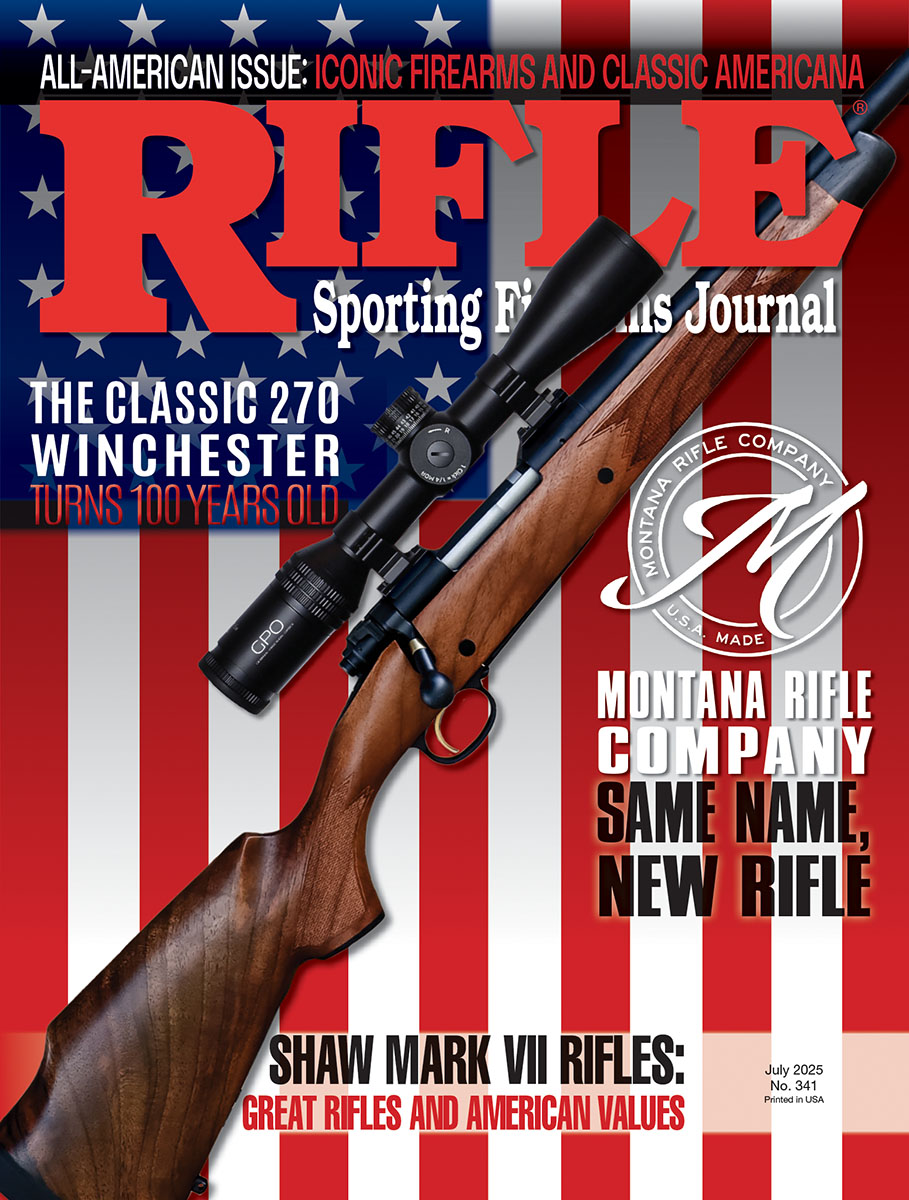
cover... The SIG SHR 970 .280 Remington is outfitted with a |
|
|
|
|
|
|
An ultralight rifle could increase
your hunting success in a big way. They have mine. Ill give you an example.
My guide and I had been
climbing and glassing the Alaska Range for roughly 14 hours on the third day of a Dall
sheep hunt. The little hand was on the 10, the big hand on the 11, and clouds were piling
in from the southwest. We needed food, rest and a level spot on which to build a crude
shelter from the coming storm, but there was one more peak before us, and I had just
enough gas left to tackle it. What do you suppose we spied on the other side? Thats
right, the 39-inch ram currently staring down on me in glassy-eyed defeat. I dont
know if youve ever pushed to the shaky edge of endurance, but if you have Im
sure youll realize how an extra 2 to 4 pounds of dead weight can wear you down. Had
I been packing my old Ruger Model 77 .270 Winchester instead of my new Ultra Light Arms
Model 20 .284 Winchester, I honestly believe Id have been lying under a tarp on a
low grassy ledge instead of shooting at that big, wonderful white sheep. Moral of the
story: ultralight was just right.
Heres another Alaska sheep
story. This time Im running on a mountain slope covered deep with scree, those small
rocks that spill out from under your boots like a big pile of shelled corn. Step up two
feet, slide down one. There is a 20-pound pack on my back, a 6-pound Rifles Inc. Strata
Stainless .280 Improved rifle in my hands and a marvelous Dall ram fleeing around the
corner. I must clear the roll of earth before my quarry disappears into cliffs and ledges
beyond. Mind you, Ive already backpacked nine miles to the site, slept on rocks and
climbed a few thousand feet, and Im past 40 with no history as a star athlete. Well,
the sheep has enough manners to wait. When I puff to the crest of the ridge, that splendid
animal is standing across a side canyon and high above among towering spires, feeling
pretty safe. He hadnt reckoned on my Strata Stainless. I laid that 11-ounce,
wasp-waisted synthetic stock across a flat-topped boulder, steadied the crosshairs on
white, and applied about 2.5 pounds of index finger pressure. A
satisfying whap floated back across 350 yards of pure
mountain air. Once again, if Id been lugging a 10-pound rifle, I dont think
I could have survived the run up that scree with enough energy left to steady myself for
the shot. I was gasping the way it was.
Lest you think ultralights are
useful for nothing but running sheep, heres a whitetail story. A buck that appears
to have lodged a section of picket fence in its antlers has secreted himself in a brush
thicket with an estrus doe at dusk. The hourglass is sifting down to its last few grains,
so I rise from my hiding place to sneak across an open flat. The doe spooks up a distant
grass hill, the buck follows, figures out theres trouble afoot and kicks into warp
drive, angling just slightly right. Despite the fact this is the largest whitetail Ive
ever fired at, that Ive stalked a half mile to get this close to him, that Id
lain watching him so long I could pick him out of a police line-up if he were wearing a
fake beard, and that he is now 200 yards away and about to run out of my life forever, I
calmly raise the Ultra Light Model 20, send a 140-grain Nosler Partition on its way and
dump him.
Credit my superior skills with a
rifle? Dont flatter me. I once missed a standing pronghorn at 80 yards. No, credit
reasonably good marksmanship and a light, responsive, familiar rifle that fits perfectly,
flies into action without conscious thought on my part and places its bullets so
dependably that I fire it with complete confidence. I mean I just knew that buck was mine.
No question, no doubt. All I had to do was take him. There was no long hike this time, no
endurance test. Nevertheless, I credit the minimal weight of that rifle with aiding me in
a nearly instinctive shot. I compare it to hitting a baseball with a properly sized bat. I would
not do well with Mark McGwires stick.
Mule deer hunting. Montana. Another
buck of a lifetime. Hey, it happens. This time hes only a mile away, but hes
walking toward a No Trespassing fence. If he crosses, hes safe. So I
run, even though I havent jogged so much as a half mile in months. My legs burn. My
lungs hurt. I wonder if a deer is worth a heart attack. Then I lay the superlight Strata
Stainless across the Steady Stix, concentrate on keeping the Leupold crosshair on the neck
and press the magic button releasing the Barnes X-Bullet. Bingo! The buck collapses two
steps from the fence. Oh, I love those ultralight rifles.
By this point you may be arguing
that Im overdoing all this climbing and backpacking and running. A good hunter doesnt
have to sweat so much. Hunt with your brain and eyes instead of your feet. You never run
after giant bucks or climb after giant rams, do you? Perhaps you would if you didnt
carry such a heavy rifle.
Now before you write me a nasty note or call
me out behind the bar, allow me to acknowledge something. You or your buddy or your uncle
or nearly anyone else you know is quite likely stronger, faster and smarter than I and
probably a better hunter and shot too, but that doesnt mean you couldnt become
an even better hunter and better shot if you switched to a lighter rifle. Like they say in
the commercials, if it worked for me, imagine what it could do for you.
|

Ive heard the arguments about
mass contributing to accuracy. This is basic physics, and theres no use fighting the
laws of nature. If heavy rifles werent more accurate than light rifles, heavy rifles
wouldnt win all the benchrest competitions, but hunting isnt target shooting.
Different factors come into play, two of them being human endurance and responsiveness.
Exactly when does the ease of carrying and throwing into action a light rifle more than
compensate for the steadiness of a heavy one? I dont pretend to have an objective,
scientific measure of the quantitative difference in stability of the human shooter over
200 yards when carrying an 8-pound rifle versus a 6-pound rifle over 5 miles at 57 degrees
5,000 feet above sea level on an empty stomach with the sun in his eyes. All I know is how
well ultralight rifles have worked for me in the hunting fields for 15 years. I shoot
better with them than with heavy rifles under most hunting conditions. Like everyone, Ill
take a heavy sniping rifle for stand hunting.
As for pure accuracy potential, I
can offer some controlled tests. Representative groups from four light to ultralight
hunting rifles Ive used over the years are listed in the table.
As you can see, these groups arent
bench winners, but they arent dog dandruff either, and they carry their accuracy
afield. None of these guns has felt whippy, ungainly, flighty or uncontrollable in wind,
rain, snow or desert heat. Quite the opposite. If anything, the slightly muzzle-heavy
balance of the Rifles Inc. Strata Stainless and Ultra Light Arms Model 20 make them feel
as if they hang on the target.
I first noticed this during a coyote
hunt one December. I was alternating a slightly butt-heavy Ruger Model 77 .22-250
Remington with the muzzle-heavy Model 20. I went five for five with the Model 20 but
missed several shots with the .22-250, and at the time I felt like one of those cartoon
characters who has a light bulb flash overhead. Ureka, Id found it. Since then my
only complaint with my Model 20 is that it isnt chambered in .22-250 or 6mm
Remington.
My latest light rifles have been the
Weatherby Ultra Lightweights in .270 Winchester and .30-06. They weigh right at 5 3/4
pounds naked, which is a pound more than the Strata Stainless and Ultra Light Model 20,
but Ive been so impressed with them that Ive ordered one in .300 Winchester
Magnum, guessing it could be just about the ideal elk-moose-bear rifle. This magnum
version weighs 6 3/4 pounds because it uses the beefier Mark V nine-lug magnum action.
Standard calibers use the lighter six-lug standard bolt. Despite their extra weight these
Weatherbys offer several advantages over most standard production lightweight
rifles:
·
They retail for about $1,300 less
than the Strata Stainless and Ultra Light Arms.
·
They are between 1/2 and one pound
lighter than most companys lightweight rifles in comparable chamberings.
·
They are the only light rifles from
a major manufacturer available in magnum chamberings. Most companies limit their light
rifles to short-action cartridges.
·
They offer 24- and 26-inch barrels
for maximum velocity potential from all calibers. Most major manufacturers put 20- to
22-inch tubes on their light rifles.
·
The stock (one pound, 11 ounces) is
hand-laminated glass with integral aluminum bedding plate.
·
The stainless steel barrel reduces
chances of rusting on long mountain hunts.
Weatherbys
major departure from other major manufacturers in the designing of ultralight rifles is
its willingness to lighten its own action by skeletonizing the bolt handle and bolt sleeve
and cutting deep flutes into the bolt itself. Since the bolt lugs secure the cartridge and
gases in the chamber, removing metal from the bolt behind the lugs does not compromise its
strength. Such metal removal is what Lex Webernick does to Remington Model 700 actions to
create his Strata Stainless. He goes farther than Weatherby, however, cutting metal from
the rear bolt shroud and even the action walls. You could cut the bolt off behind
the lugs and throw it away without compromising locking strength, Webernick once
told me.
|

Mel Forbes took this weight
reduction to its logical conclusion when he designed his ultralight actions in short, long
and magnum lengths. Instead of paring down someone elses action, he designed his own
by matching thickness to the strength of modern steel. Despite their diminutive size,
Models 20, 24 and 28 actions have withstood exhaustive testing pressures double that of
the highest acceptable chamber pressures for modern centerfire cartridges.
The folks at Browning, Remington,
Ruger, Savage and Winchester make fine light rifles, but no truly ultralight rifles in my
estimation. Forgive me for saying so, but wheres the feather in a 7-pound
Featherweight? I think this Winchester is one of the best looking and best performing
walnut/blued rifles on the market, but I dont classify it as a lightweight. To me
its just about perfect for a general-purpose, traditional-weight rifle. Winchester
actually offers a lighter option in its 6-pound Classic Compact but in short action only.
I will not limit my criticism to
Winchester. Remingtons Mountain Rifle, another classic design that catches my eye,
is in my humble opinion overweight (for a true mountain rifle) at an advertised 6 1/2
pounds (actual rifles never seem to match the optimistic numbers in the catalogs, but well
take Remingtons and everyone elses word for it here). The Model Seven at 6 1/4
pounds sounds better, but that specimen, like the Winchester Compact, wears a
trimmed-down, 20-inch barrel. Ditto the 6-pound ultralight Savage Model 10FCM, 6-pound
Ruger Ultra Light Model 77 Mark II and the Browning Micro-Hunter at 6 pounds, 4 ounces.
Admittedly these rifles have been shaved considerably from their 7 1/2- to 8-pound
predecessors, but they remain a far cry from the likes of the Ultra Light Arms Model 20 at
4 3/4 pounds with a full-sized, 22-inch tube.
The biggest flaw in these
pared-down, big-name rifles is the way in which theyve been pared. Instead of
removing superfluous weight from the action or stock, they lop useful mass off the barrel.
A 20-inch tube balanced to the right stock can make a perfectly adequate, quick,
natural-pointing woods rifle, but it isnt state of the art for long-range work. Why
not keep those 2 ounces of barrel and the 50- to 100-fps velocity they represent and
instead lose 8 ounces of fat from the action and another 8 ounces from the stock? We have
fiberglass/graphite materials stronger than steel at a fraction of the weight. Why not use
them?
The short-action chamberings
available in these lighter guns also limit their versatility, or at least popularity. In a
subculture gone gaga over super magnums, the .308 Winchester class of cartridges isnt
going to be voted Prom Queen. Of course, you know as well as I that any .284-inch bullet,
or even .264-inch bullet, launched at 2,600 fps is more than adequate for deer and sheep,
and learning to hold a bit higher than usual beyond 300 yards is no impossible dream. A
practiced, dedicated hunter could take any game animal in North America and most in Africa
with one of these 20-inch barreled, short-action rifles. But that doesnt put them in
the same league as a 4 3/4-pound Rifles Inc. Strata Stainless long action all dressed for
the big dance in a 23-inch barrel. Hunters know this, and Im certain that more than
fear of recoil and inaccuracy, this sacrifice in power keeps ultralights near the bottom
of the pop charts.
Here we return to that problem of
price. True, there are ultralight rifles with all the durability, punch and accuracy of
heavy rifles. To claim one, however, youre going to lay something like $2,500 on the
counter, maybe a couple hundred less, maybe a few more. Prorated over a 25-year hunting
career and measured against the likes of a B&C elk or mule deer, that might be more
than a fair price. I find it to be. On the other hand, a more practical hunter might
simply put up with the 8-pound rifles his daddy used and invest the $2,000 he saves at 10
percent interest to pay his kids college tuition (good luck on that).
I also believe Weatherby is on the
right track and might start a trend. Look what happened after it became the first major
manufacturer to put a synthetic stock on a big game rifle in the mid-1980s. However, even
though its Ultra Lightweight retails for considerably less than an Ultra Light Arms or
Rifles Inc. gun, it remains significantly higher than the low-end traditional bolt actions
most average hunters buy for around $600 to $700. Im guessing the first manufacturer
to produce a true, full-sized ultralight (say 5 3/4 pounds, long action, 22-inch barrel)
for roughly the same price as its traditional rifles will jump-start this market, but dont
hold your breath waiting.
If you have caught on to the
advantages of an ultralight hunting rifle, dont wait. Act now. If you only hunt
eastern deer or bear and have no plans to roam the Rockies, youre in the drivers
seat. Grab yourself a 6-pound Savage, Ruger, Winchester, Browning or Remington and hit the
woods. Youll benefit immediately from the trimmer package, lighter weight and more
responsive handling over that 8-pound, long-barreled Model 700 or 70 youve been
carrying, or that big pump or autoloader, for that matter. If you just sit in a box and
shoot across big fields, keep your 10 pounder. Youre dialed in.
However, if you yearn for adventure,
if you plan to hunt as long and hard as you can in as many wild and wonderful places as
you imagine, study todays ultralight rifles long and hard. Take every opportunity to
lift them, mount them, test fire them. Hunt with one if possible. Feel the difference.
Feel the advantage. Then scrape your pennies together and buy one. You wont regret
it. These are the best all-around hunting rifles ever made.
|
|
 |
|
|
|
|