|
 |
September - October 1999 Volume 31, Number
5 ISSN: 0162-3583 Number 185 |
|
|
On the
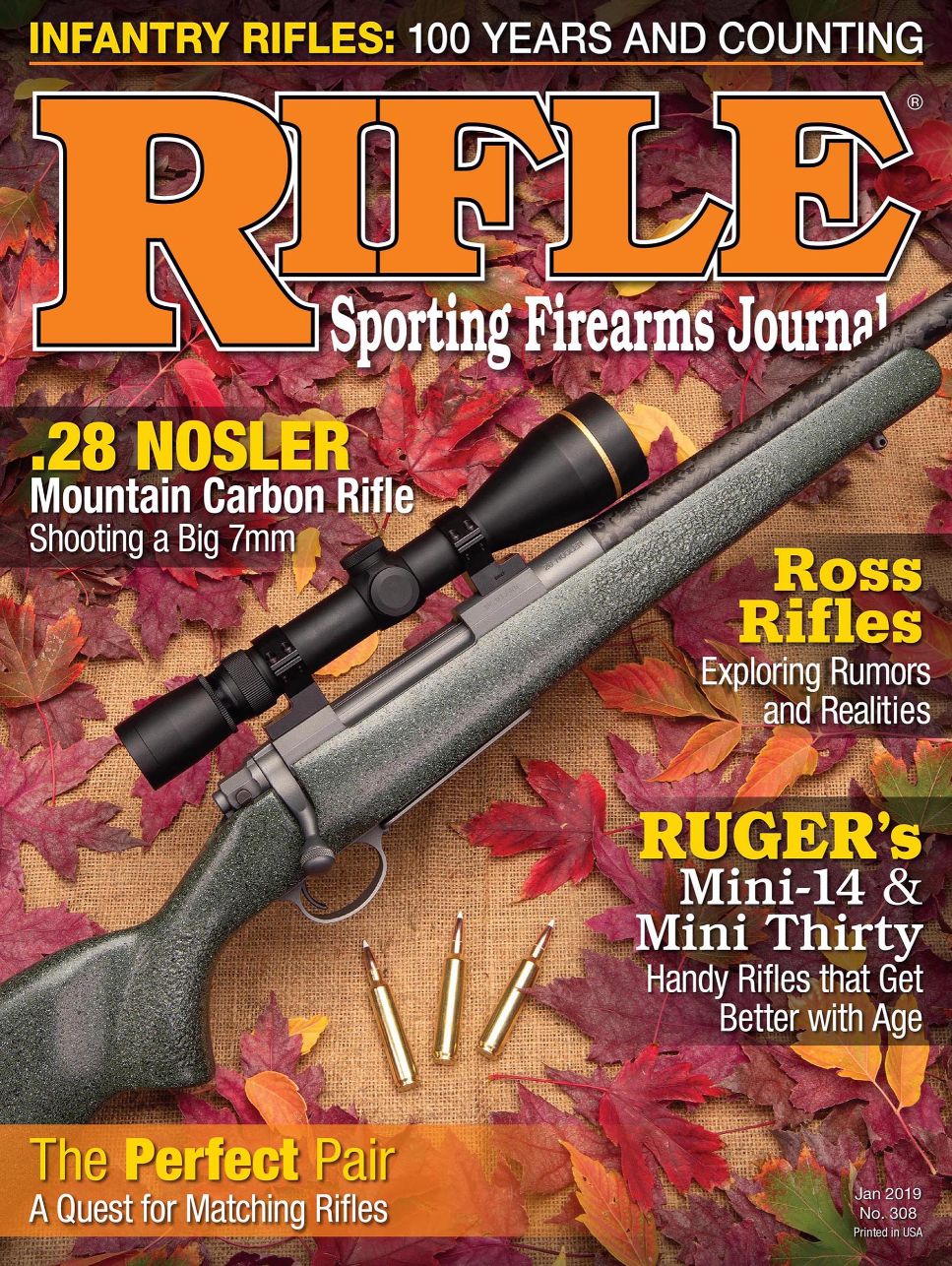
cover... Sako Model 75 Varmint in .22-250 Remington. Jeff C |
|
|
|
|
|
|
Golfers take lessons, so do scuba divers, fly fishermen
and rock climbers. Our English friends the Walkers came over ostensibly so Freida could
attend a five-day class at a famous "tennis ranch" near New Braunfels, Texas.
Wing shooters and clay pigeon competitors pay for instruction. But rifle and handgun
shooters? Nah, they are natural-born great shots; there's nothing anyone can teach them
about that. Jeff Cooper some years ago offered a rifle course specifically for
Africa-bound hunters, reasoning that anyone who was going to that expense would welcome an
opportunity to enhance his shooting skills to the utmost. There were few takers.
In the past the military took shooting quite seriously and devoted much time and effort to
instilling the art of the rifle into its recruits. Before the adoption of the M1 Garand in
the late 1930s, that was the art of the bolt-action rifle, which today is by far the most
common action for hunting rifles. Now other firearms take precedence, and the militaryexcept
for the Marine Corpsseems to put little emphasis on rifle marksmanship. Besides, a
far smaller proportion of young people than formerly serve in the armed forces or receive
any form of firearms training. My
father began teaching me to shoot with a Diana air rifle when I was about five years old
and graduated me to a Winchester Model 67 single-shot .22 rimfire shortly thereafter. He
had some idea what he was about, as he had been trained with the Krag-Jürgensen 6.5x55mm
bolt gun during his compulsory military service in Norway. Later the Kenya Regiment
continued my education by drilling me relentlessly in the use of the .303 Lee-Enfield
service rifle. A large proportion of modern fathers could not begin to teach their
offspring to shoot, even if they cared to do so, because they have had no training at all
themselves.
After 30 years of guiding, I have to conclude that most hunters are rather poor shots and
have little inkling how to handle their rifles. A few gifted people shoot very well indeed
despite doing it all wrong Karamoja Bell's form was apparently atrocious in some
respectsnevertheless they would do even better if they had been taught the right
way.
Your average hunter does not know how to hold
his rifle; he fumbles the safety, drops the butt from his shoulder to work the action,
even with a lever gun, and jerks the trigger in an attempt to catch the target as the
sights slide past it. He cannot assume a steady position, neglects to make the most of
available natural supports and is totally ignorant of the loop shooting sling. Two
experienced American big game hunters were astounded when I acquired the loop sling as I
dropped into sitting with my .375 to stop a fleeing wounded zebra on an open plain. (I had
learned about the loop sling from the writings of that dean of riflemen-hunters, Col.
Townsend Whelen. The British army did not teach it.)
The standard of pistolcraft among the general
public was, and in general remains, even sorrier than that of riflecraft. The military
establishments of the world (except possibly the horse cavalry) seldom took handguns
seriously, and at most allowed recruits to fire a score of rounds for
"familiarization." My father also allowed me, under strict supervision, to shoot
his FN Browning .32 auto pistol but could tell me only to hold the thing firmly in one
extended hand and attempt to use the miniscule sights, as he knew no better way. (The
noisy little brute would hurt my ears and leave them ringing for a long time afterwards.
No one had heard of hearing protection in those days, which is why I can't hear much now.)
Later I practiced the FBI crouch and various
other styles of "instinctive" point shooting until I could usually hit a
substantial target close up. Using aimed fire I could nearly always drop a guinea fowl out
of a tree with an S&W K22 Masterpiece revolver; but I held the gun in only one hand,
as did everyone else, mostly. The original reason for the one-hand hold was to allow a
horseman to control his steed with the other hand, I suppose. It was required by the code
duello and by the rules of formal target shooting. With practice, fine shooting can be
done that way, but it is not the optimum stance to adopt when defending oneself against
lethal criminal violence.
Who first thought to hold the handgun in two
hands is unknown. In his book Shooting, first published in 1930, and reissued by Wolfe
Publishing in 1993, J.H. "Fitz" FitzGerald has a description and a photograph of
a two-handed hold that is very close to the modern doctrine. In 1958 Jack Weaver
rediscovered the advantages of employing both hands during practical combat competition
organized by Jeff Cooper and his cohorts of the Bear Valley (California) Gunslingers,
which developed into the Southwest Combat Pistol League and eventually into today's IPSC
(International Practical Shooting Confederation), which no longer stresses the practical
and has become merely a game.
|

Cooper, a born teacher, founded Gunsite Training Center
and the American Pistol Institute near Paulden, Arizona, in 1975 to develop and teach
defensive pistolcraft and later riflecraft and the defensive use of the shotgun. At about
the same time (or a little before), Roy Chapman, one of the original Gunslingers, started
his Chapman Academy of Practical Shooting in Hallsville, Missouri. From these beginnings,
schools that teach practical (more or less) techniques of firearms have sprung up all over
the country.
Eventually I came to understand that if I were going to continue to keep a handgun around
for defensive purposes, I ought to learn how to manage it properly. I had read everything
I could find about the modern technique of the pistol and had practiced as best I could.
But I was strictly self-taught, and self-taught is all too often badly taught.In 1994 I signed up for the five-day basic handgun
class at Thunder Ranch near Mountain Home, Texas, because it lies only a hundred miles
from my home and because I had heard good things about it. Clint Smith, the director, is
well qualified: a Marine Corps veteran of two tours in Vietnam; seven years in law
enforcement, serving as head of a Firearms Training Division as well as being a S.W.A.T.
team member and counter-sniper; Operations Officer at Cooper's American Pistol Institute;
Director of Training for Heckler & Koch Inc. He holds credentials from FBI S.W.A.T.
School, NRA Police Firearms Instructor School, the S&W Academy Advanced Weapons School
and the like.
The facility was built on a large ranch to
Smith's specifications, almost without regard for cost, by his patron, from whom he leases
it. It has about everything a firearms instructor could desire, all of it first-class.
There are several ranges with conventional silhouette targets, turning targets, moving
targets and even targets that charge at the student. There is a replica city street,
Thunderville, a four-story tower live-fire tactical simulator, a 1,200-yard
unknown-distance range and far from least, the Terminator. This is a large concrete
building completely surrounded by a berm with movable inside partitions that allow all
sorts of tricky situations to be set up for the elucidation of the students.
We started in the classroom with the four
commandments of gun safety, range rules, the purpose of a handgun (to stop fights and save
lives), the legal and moral implications of the use of lethal force, the aftermath,
mind-set, the color code of preparedness, avoidance of confrontations (the best way to
survive a gunfight is not to get into one), the use of concealment and cover, tactics and
much more.
On the range we began with grip and stance,
went on to sight alignment, the flash sight picture, the surprise trigger-break,
presentation of the handgun, shot placement, loading, unloading, reloading, malfunction
drills. We shot from the Weaver stance and with the strong hand and weak hand alone. We
shot from standing, from kneeling, from flat on our backs and while back-peddling to
"open the hole" between us and an assailant. We practiced point-shooting close
up, learned how to shoot from cover and toward the end of the course did a night-shooting
exercise. I was surprised to find that at 15 feet I could keep all my shots on the target
without being able to see the sights. We finished up with some runs through the
Terminator, putting to the test what we had learned.
For my final run, Smith presented me with this
scenario: "While in a restaurant you go to the restroom. You become aware of a lot of
noise and shouting, there are some shots, then Berit (my wife) begins screaming. Go!"
Imagining that situation—it would have to be awfully bad to make Berit scream—I
worked myself into a cold rage, almost. I determined that I would immediately take out
anyone who appeared to pose any threat whatsoever. I shot quite well, for me, cleaned up
all the bad guys and managed to avoid hitting any innocents. I almost turned my back on
one fellow with a little boy in his arms, until I noticed the knife he was holding against
the child. I terminated that problem with a quick head shot. The Terminator was a lot of
fun, but the lesson it taught above all else is that house-clearing is an excellent way to
get killed. One should not attempt it unless he absolutely must.
Clint Smith proved to be an outstanding
teacher who kept his students interested and highly motivated throughout; I do not think
any of us ever thought ho-hum, even for a moment. The most important thing we gained from
the course was confidence—the calm confidence that comes from knowing one can cope,
one can retain control of his immediate environment. It is a wonderful feeling, and the
confident demeanor it engenders has defused many a potentially dangerous situation. When
non-shooting visitors ask, "Why are you people wearing pistols; what are you scared
of?" Smith tends to answer serenely, "Why, nothing, nothing at all." That
is the whole point.
Subsequently I took a general rifle class with
Triggers Training, under Jeff Cooper's supervision, at the NRA Whittington Center near
Raton, New Mexico. (Cooper has sold Gunsite, which continues under new management.) The
Whittington Center claims to be the biggest shooting range in the world. The high-power
range can accommodate 100 shooters firing out to 1,000 yards, for instance.
|
Triggers Training's chief instructor, Rich
Wyatt, a firearms instructor with the Aurora, Colorado, police department, is a fine and
most knowledgeable teacher, as were his associates. They were a little surprised I wanted
to take the coursewas I not a former African professional hunter and a sort of
pseudo gun writer? Yes, but I learned a lot nonetheless. Cooper, who is now in his late
70s and suffers some physical disabilities, gave the key classroom lectures and made his
presence felt on the range for an hour or two each day. His mind is as sharp as ever, as
is his Marine colonel's bark.The one
essential to good rifle (and pistol) shooting is trigger control. We were taught: don't
force it, surprise break, let it happenbut quickly. We practiced acquiring the sling
(loop, CW or Ching) while dropping into positionfrom standing to sitting with the
sling in 1½ seconds was the goal. By the end of the course, I found I was about as steady
with the sling as with a bipod or crossed sticks, and the sling is much more convenient to
take along. We were taught the offhand, hip-rest, kneeling, squatting ("rice paddy
prone"it keeps your butt out of the wet or off the Wyoming cactus) and prone
and the field adaptions of them.
We learned that bolt manipulation consists of
only two movements: up and back, hard, all the way; and forward and down, hard, all the
way. The bolt is worked with the butt in the shoulder immediately after the shot: Bang!
Snick-snack, loaded and ready for whatever might come next. We practiced until it was an
automatic reflex.
We discussed, and practiced, the field-ready
position, the use of trees and other natural rests, range estimation, the point-blank
range concept and getting a good hit as quickly as possible. Only hits count!
Exercises included Snapsfast pairs at the head of an IPSC (old style) target at 25
yards and at the A-zone at 50 yards; the Rifle Bounceone hit on a Pepper Popper at
100, 200 and 300 yards, timed, while shifting position between each target; and not least
the Rifle Ten. This last entails hitting an IPSC target twice from each of 300, 275, 250,
225 and 200 yards, against the clock, Comstock scoring, free-style except that standing is
required at 200 yards.
The aim of the course was to qualify us for
the rifleman's motto: "If I can see it, I can hit it." We might not quite have
reached that ideal, taken literally, but all of us showed a decided improvement. It was
noticeable that by the end everyone was handling his rifle confidently and smoothly, as if
it were a part of him, rather than some awkward burden of which he was nervous. Indeed,
within 300 yards, if we could see it, we were very apt to hit it.
I returned to Triggers Training for their Tactical Pistol class, which continues where the
basic pistol class leaves off, and then quite recently went back to take the General
(basic) Pistol course again. It was the only way I could get my long-time friend and
hunting partner Jim Clifton to take the instruction he badly needed; besides I did not
think some revision would do me any harm. It didn't. I discovered that I had acquired some
bad habits I needed to correct, and the improvement in Jim's ability with the defensive
pistol, and in his confidence in it, was almost incredible.
There was one woman in the class, Heather
Olson from Minnesota. She brought her 17-month-old son and another lady to look after him
while she was on the range. She had decided to take the class when she realized she was
alone with the boy, responsible for his safety for much of the day, while her husband was
out working their farm. She studied and practiced harder than anyone and finished well
into the upper half of the class. Although she is a small person, she handled her
full-size Government Model .45 ACP very competently. Any punk who tries to mess with her
or little Nicholas is in for something of a surprise, and because her confidence and
determination would be clearly evident, it is highly likely she would not have to press
the trigger.
I am convinced anyone who keeps a handgun for
defense ought to go to school and learn to use it properlyand when and how not to
use it. It is the responsible thing to do. To a lesser degree, perhaps, the same applies
to the sporting rifle. The more competent you are with it, the less likely you are to
cripple some poor beast and have it go off to die a slow death. In addition, a hunter
should take pride in being skilled in the use of the tools of his sport, one might think.
Should you go to school? Yes, absolutely, by any means whatsoever. For more information
contact Thunder Ranch, HCR 1, Box 53, Mt. Home TX 78058. Write to Triggers Training at
3650 Wadsworth Blvd, Wheat Ridge CO 80033.
|
|
 |
|
|
|
|