

Browning's First Family of.22’S
Up to the Challenge
feature By: Terry Wieland | November, 26
Nineteen sixty-two was a notable year in the world of guns and hunting. That was the year Remington introduced its Model 700, rifle for rifle the most accurate mass-production bolt action ever; it also unveiled the 7mm Remington Magnum, the most popular of all the belted short magnums to come along in that era.
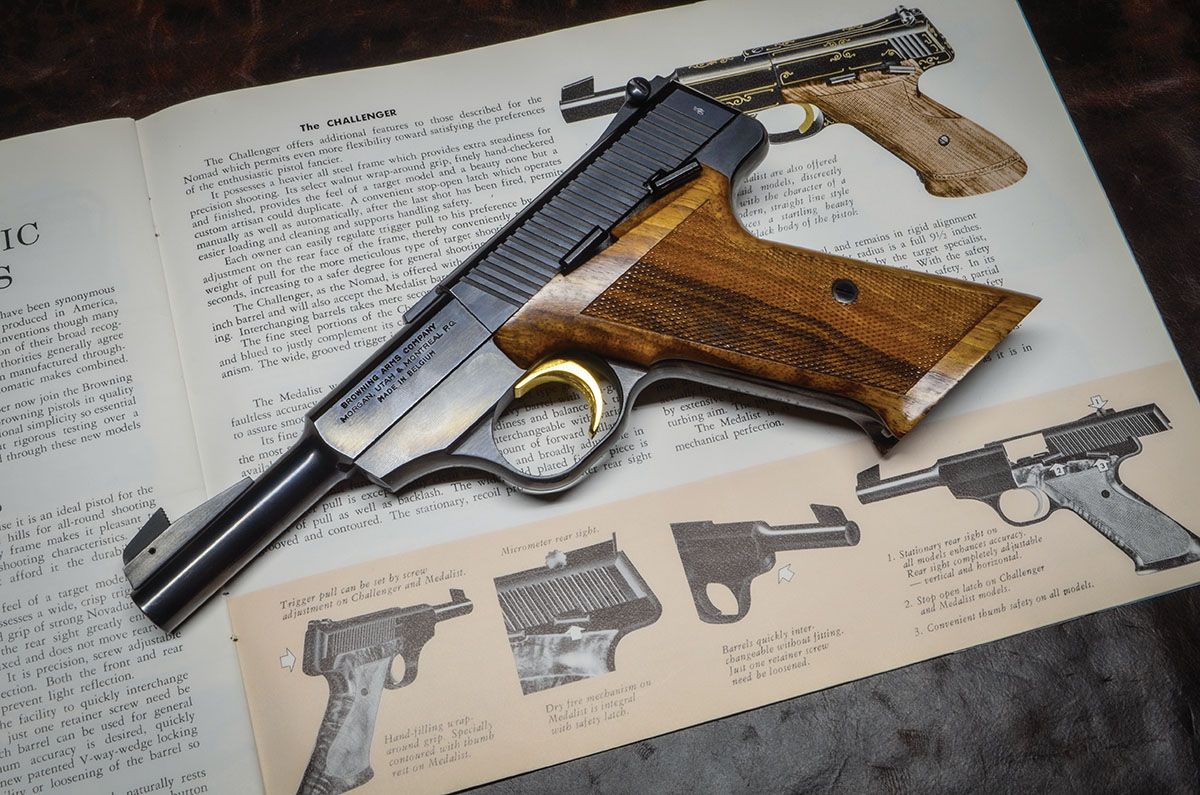
Among these was Browning’s high-class literary effort, printed on artist-grade matte paper and including lessons on ballistics and shot patterns and the announcement of a new family of semiautomatic .22 pistols. The illustrations of these were destined to haunt my teenage dreams.
This semiautomatic family had three members: the full-dress target Medalist, the gentlemanly Challenger and the economy model Nomad. All were built on a blowback semiautomatic mechanism remarkably similar in size and shape to the final iteration of the Colt Woodsman. The Woodsman was a John M. Browning design, introduced in 1915, that went through a process of refinement over the next 50 years. Colt had even used the name “Challenger” for one of the lower-priced variations. It was not surprising, then, that Browning would base its new family on the familiar design.
Leaving internal differences aside, such a comparison not being our purpose here, the major aesthetic feature the Browning line shared with the Woodsman, as well as with Ruger’s Mark I and, loosely, that other great family of American semiautomatic .22s, the High Standards, was a resemblance in size and form to the Luger. This was mainly manifested in the shape and angle of the grip, which Georg Luger had brilliantly modeled on the exact shape of a man’s fist when he clenches it and points his finger.
These facts are not unrelated.
In the 1960s, the dominant competitive pistol-shooting game was Bullseye, and it was shot with three guns: A .22, a 45 ACP 1911 and a medium-caliber centerfire of your choice. In The Pistol Shooter’s Book (1953), Colonel Charles Askins, a one-time national pistol champion, praises the grip on the Woodsman (and, by extension, the Luger) highly and predicted that one day the .45 would be brought into line with it. He was wrong.
What actually happened was that Bullseye competitors began demanding a .22 with a grip that matched the Colt 1911, not the other way around, and this led ultimately to both High Standard and, later, Browning, abandoning their Luger-like grips and adopting the so-called “military” grip. But all of that came later.
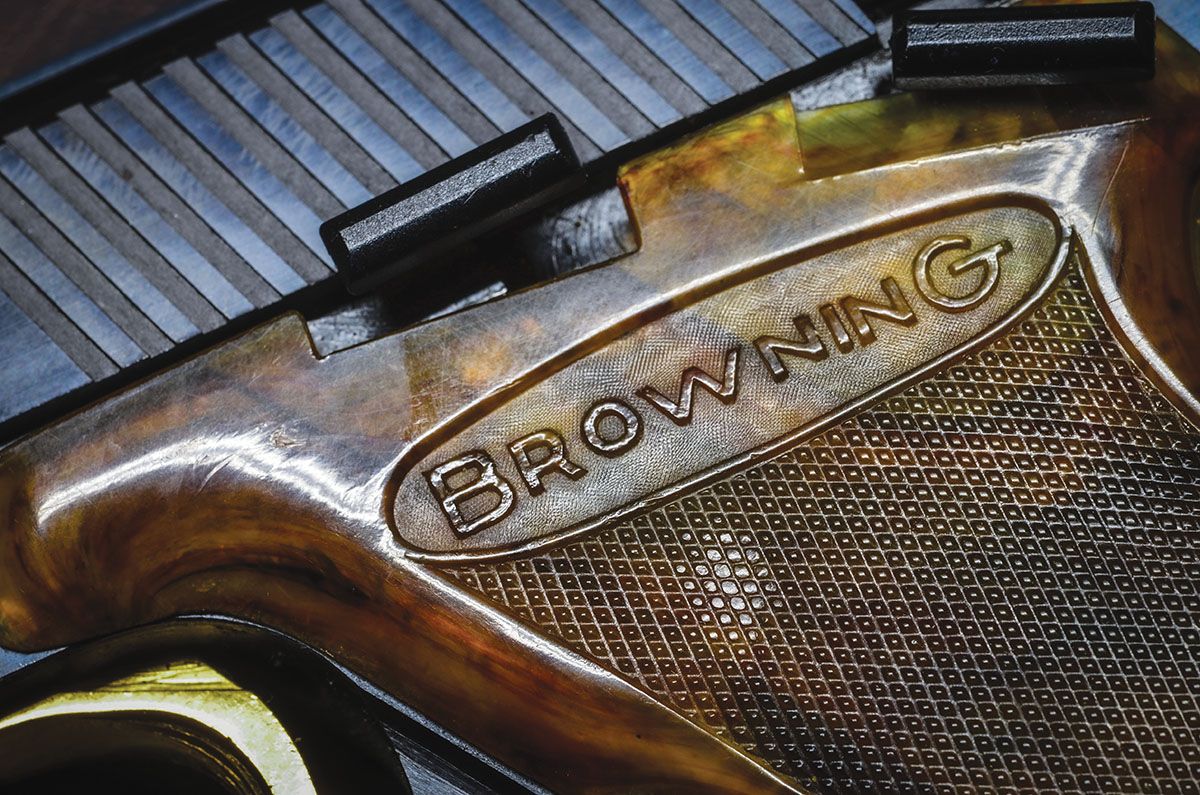
Browning believed the Medalist would put it on the map in the world of competitive pistol shooting, and it was replete with every bell and whistle. It came in a fitted case to hold the pistol, accouterments and 50 rounds of match ammunition in a removable wooden block. The pistol had a five-inch bull barrel with a ventilated rib. The grip was walnut and fully fitted to the hand, flaring at the base for a solid hold. The safety had a midway position that allowed dry firing for practice, without allowing the striker to contact the face of the breech. The trigger pull was adjustable for both weight and creep.
Oddly, the pistol had a wooden forend which was removable to allow the fitting of barrel weights to adjust balance. At $112.95 in 1962, its price was higher than the High Standard Supermatic Trophy ($105.00), Smith & Wesson Model 41 ($100.00) or Colt Woodsman Match Target ($84.50).
There was one immediate problem with the Medalist: In its earliest production, the admittedly elaborate stock, while sexy to look at, was too bulky to allow the average finger to reach the trigger. Definitely a drawback.
At the other end of the scale was the Nomad, with an alloy frame, plastic grips and lacking both a magazine safety and a slide-stop on an empty mag. These were omitted to reduce costs, and its $49.95 price reflected that. It could be had with either a 4.5-inch or 6.75-inch barrel. These could be purchased separately and were readily interchangeable.
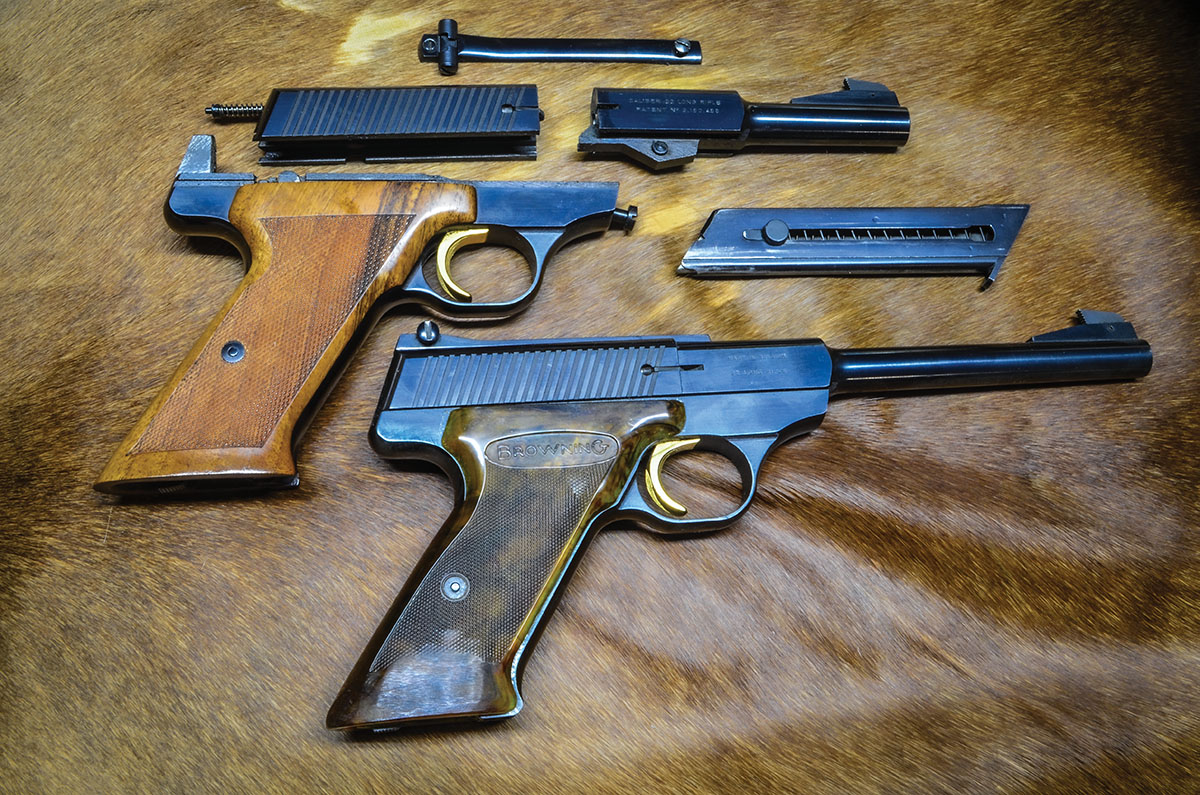
This being the sixties, when white-line spacers, skip-line checkering, gold-plated triggers, and dubious space-age extravagance were all the rage, the Browning line was somewhat affected, notably the Medalist, but the Challenger escaped with just the gold trigger and an overly bulky grip. Both the Medalist and Challenger were available in a deluxe model with engraving and gold inlay ($249.95 for the Challenger).
Now for a few broad observations.
First, of the three, the Challenger has to be judged the most successful and, in fact, as one of the iconic .22 semiautos of the postwar half-century. Conversely, as a match pistol, the Medalist was an expensive failure. No one that I know of ever posted significant victories with it, and the vast majority of Medalists that come up for sale today look practically unused, housed in their pristine presentation cases with similarly pristine accouterments.
The Nomad, which was the quintessential tackle-box gun, is so rare on the used-gun market you have to conclude that either very few were sold, or those that were did not last long. In a quarter-century of keeping an eye out, I have seen exactly one (1) Nomad come up for sale.
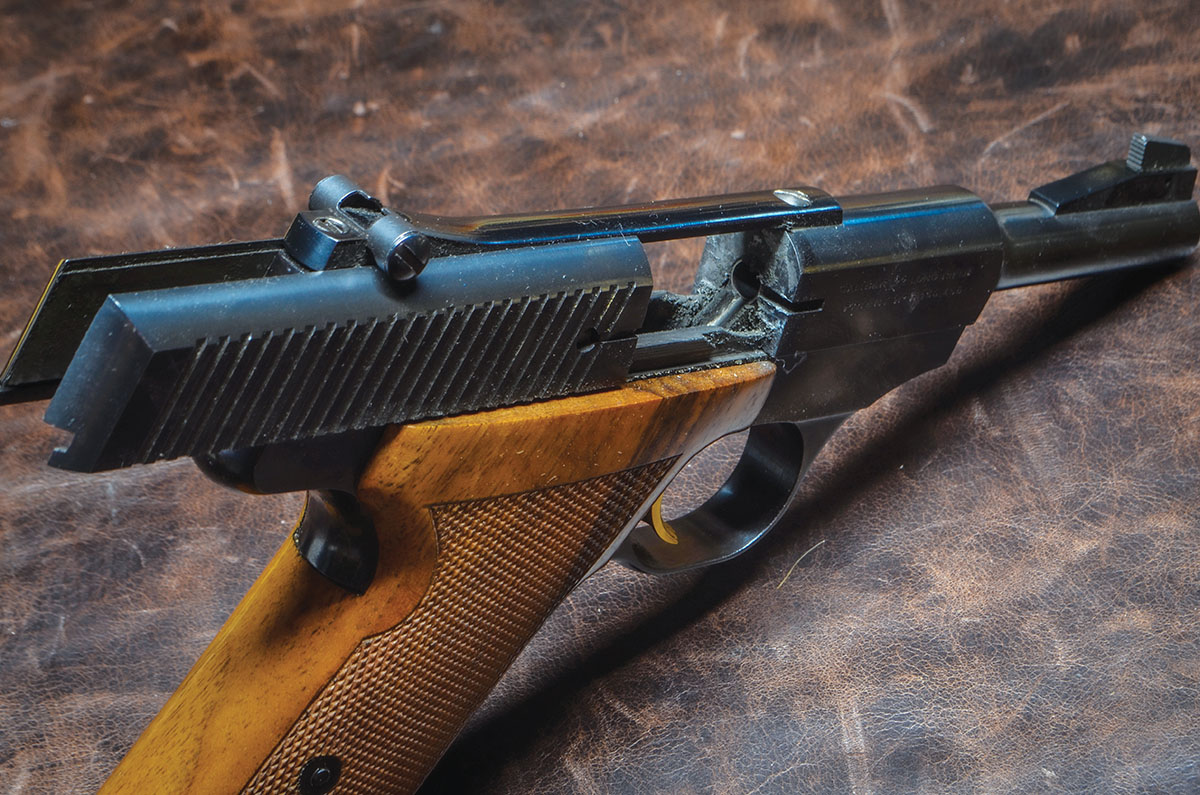
From 2000 to about 2020, it was possible to pick up a Challenger in 90-percent-plus condition for about five hundred dollars, and spare barrels, magazines, walnut grips and sight ribs were readily available and not expensive. Prices have since climbed, but they still represent a real buy in a quality .22.
A second observation deals with accuracy and reliability. The Challenger was never offered with a bull barrel, which, by the mid-1960s, was recognized as a key to the finest match-grade accuracy, so it’s unfair to compare it to the High Standard target pistols. But then, the Challenger was always intended as a multi-purpose pistol.
Having owned and been captivated at various times by High Standards (I have owned seven) and Woodsmen (only three at the moment) as well as Brownings, it’s not biased when I give High Standards the edge in accuracy. As for reliability, I would give the laurels to Browning, hands down. I never never have feeding problems with their mags, whereas my High Standards are all picky with both original and new magazines. It seems you can put any Browning mag in any Challenger and it will sing with any ammunition. The Woodsman falls somewhere in between.
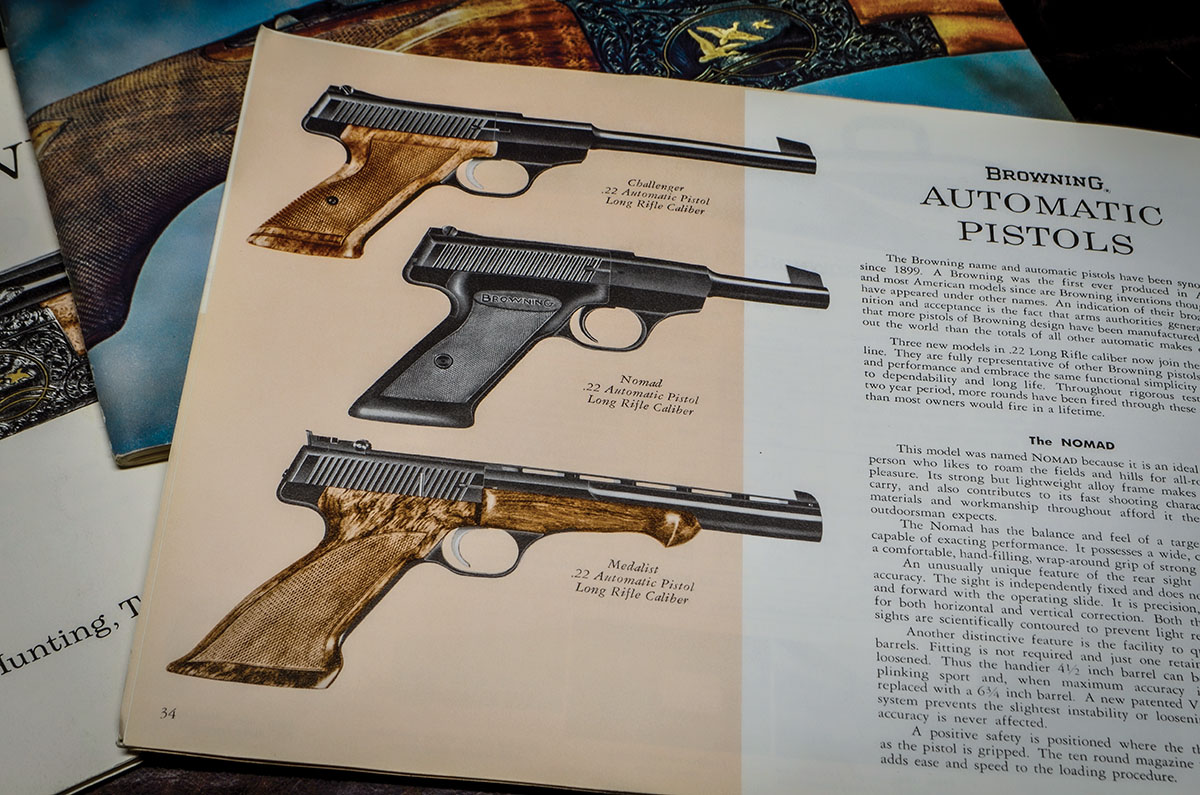
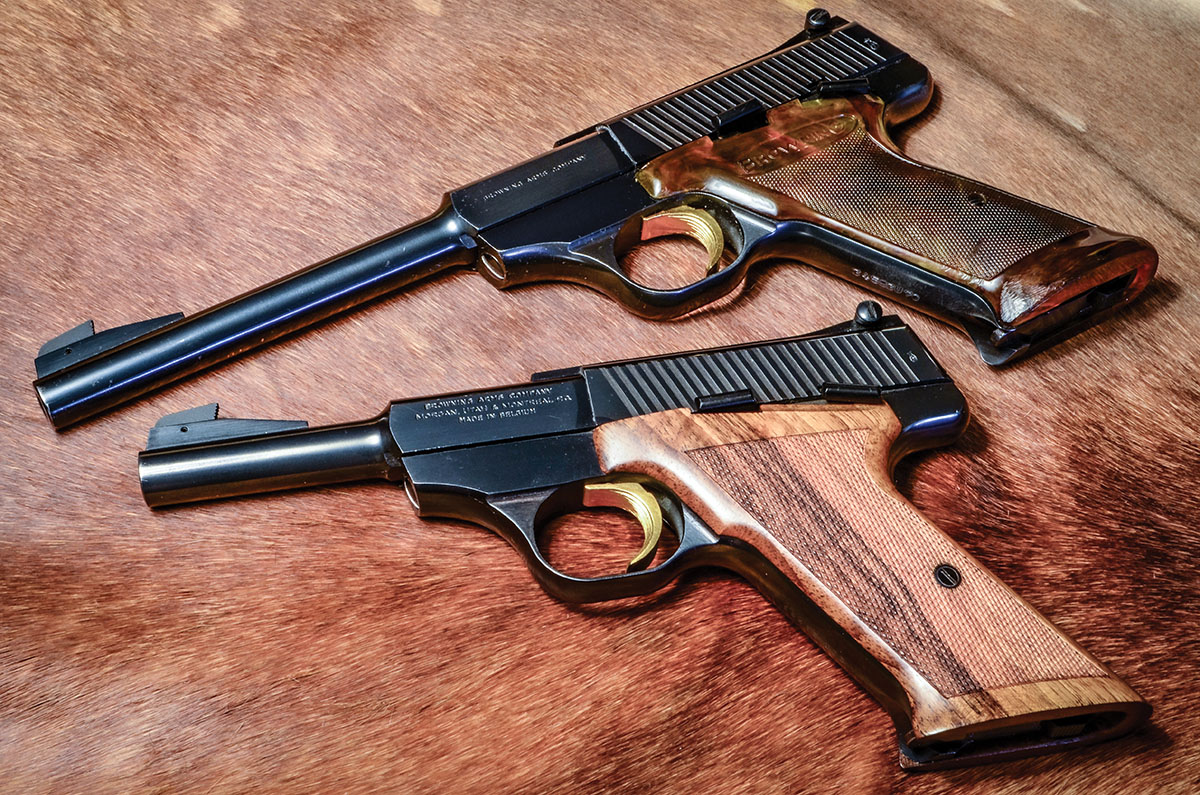
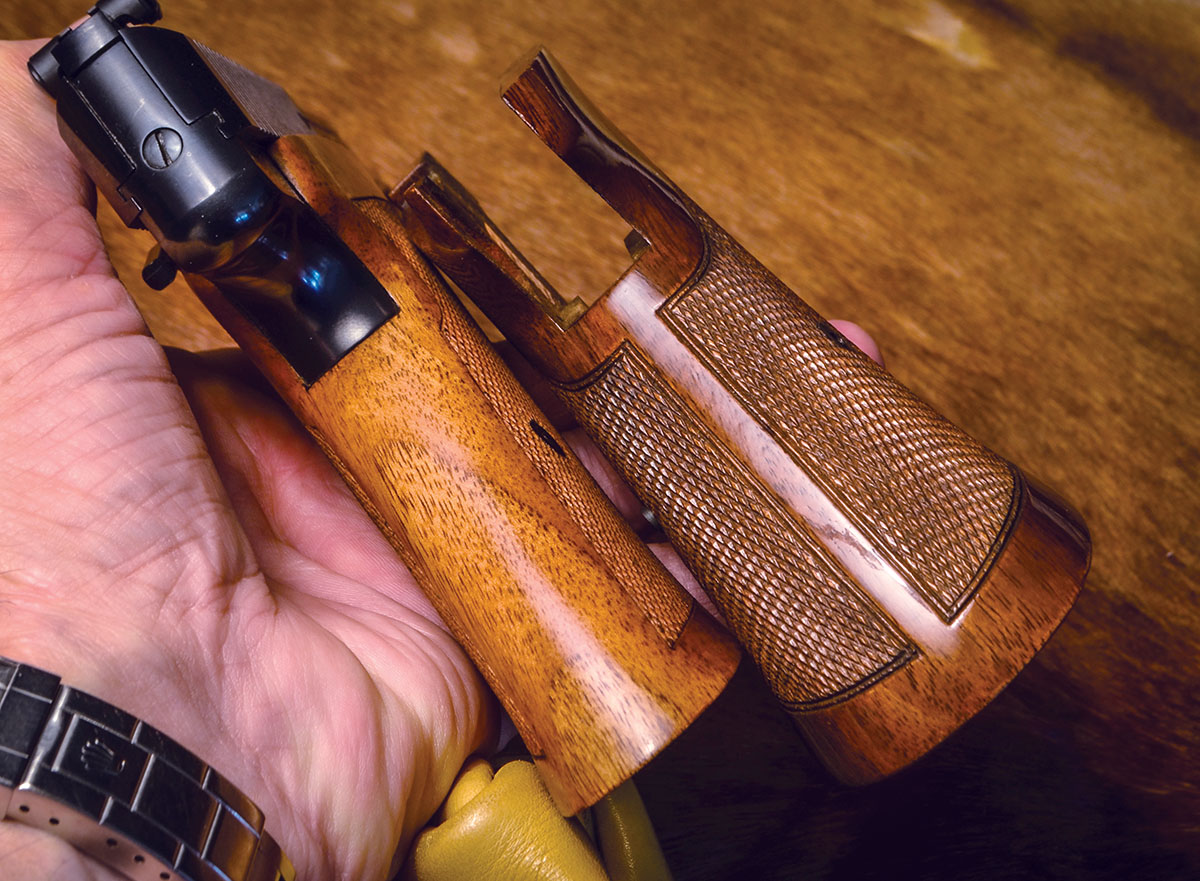
Naturally, confronted with a plastic grip with file marks, I searched until I found an original walnut replacement, and it was then I realized that it was simply too bulky for my hand, too bulky for a holster and overall just too big! Okay for a target pistol, maybe, but not okay for me. True to form, I tracked down a second original, found a compliant stockmaker, and cajoled him into slimming it down and recheckering it to fit my hand. The rasped-down Novadura I put on a second Challenger I acquired a few years later because, disfigured as it might be, it fits me beautifully.
When the Challenger was introduced in 1962, the first ones to find their way into the hands of writers drew some criticisms. The Nomad was available first, and Ken Waters, then handling reviews for Gun Digest, received one for testing. His comment on the grip: “…well-shaped (of Novadura plastic). Nicely handfilling, it’s positioned at a correct angle for natural pointing, and has that comfortable effortless feeling reminiscent of a Luger.”
Overall, however, Waters did not like the Nomad’s lack of a magazine safety and slide-lock, and recommended that potential purchasers save up an extra 15 bucks and get the Challenger instead. Inexplicably, the Challenger lacked a magazine safety, too, and one was never added throughout its life.
The oil shock of 1973 ignited a period of rampant inflation around the world, with resulting steep increases in the cost of labor and materials. This hit Fabrique National (FN), manufacturer of all Browning firearms, hard, and led to many models being dropped. The Challenger was among them, quickly priced out of the market.
By that time, however, other changes in the handgun world were having an impact, not least a general move to abandon the “Luger-angle” grip so beloved of Charlie Askins and Ken Waters, to be replaced by the 105-degree so-called “military” grip identical to the Colt 1911.
This trend actually began in 1957 with Smith & Wesson’s cutting-edge Model 41 .22 target pistol. By 1964, it was slicing into High Standard’s sales severely, which led to the design of their 106 series “military” pistols, with the first on the market in 1965. Seeing which way the wind was blowing, when Browning decided to replace the Challenger, it was no surprise that the Challenger II appeared with a military-style grip rather awkwardly married to what appears to be a Challenger/Medalist upper. The Challenger III was more of the same, and the later Buck Mark series all kept the military grip.
In the past couple of years, the price of original Challengers has started to climb, and those I have seen at auction recently have brought $800 to $900; barrels, magazines and walnut grips have increased as well, and become harder to find.
It’s hard to believe the Challenger departed the market a full 50 years ago. Today, there are any number of good .22 semiautos available, both domestic and foreign. Browning is still with us, as is the Smith & Wesson Model 41 (now retailing for $2,200!) and various others. None that I have handled, however accurate as they might be, can compare to the old Challenger for simple pleasure in handling.
It’s an ergonomic, as well as an aesthetic, masterpiece and beautifully accurate to boot.