Spohr’s 285 Universal 357 Magnum
Clever Engineering and Exceptional Ergonomics
feature By: Art Merrill | November, 26
“Good morning, Art,” the smiling gentleman said with a European accent, noting my name on my SHOT Show badge and waving me over to his shooting lane. “Come shoot our revolver.” Media Day at the Range is likely every writer’s favorite SHOT Show event, where we get to shoot free ammo in other people’s new guns. Let’s call it a job benefit.
The sign at the gentleman’s shooting lane read “Spohr GmbH” a name which I (and you) might have seen before, but then again, maybe not. Spohr GmbH is a German manufacturer of revolvers. As it turned out, not just revolvers, but revolvers that are the equivalent of a Mercedes-Benz E-class sedan, standing out among Corollas.
Waiting patiently for my turn at the shooting bench, I looked over shoulders and around elbows at a selection of revolvers lying on a table, revolvers that at first appeared to be Smith & Wesson N-frame-ish clones sporting a few bells and whistles. Once in my hands, however, as I examined the details of one of the 357 Magnum revolvers, I began to see that this wasn’t a clone, but quite a different machine altogether. After shooting the revolver, which exhibited absolutely no stacking of the trigger in double action, the first thing I said to the Spohr rep, Export Manager Hendrik Hansen, was, “Can I get a look at the innards?”
I’ve shot and worked on quite a few revolvers, Smith & Wesson (S&W) and others, and I sensed something was quite different inside
the Spohr. The next morning, I went straight to Spohr’s SHOT Show booth, where Chris Rhodes, gunsmith, competition shooter, handgun hunter and owner of Spohr’s American retailer, Precision Shooting Supply, pulled the grips and side plate off a Spohr 285 Universal revolver for me. Sure enough, Spohr had exquisitely re-engineered a basic Smith & Wesson action into a practical yet luxurious, butter-smooth revolver eminently suitable for but not limited to competition shooting, and we’ll get to those innards shortly.
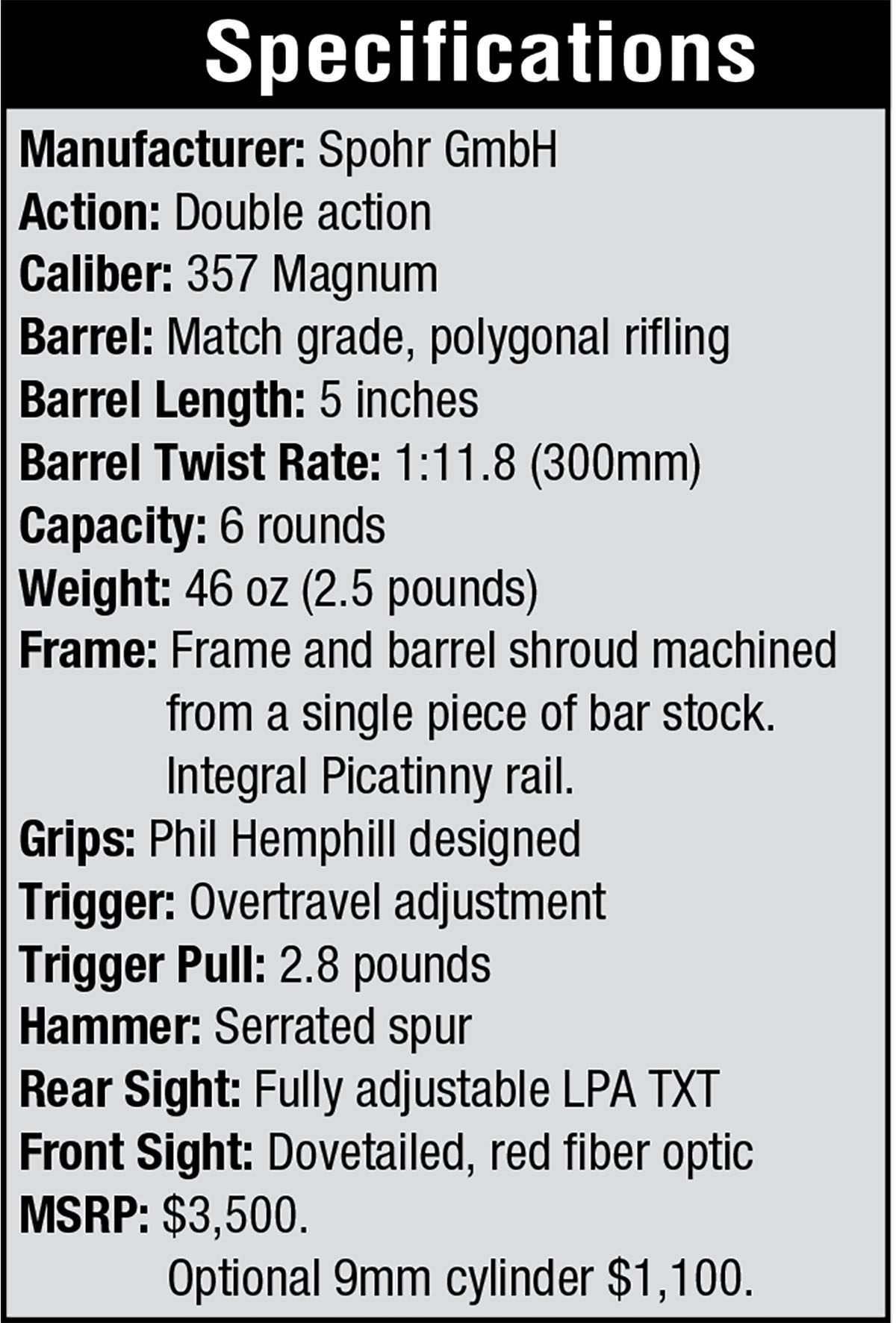
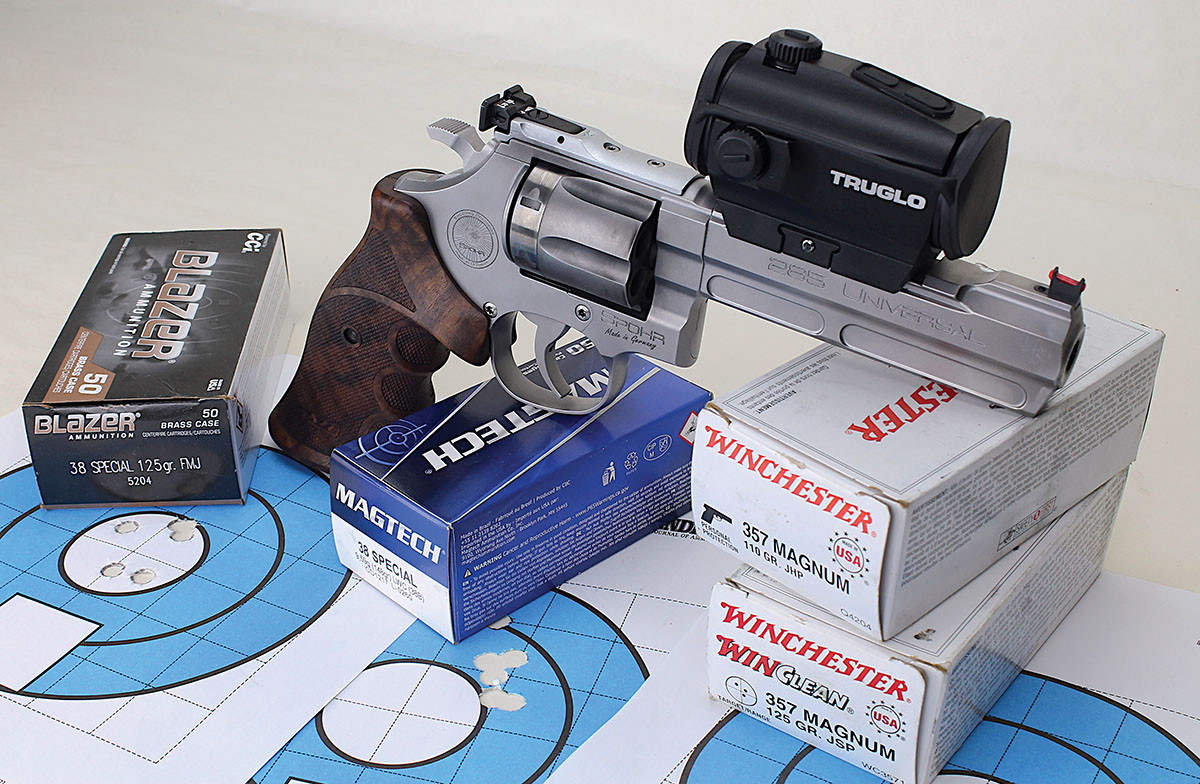
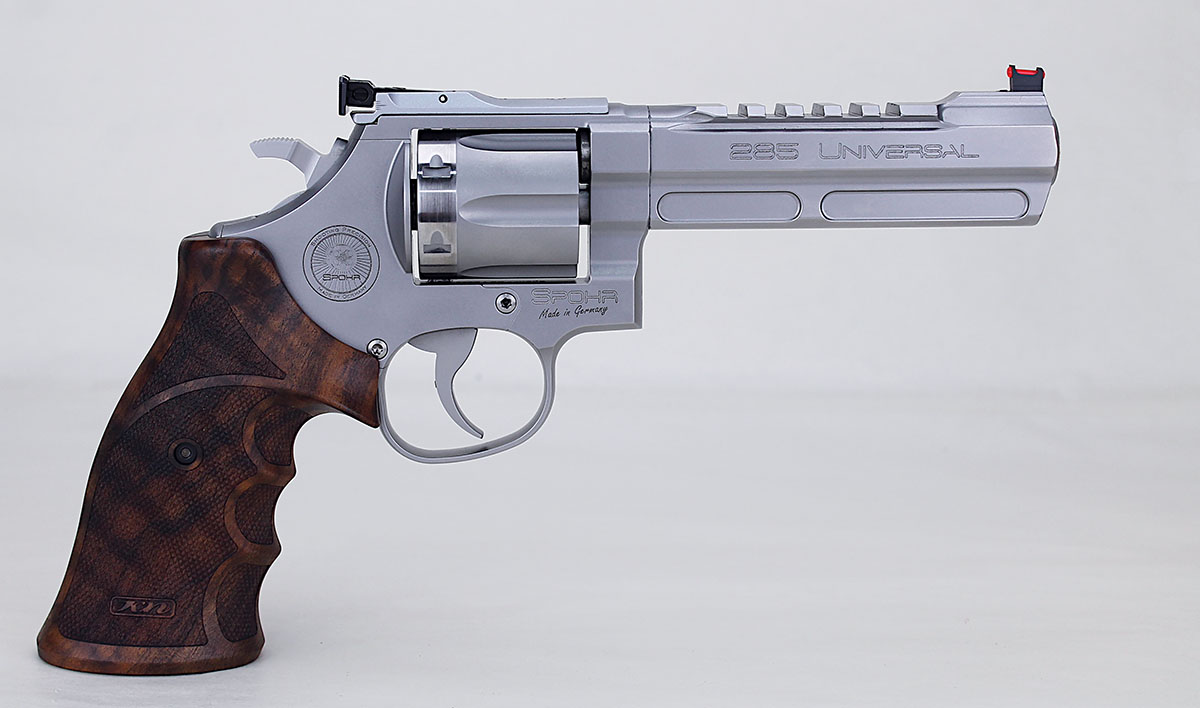
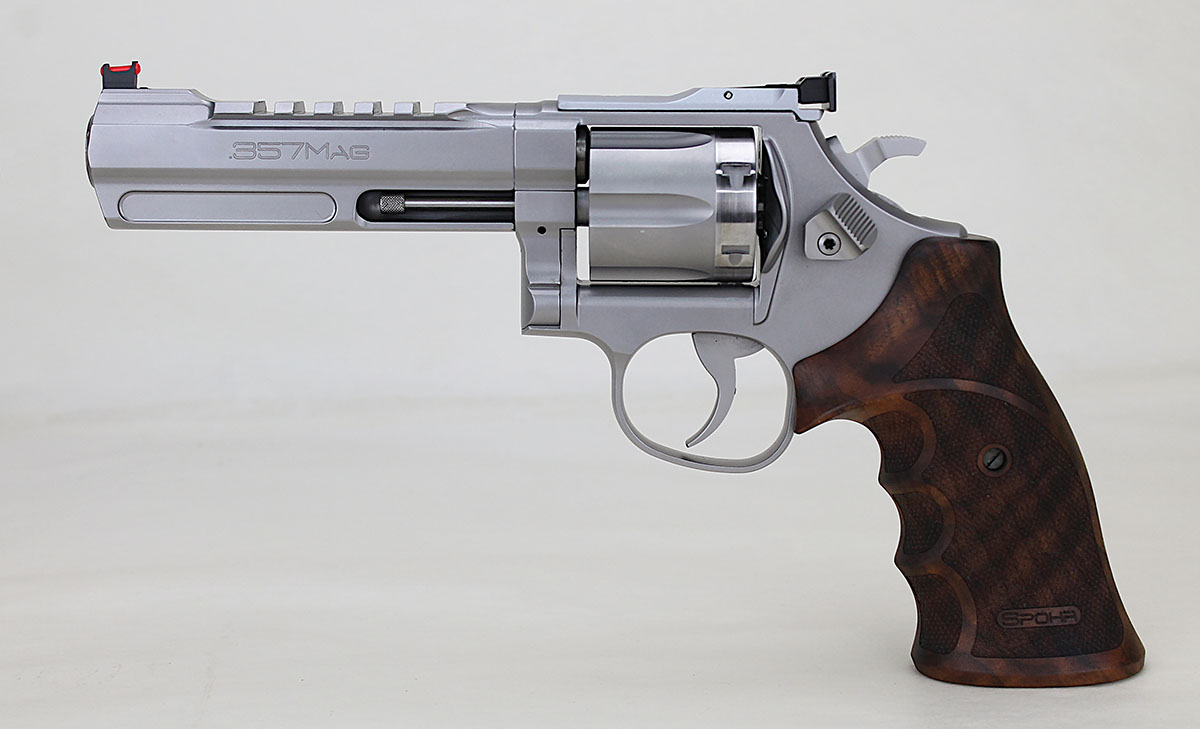
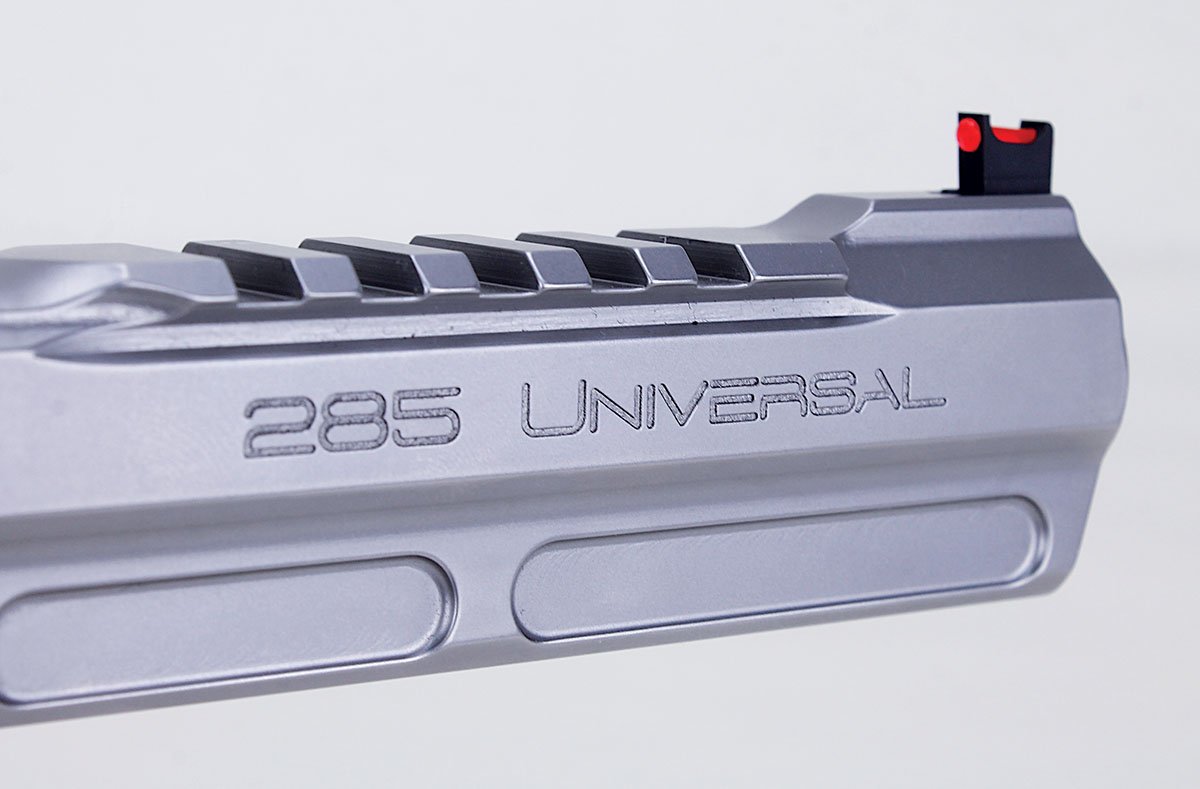
What we see on the outside of the 357 Magnum Spohr 285 Universal is a matte stainless-steel finish on a large-frame revolver, stocked with graceful wooden grips. Perhaps the first detail to jump out at the viewer is the Picatinny rail slots machined integral to the top of the revolver, allowing the owner to readily mount an optic without the need for a model-specific mount. Examining the Pic rail, it suddenly dawns on the handler that the rail is not machined into the barrel; the Spohr differs significantly from other revolvers in that it consists of a one-piece frame and barrel shroud, with the barrel press-fit into place. Indeed, Hendrick confirmed that Spohr machines the frame and shroud from a single piece of bar stock.
Rifling of the barrel is polygonal, which, as you may know, features smooth “hills and valleys” instead of sharp-edged lands and grooves. The advantages of polygonal rifling include reduced fouling, better gas sealing and longer barrel life. Being made of conventional steel rather than stainless steel also adds to Spohr’s barrel life, an important feature especially when considering the round counts in competition shooting.
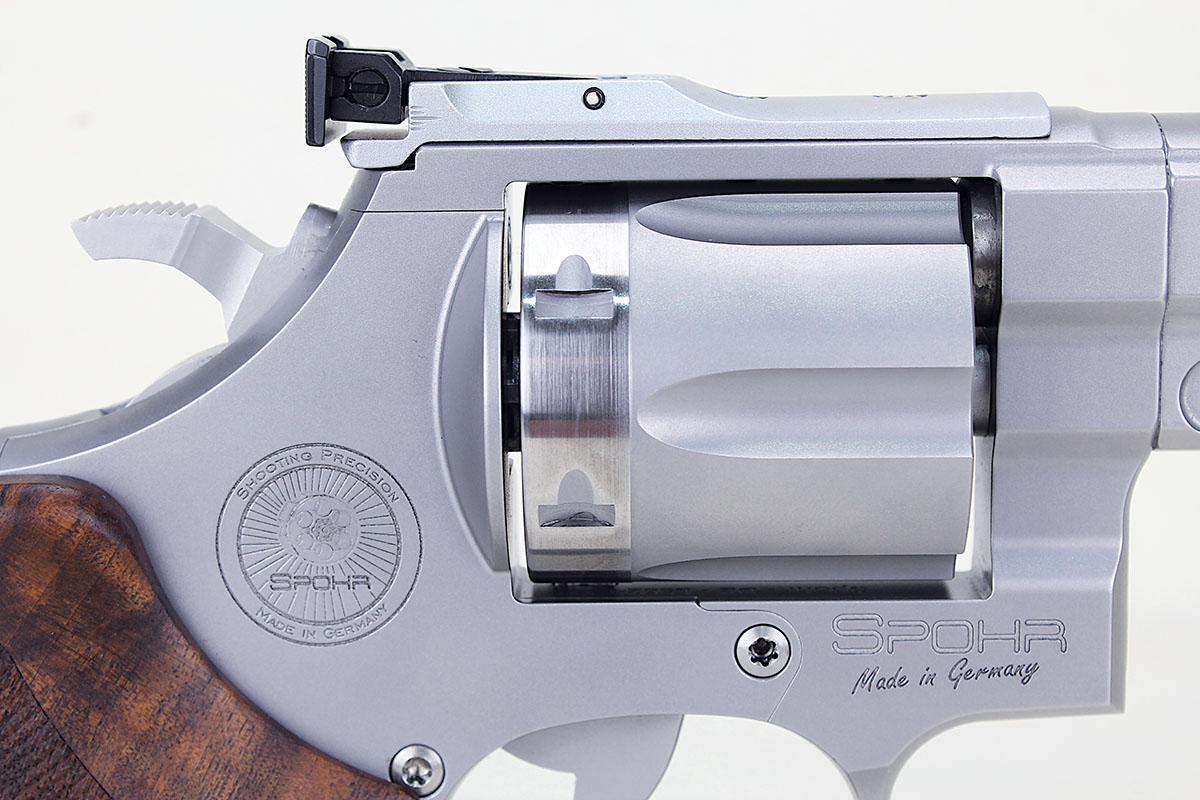
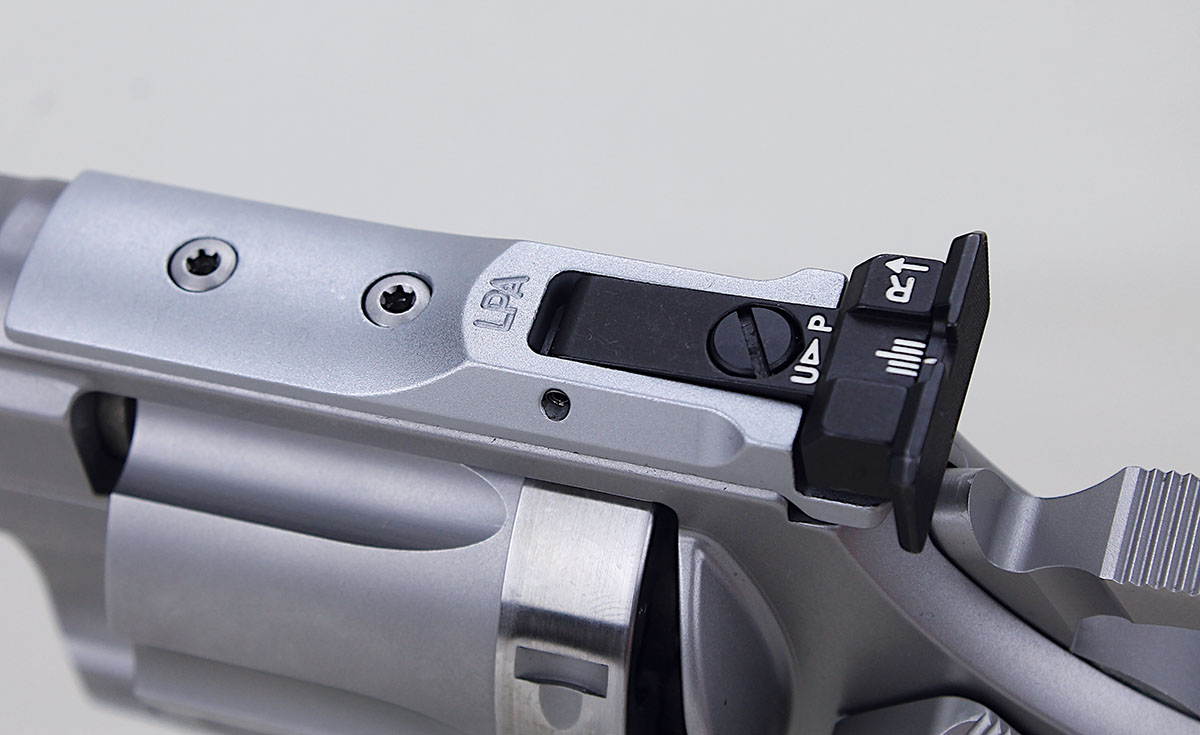
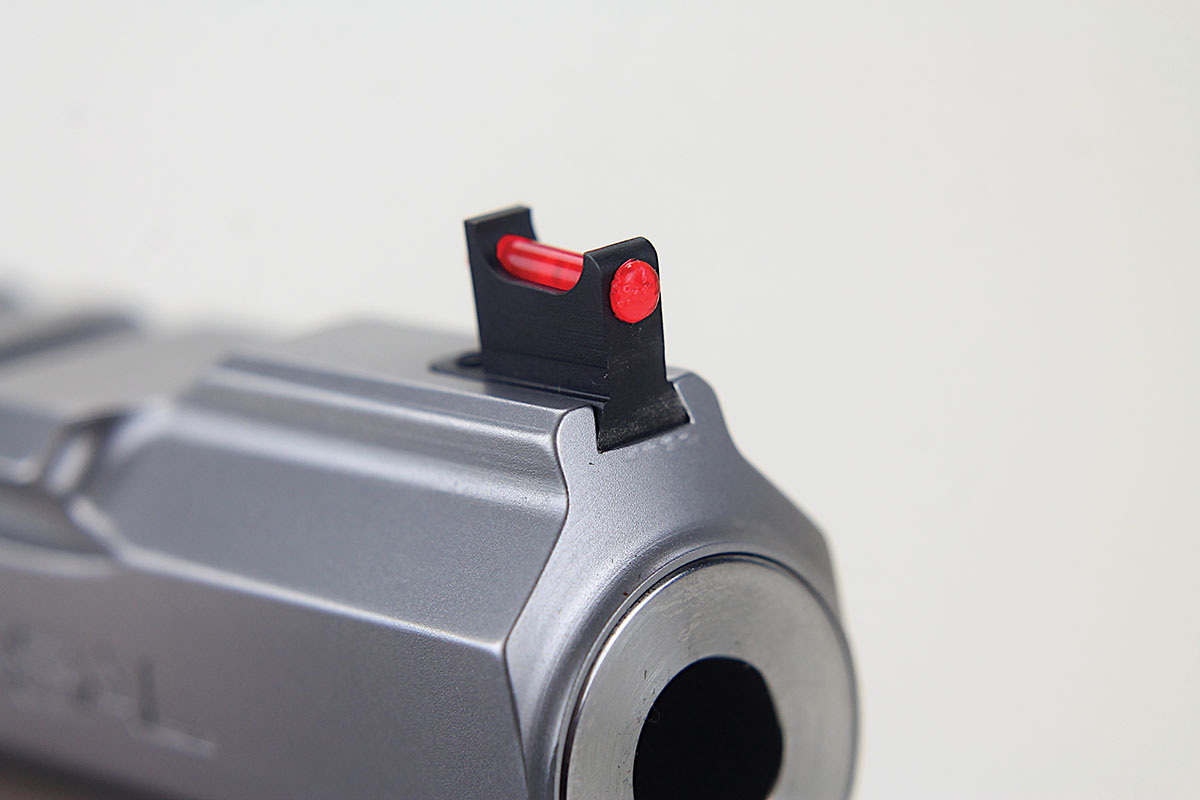
Spohr went with the excellent LPA TXT fully adjustable rear sight assembly, held to the frame via two small Torx-head screws. The front sight is a red fiber optic, and its base, too, is as readily removed as the rear sight assembly by turning out its single screw. A full-length underbarrel lug protects the extractor rod while adding mass to the revolver, an aid to accurate shooting and absorbing recoil.
Spohr polished the matte cylinder circumference where the cylinder stop notches are located. It’s an interesting aesthetic and
perhaps, as a practical matter, intended to mitigate that unsightly cylinder drag mark common to revolvers. However, for that latter purpose, it is unnecessary because Spohr’s timing is so exactingly precise that, on cylinder rotation, the cylinder stop doesn’t fully rise until aligned with the notch.
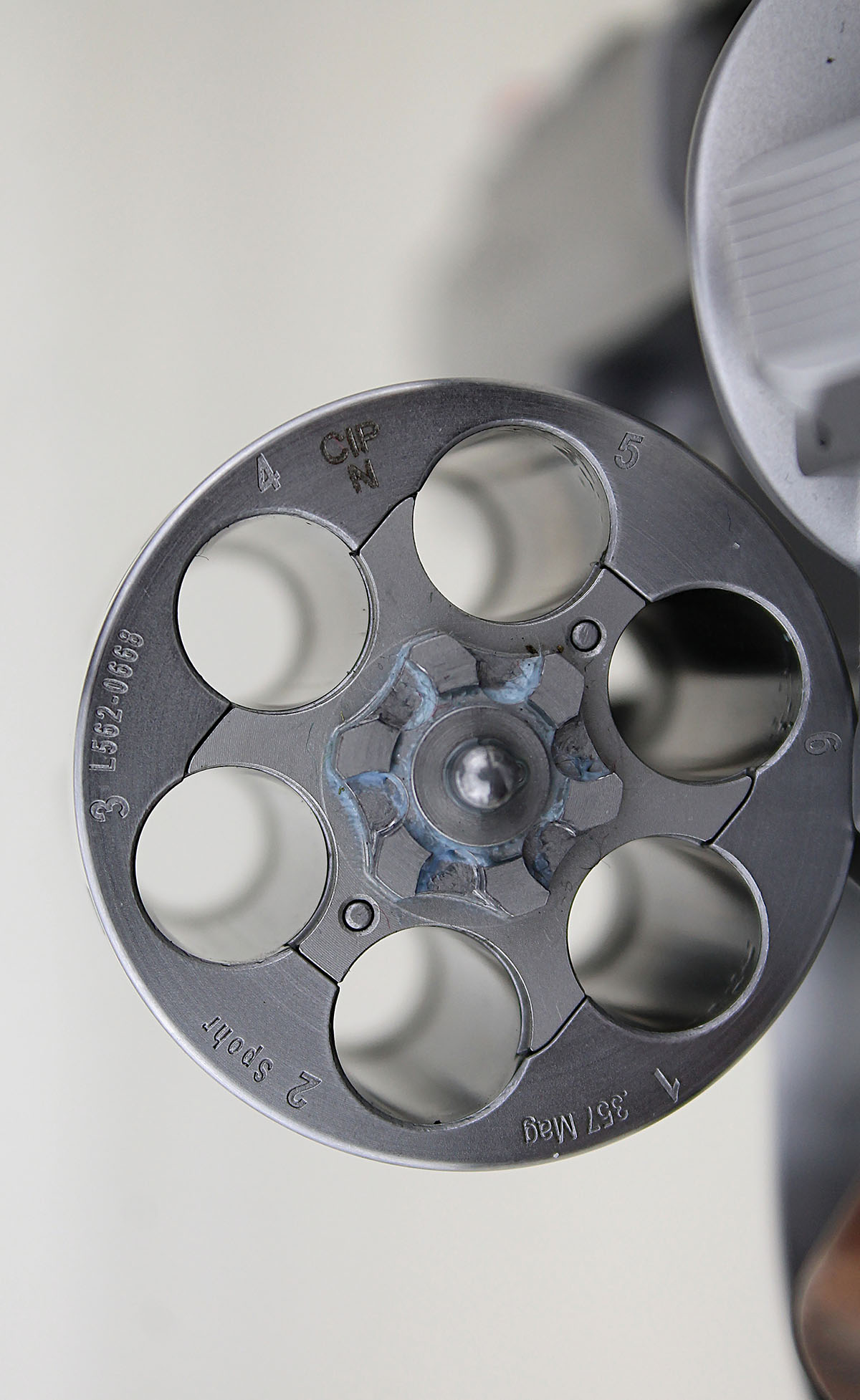
Unlike most modern production revolver cylinders that lock only at the rear via the extractor rod center pin entering a hole in the recoil shield, the Spohr features a spring-loaded steel ball in the yoke that engages a detent in the frame to align lockup of the front of the cylinder, as well. There is no gap between the yoke and frame, no end shake to the cylinder and cylinder play is barely discernible. A .006-inch feeler gauge is a snug fit in the gap between the cylinder and barrel forcing cone. The cylinder is serial numbered to the revolver, and the chambers are numbered 1 through 6.
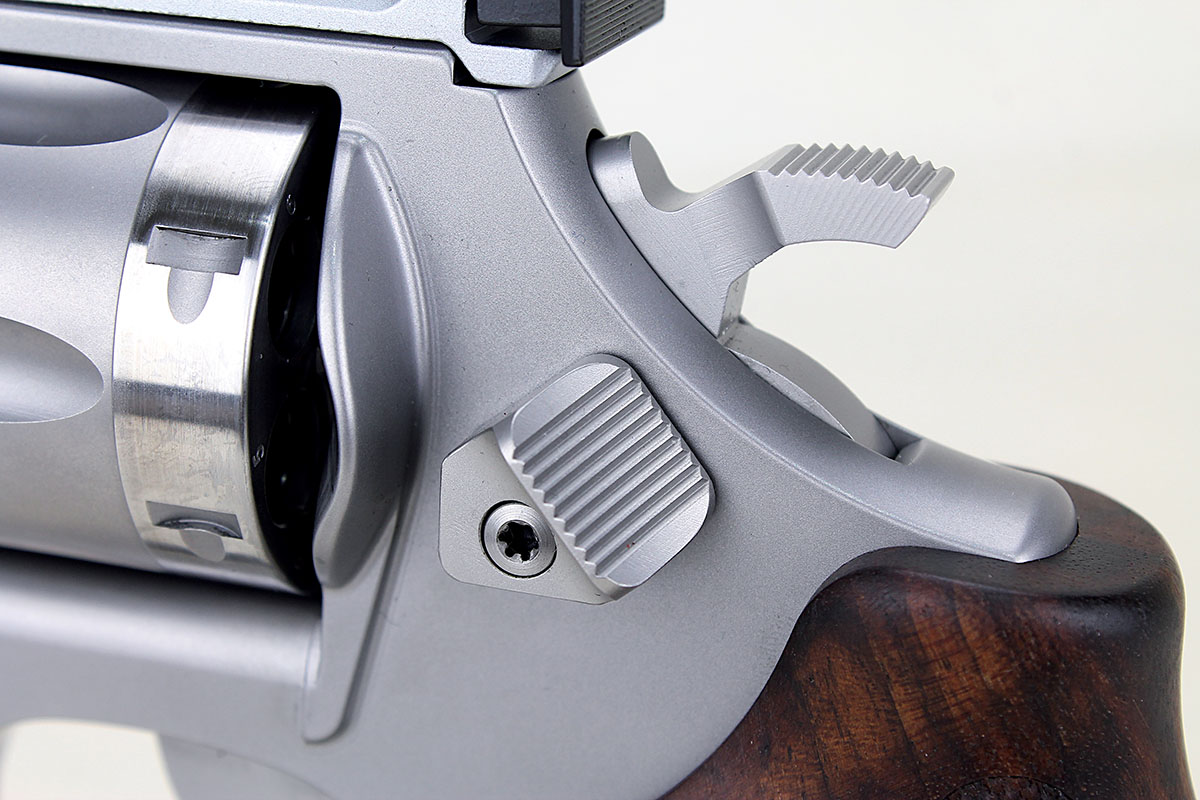
Intelligently reengineered, the thumbpiece for the bolt (cylinder latch) is pronounced, serrated and angled ergonomically – there is no fumbling to open
the cylinder. Deep, sharp serrations cross the hammer spur for no-slip, single-action thumb cocking. The trigger face is smooth and features a screw to adjust overtravel.
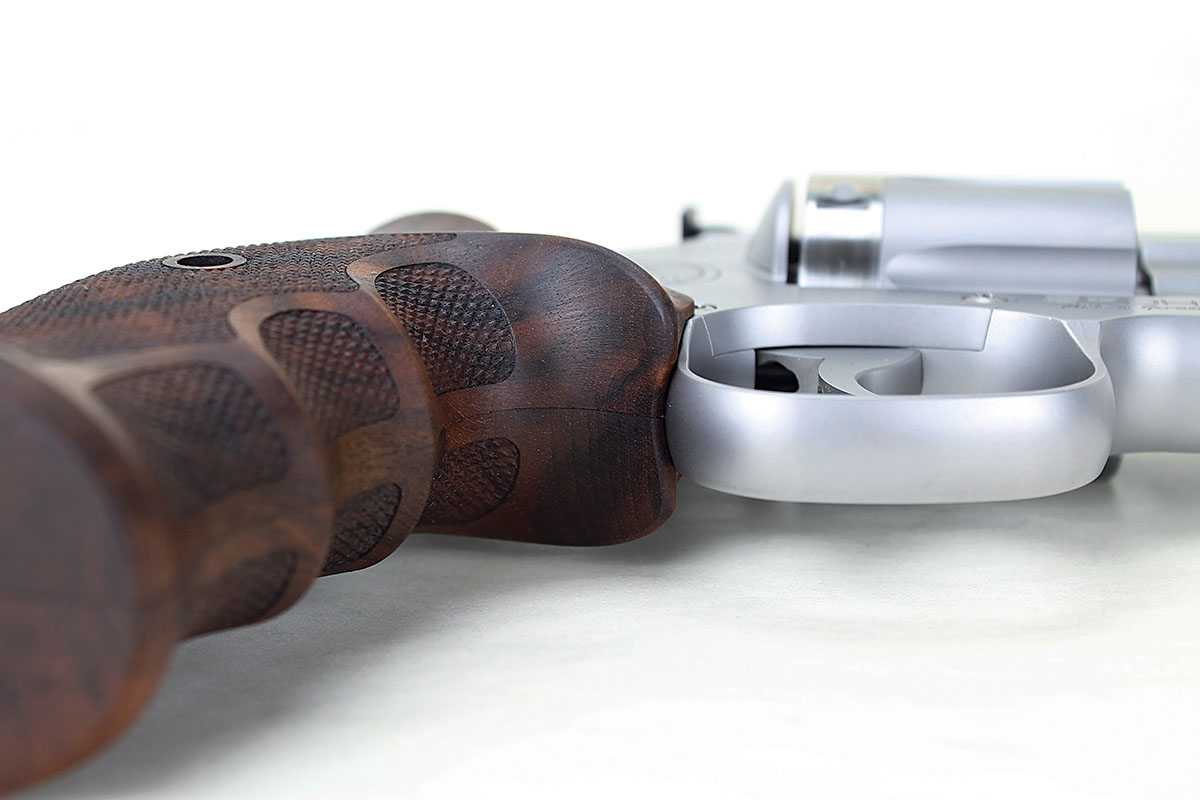
Factory finger grooves in a handgun grip can be controversial; some shooters like them, some don’t, and others are ambivalent about them. The Spohr’s wood grip is based on a design by Phil Hemphill, a competition shooter with the Mississippi Highway Patrol team, and sports finger grooves that fit my medium-sized hand very well. Beyond being attractive and complementing the revolver’s matte finish, the grip itself is as carefully engineered as the rest of the revolver. Slim at the top, the grip swells in the middle to spread out recoil over a larger area of the hand, then tapers again to accommodate the pinky finger, and swells again at the bottom to aid control during recoil. Checkering of the side panels is a bit fine, but that same checkering within the finger grooves works very well for positive grip and control. The underside of the grip is very wide where the middle finger grasps during shooting; it is comfortable, and it prevents the trigger guard from bashing into the finger under recoil. Perhaps coincidentally, the relief
in the wood on the left side to permit reloading from a speedloader is situated perfectly as a rest for my right-hand thumb.
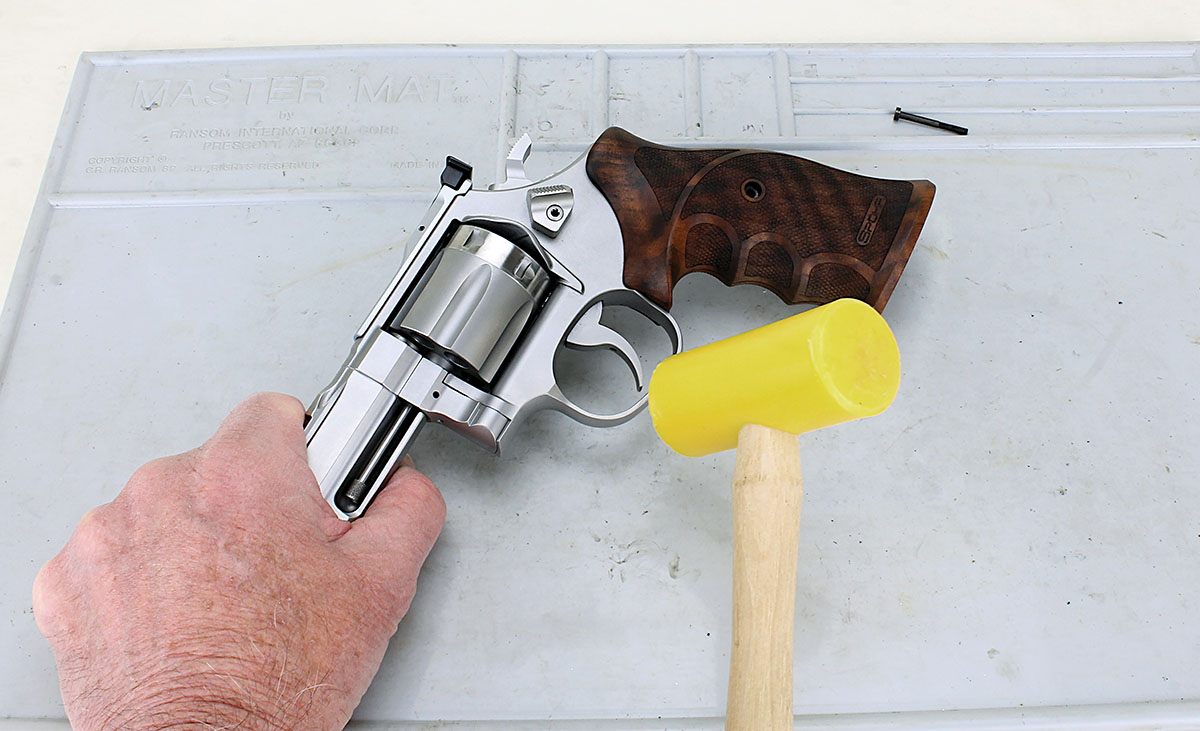
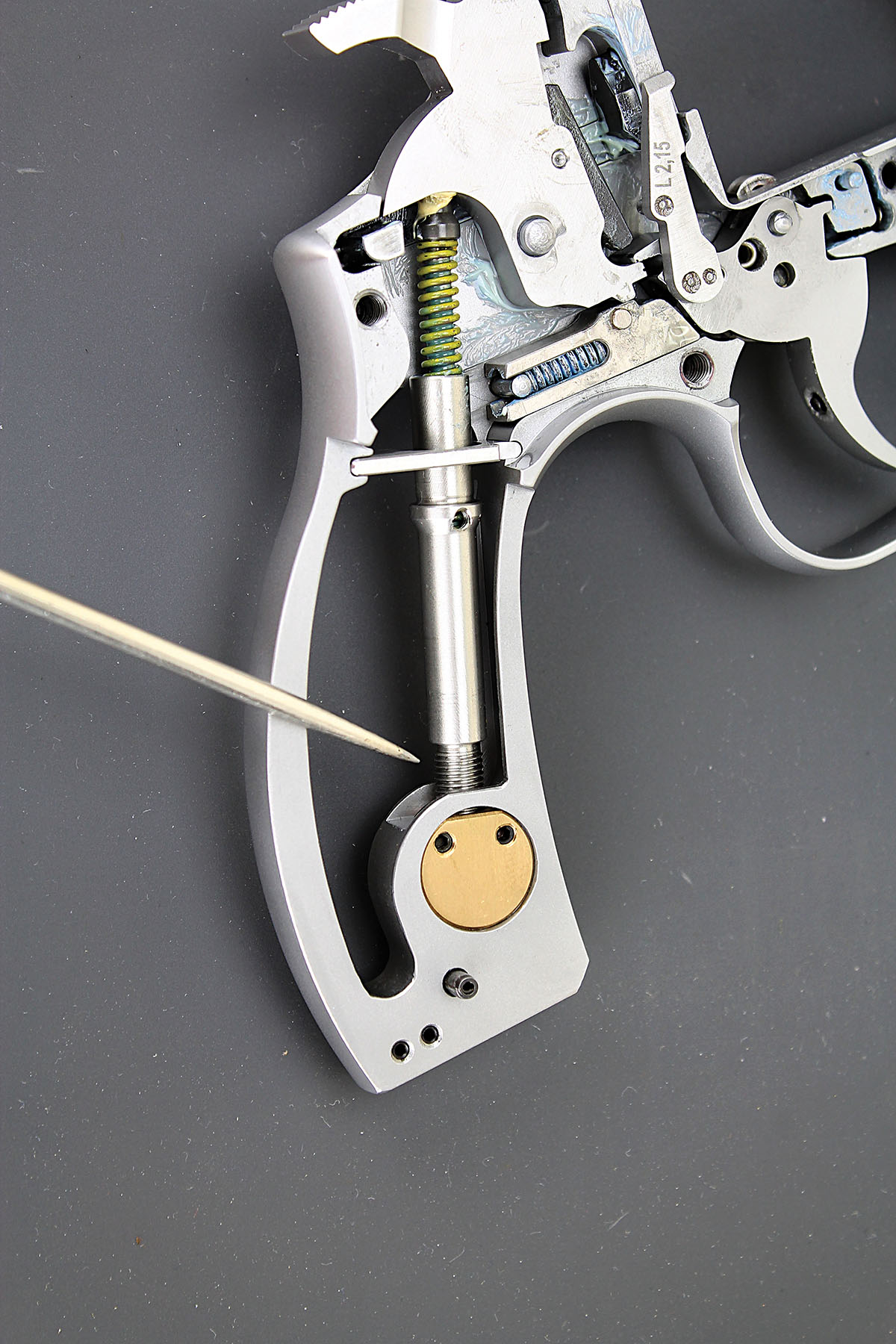
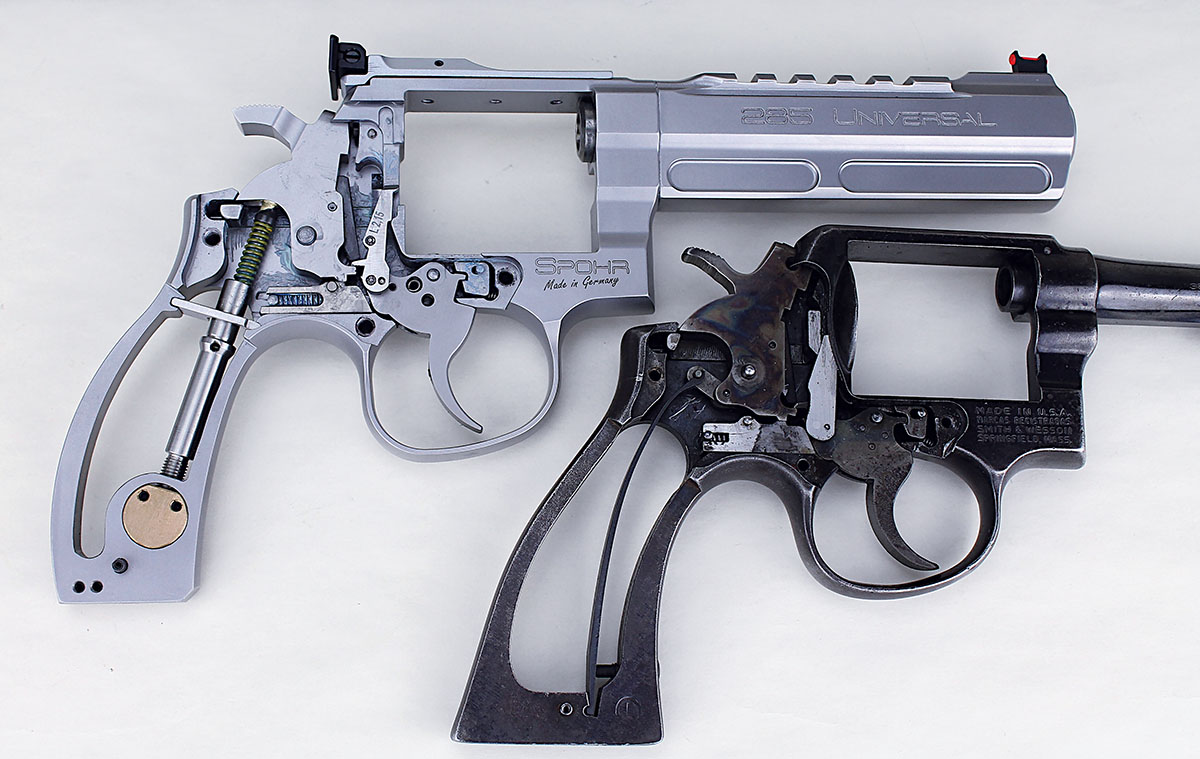
OK, now for those innards, and though the Spohr 285 Universal stands tall on its own merits, comparisons with the Smith & Wesson revolver are inevitable. The grip must come off first; it is a very tight fit to the revolver’s frame and requires tapping on the trigger guard with a plastic or leather mallet to coax it loose. Once accomplished, we see one reason we feel no stacking (increased resistance as the trigger moves further rearward) when shooting the Spohr double action: a coil spring replaces the traditional flat mainspring. That in itself isn’t exactly revolutionary, as a few other revolvers also have coil mainsprings to reduce stacking. Those coil mainsprings universally are mounted with the hammer strut passing through the center of the coils, and as the spring compresses upon cocking, the end of the strut passes through a hole in the mainspring seat. The Spohr’s hammer strut, too, passes through the coil mainspring, but its seat is a hollow tube that threads into a disc mounted to the grip frame; rotating the tube allows fine adjustment of the mainspring tension, and hence, both stacking and (to some subjective degree) trigger pull. So, my “something-is-different” intuition at the range is vindicated.
All three of Spohr’s side plate screws are T-10 Torx head rather than straight slot (welcome to the 21st century); in fact, the only straight slot screw on the entire gun is the grip screw. Unlike the S&W revolver, the right side of the recoil shield is milled as part of the side plate; like the S&W, tapping a soft mallet on the grip frame or point of the frame’s grip loosens the side plate for removal. A look at the inner clockwork here reveals no other major differences from that of the modern S&W, though a visual perusal suggests that these parts are not interchangeable between the Spohr and S&W.
As a young Rangemaster, I used to (good naturedly) laugh at the old guys shooting handguns who tipped their heads up and down, up and down, up and down to alternately acquire the target and then the sights through their bifocal eyeglasses. Hello, karma: a few decades later, it doesn’t seem so funny now. So, for an accuracy evaluation, I mounted a TRUGLO TRU-TEC 25mm red dot sight to the Spohr 285 Universal and fired from a bench.
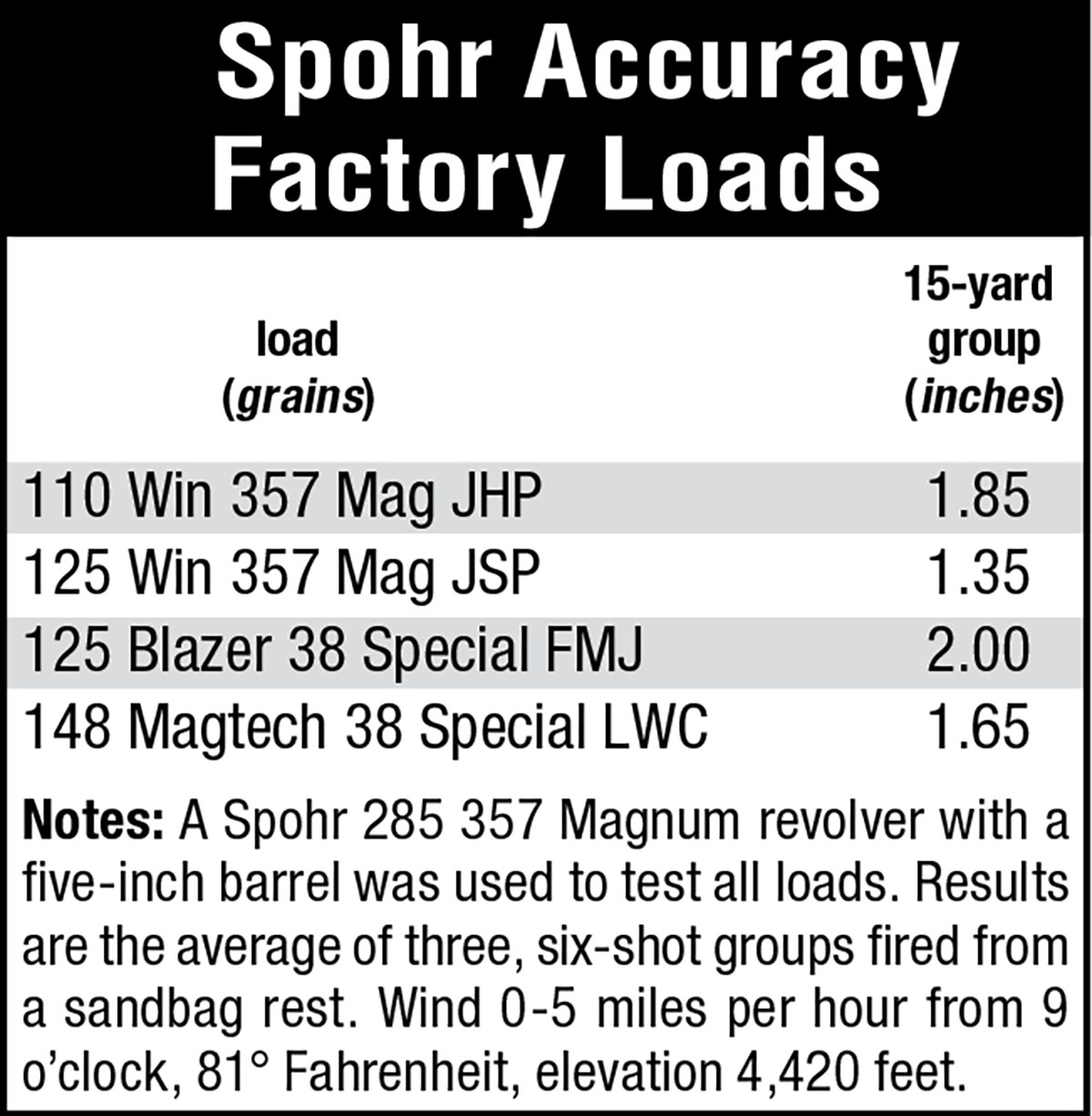
Results averaged in the accompanying table don’t tell the whole story, as I fired them without any barrel break-in, the revolver right from the box. The first groups were larger, raising the average, but tightened up as firing progressed. One might expect the lead wadcutter (LWC) load to perform best, but no, Winchester’s 357 Magnum 125-grain JSP grouped its second go into 0.75 inch, just barely missing out on making a one-hole group. This load would be my choice for hunting game such as javelina and small whitetails. That said, Winchester’s 357 Magnum 110-grain JHP made one nice, round 1.26-inch group. The Spohr performs so well with these factory loads that working up handloads is an option rather than a must-do.
Let’s be frank here: at $3,500 (with an accessory 9mm cylinder available for another $1,100), the Spohr 285 Universal is an expensive revolver, and it isn’t even Spohr’s most expensive model. Is it worth it? It is certainly the finest revolver I’ve ever fired, but only you can say that after shooting it. Can Joe Average Blue Collar Shooter afford it? Yes, but a Spohr isn’t likely to be an impulsive purchase down at the local mom-and-pop gun shop. Most shooters desire at least one really fine rifle, shotgun, or handgun for which pride of ownership exceeds even the appreciation of precision engineering coupled with absolute practicality. The 285 Universal Spohr revolver is first class in that class.
Beyond competition, Spohr revolvers rank among the very finest hunting handguns, and Spohr GmbH makes quite a number of different models of highest quality revolvers in 22 Long Rifle, 357 Magnum and 44 Magnum. They come with a two-year warranty, and if there’s ever a problem, Spohr has a service facility right here in the USA. Visit the Spohr website (SpohrGuns.com) to see all their models and watch a few videos of the revolvers in action.