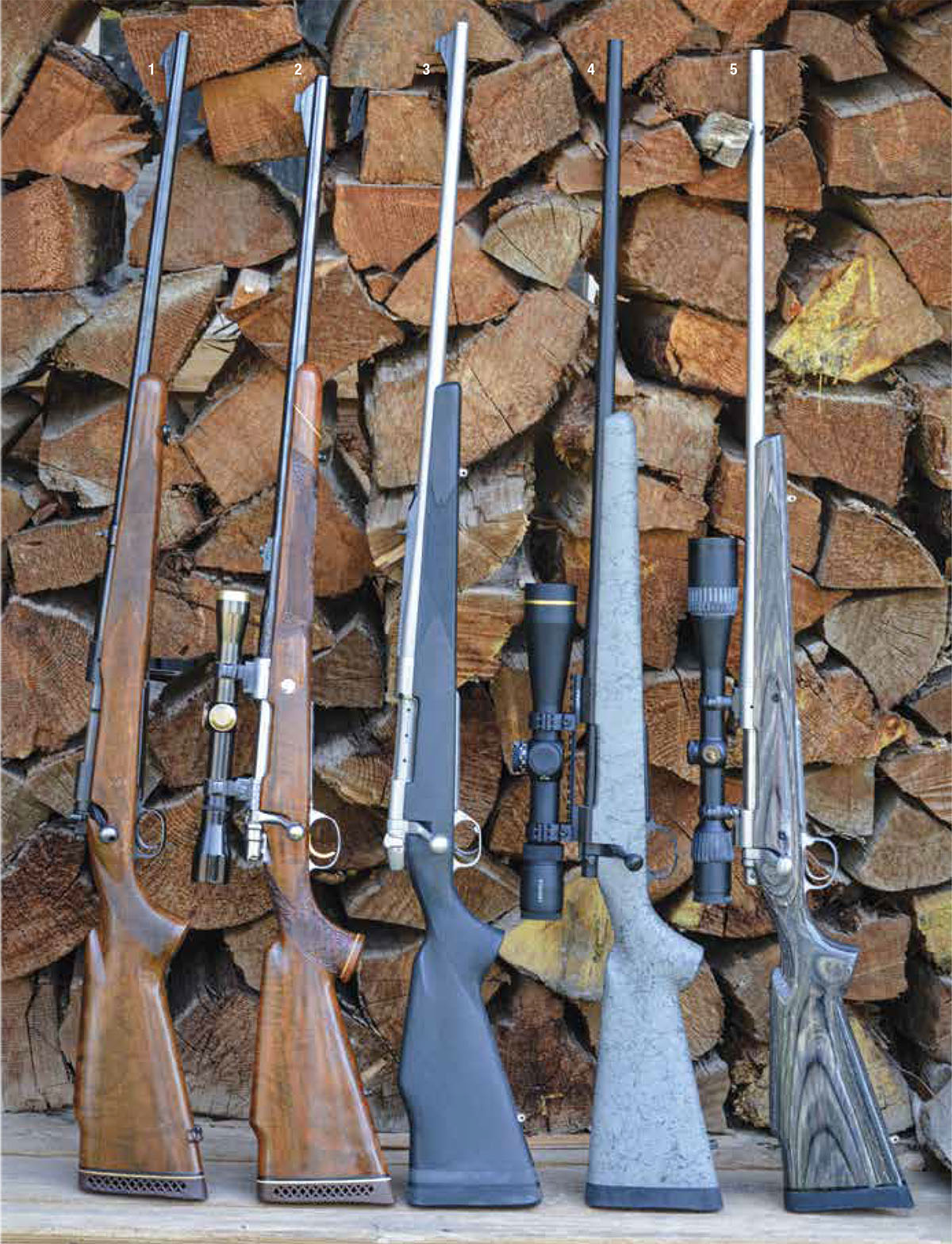
Various .338-caliber cartridges offer an outstanding blend of power, downrange power, trajectory and manageable recoil: (1) Winchester pre-’64 Model 70 338 Winchester Magnum, (2) Browning Olympian grade 338 Winchester from the Elmer Keith collection, (3) Weatherby Mark V 340 Magnum, (4) Nosler Model 48 chambered in 33 Nosler and (5) Remington 700 chambered in 338 Remington Ultra Magnum.
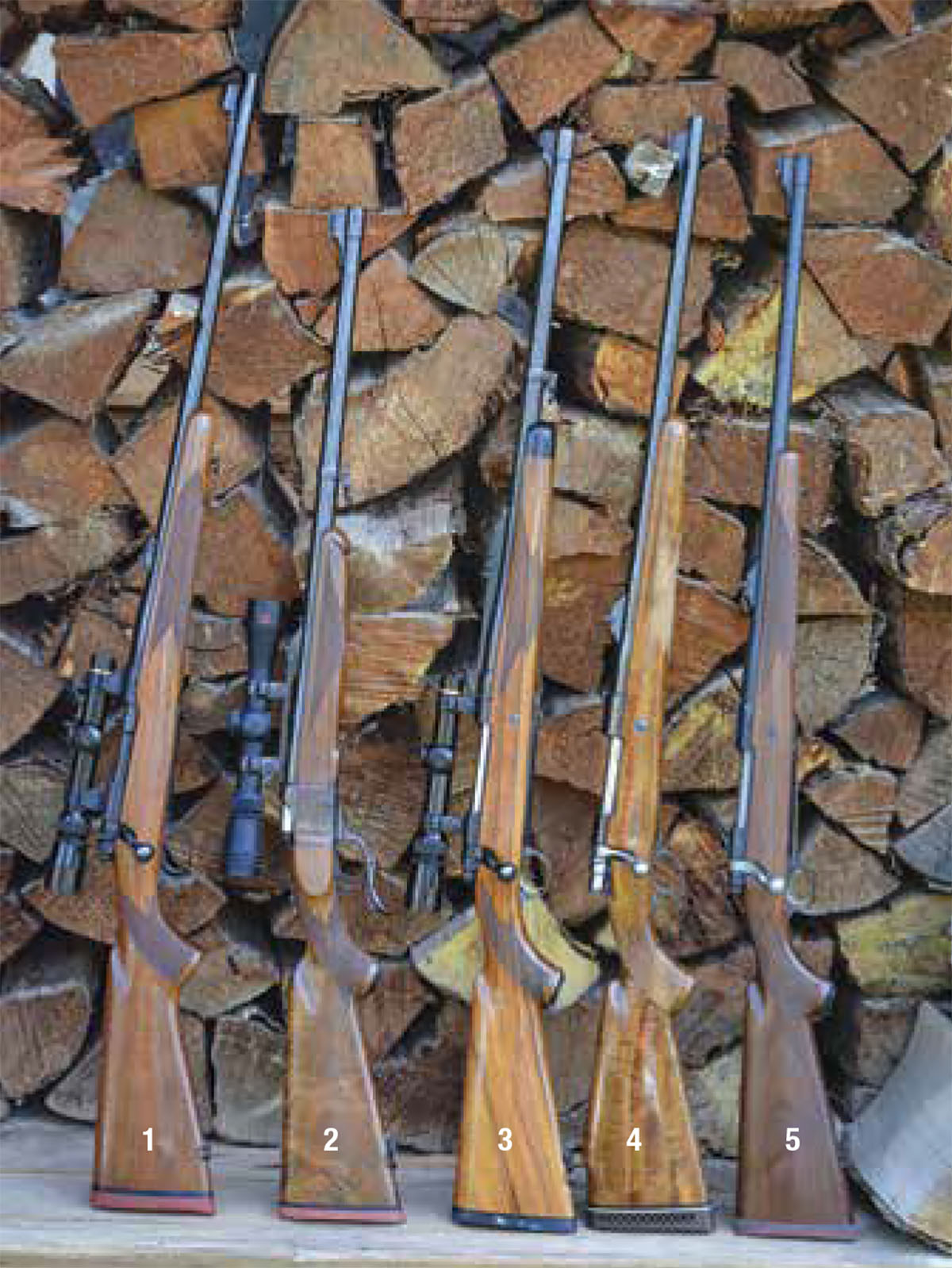
The 375 is a true classic medium-bore caliber and has been offered in many rifles: (1) Winchester pre-’64 Model 70, (2) Ruger No. 1, (3) Ruger M77 Express Magnum and (4) Browning High-Power Safari. All are chambered in 375 H&H Magnum, while the (5) Ruger M77 Hawkeye is chambered in 375 Ruger.
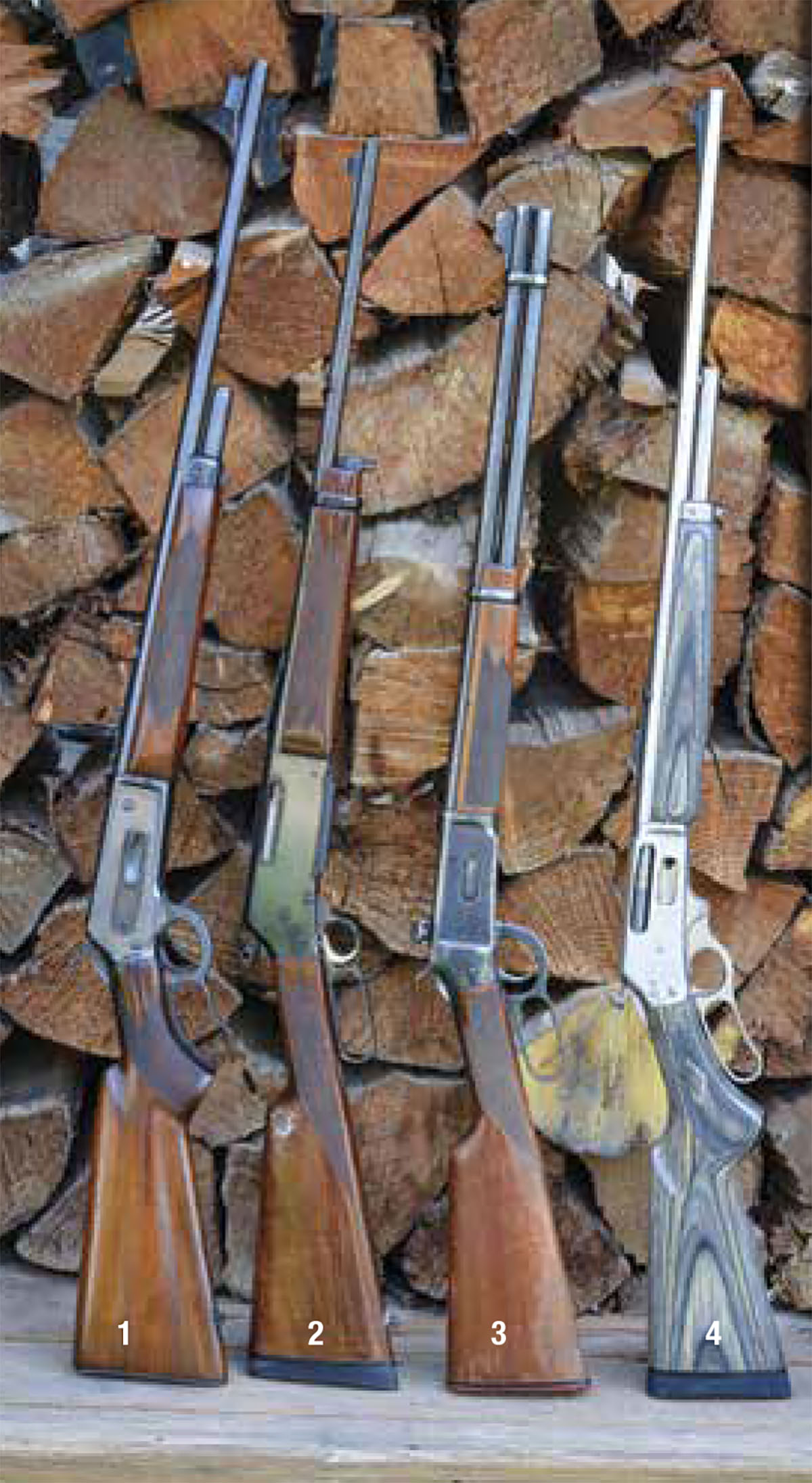
Several noteworthy medium bore cartridges are housed in lever action rifles: (1) Winchester Model 71 348 WCF, (2) Browning 81 BLR 358 Winchester, (3) Winchester 94 Big Bore 375 Winchester, (4) Marlin 338MXLR chambered in 338 Marlin Express.
Like a rock in my boot, there has been something bothering me for a long time. It seems that the gun industry has been so focused on developing efficient, super-accurate, long-range rifle cartridges with low-drag bullets that it has almost forgotten some practical, highly reliable, proven cartridges designed specifically for hunting big game, many of which are used daily by professional hunters, guides and outfitters by choice. Some will call them “big bores,” but they are actually medium-bore cartridges and are generally considered to be larger than .30 and 8mm calibers. They are not really designed as so-called stopping cartridges for wounded dangerous game, but with the right loads and in the hands of a skilled hunter, they can do that job perfectly. Even the more modest cartridges discussed today perform well on the great bears of the North and large moose that can weigh up to 1,700 pounds, while some of the more potent cartridges discussed are frequently used to take cape buffalo, lion and even elephant and other heavy game. In spite of their power and recoil, with proper stock fit, recoil pad, etc., most medium-bore cartridges are very manageable for average shooters. For today’s purposes, we are going to discuss notable cartridges that range in caliber from .338 to .375. Rather than discuss all cartridges that fall within each caliber category, they will be discussed by power level (1, 2 and 3) along with common rifles for which they are chambered.
Before getting too far down the road, let’s discuss some common field circumstances when hunting heavier game. Some critics of medium bores will point out that game can’t be taken reliably at longer distances due to their comparatively low ballistic coefficient (BC) bullets and more modest muzzle velocities when compared with recent small-bore cartridge developments and trends. While this is often true, some cartridges on this list are exceptions, as they offer a remarkable blend of downrange power and flat trajectory, which we will discuss momentarily. However, it is important to know that when hunting the great bears of the North, moose, etc., guides will virtually always get the hunter as close as possible before pulling the trigger to make a reasonable effort to assure the game is taken cleanly and to prevent the difficult and dangerous task of following up wounded animals. While distances can be around 200 yards, they are more often 100 yards or less; however, mountain grizzlies can be an exception. A cartridge with a flat trajectory and using an ultra-long-range bullet is literally pointless in brush and timber shooting. This last comment usually applies to African-bound hunters too. The same as brown bear, cape buffalo, lion, etc. are rarely taken beyond 100 yards, so flat-shooting cartridges are again pointless. Following wounded game into the brush or bush is dangerous business, and the risk of wounding increases substantially as the distance increases.
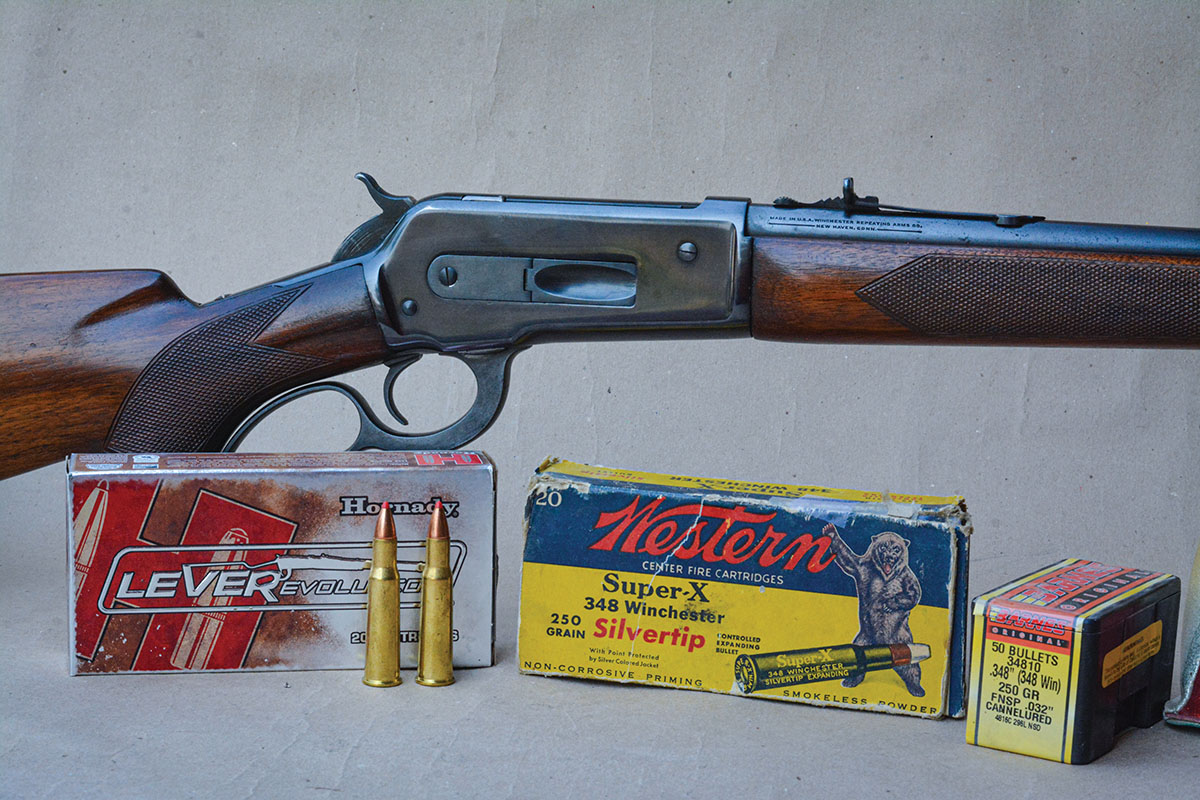
The Winchester Model 71 chambered in 348 WCF is an outstanding brush and timber rifle that is fast handling like a shotgun and offers true medium bore performance.
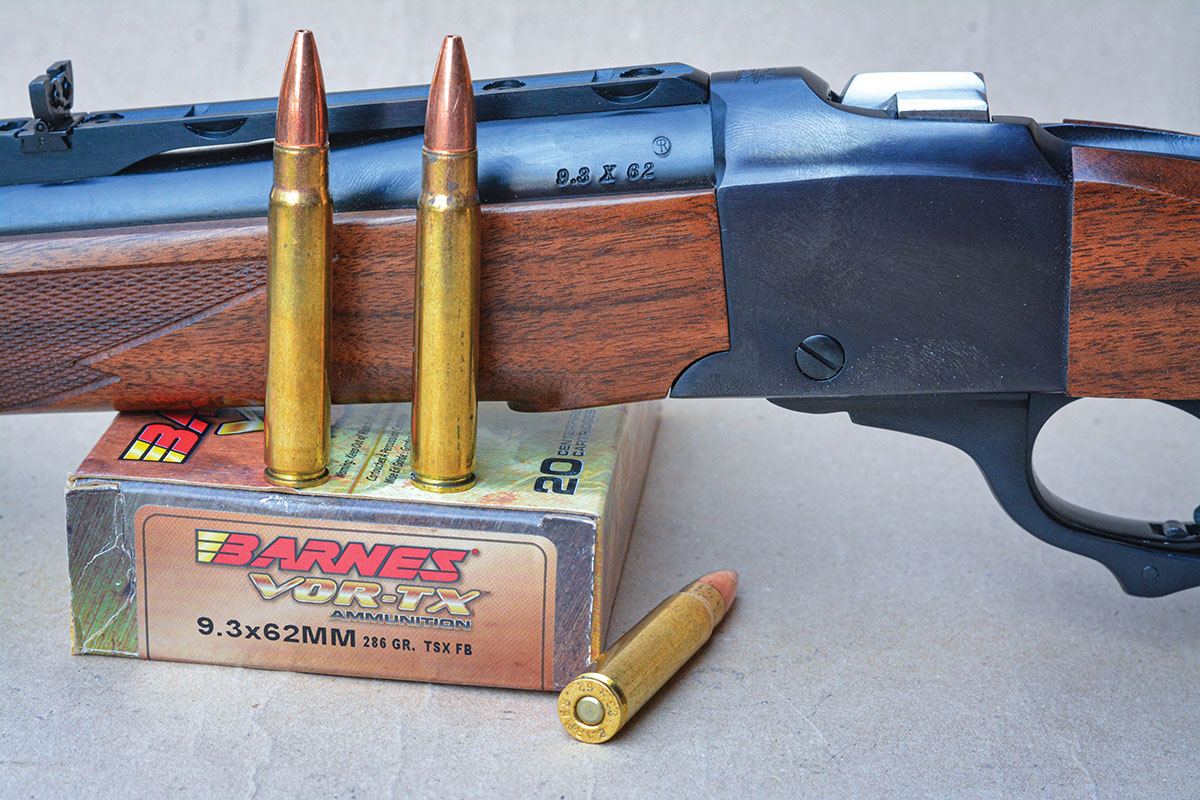
The 9.3x62 Mauser dates back to 1905 and boasts of performance that approaches 375 H&H ballistics, while offering excellent design and functions in 30-06 length actions.
I live in Idaho but have hunted a variety of game over literally all the western states and for that matter, the world. Granted, when hunting in open country, using flat-shooting, long-range cartridges with high power optics is a huge advantage; however, when still hunting deer, elk, and black bear in the dark timber, a medium bore cartridge chambered in a fast handling, lightweight, short rifle or carbine is a much better choice. In hunting Europe, where game is often driven or hunted in the timber and brush, the majority of the shooting is at running game that is taken offhand and virtually always less than 200 yards and most often less than 100 yards. The virtues of a fast-handling, medium-bore rifle that handles like a shotgun are a top choice and include bolt action, lever action and even single-shot rifles. Long-range rifles with high comb stocks designed primarily for shooting prone and used in conjunction
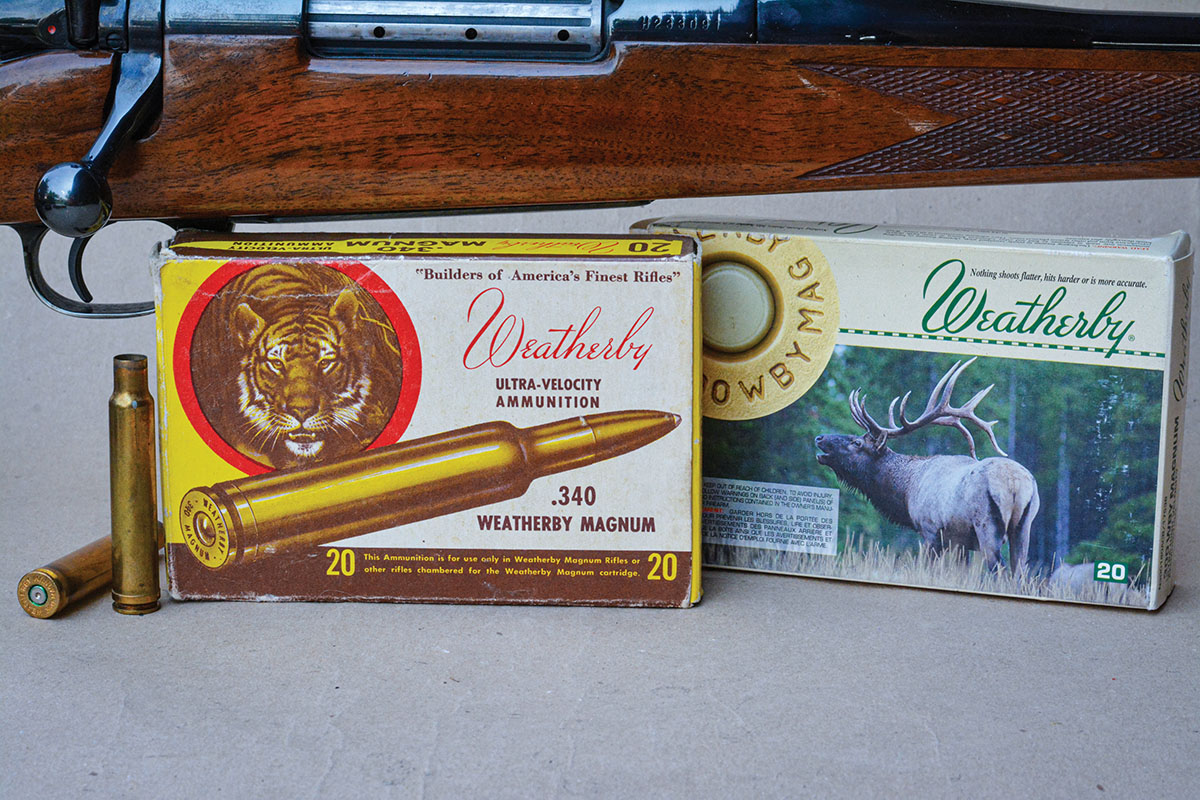
The 340 Weatherby Magnum is a flat-shooting, potent medium bore that performs well on elk, moose, large brown bear and African plains game – all while offering a flat trajectory similar to 7mm Magnums.
with high-power, top-heavy scopes and long barrels are slow and awkward when compared to sleek, fast-handling guns that come to the shoulder naturally, are designed for offhand shooting, and feature low-power scopes, aperture or reflex sights.
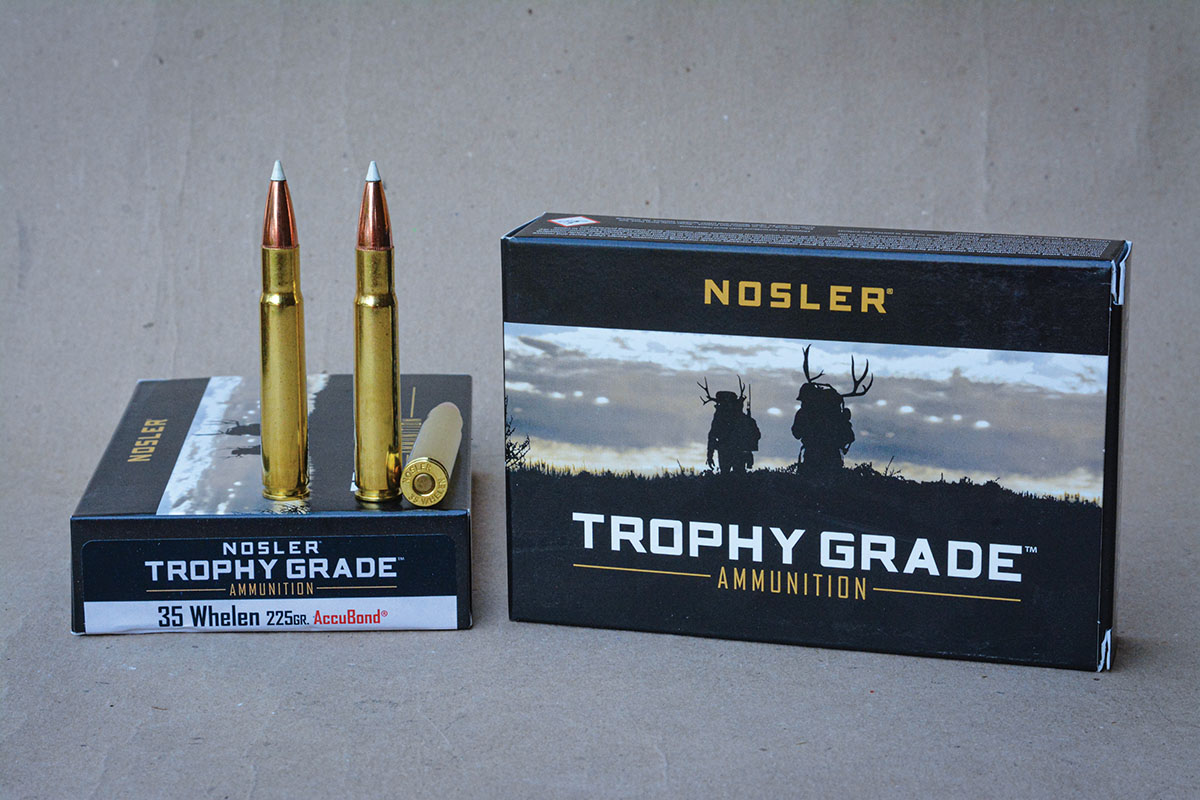
The 35 Whelen is a truly outstanding medium bore that offers excellent performance on heavier species, while producing comparatively modest recoil.
The first category includes more moderate-power medium bores, but they nonetheless deliver significant shock and provide reliable, deep penetration and performance. Let’s begin with the oldest – the 348 Winchester that was introduced in 1935 and chambered in a modernized version of the Model 1886 known as the Model 71. It featured a 2/3-inch length magazine, shotgun style buttplate, pistol grip lever and 20- or 24-inch lightweight barrels that helped it handle like a shotgun. In spite of being in the middle of The Great Depression, sales were respectable. Period ballistics listed a silly 150-grain bullet at 2,920 feet per second (fps), a 200-grain at 2,535 fps and a 250-grain at 2,350 fps, with the first two loads being similar to the 30-06 with the same weight bullets. While brush and timber hunters in the Lower 48 states found great favor with the rifle and cartridge, it became especially popular in Alaska and was frequently used on grizzly/brown bears, moose, etc. Unfortunately, the big levergun was costly to produce and fell victim to its rugged design and solid machined quality, and was ultimately discontinued in 1958. Several Model 71 reproductions have been offered, and Ruger is currently chambering their No. 1 rifle for the 348.
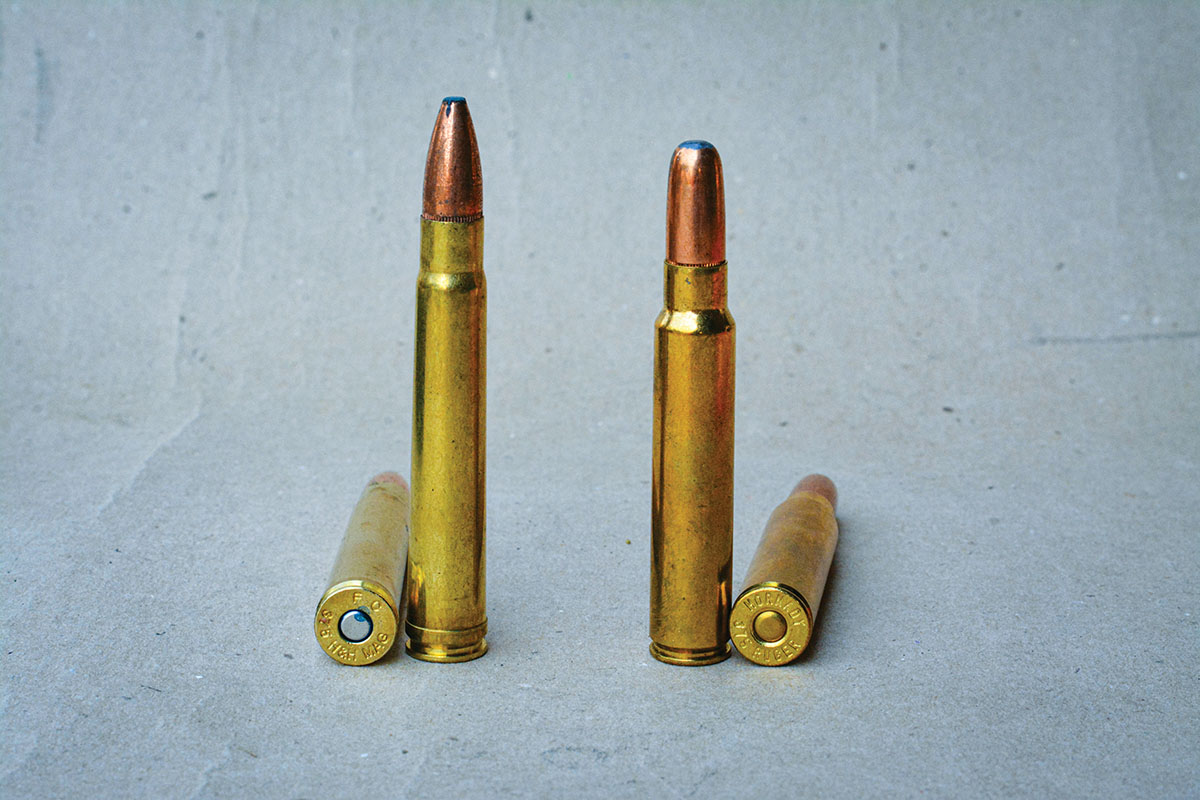
The 375 H&H Magnum (left) requires a 3.600-inch-long action, while the 375 Ruger (right) functions in 30-06 length actions, while offering a beltless case with greater velocities.
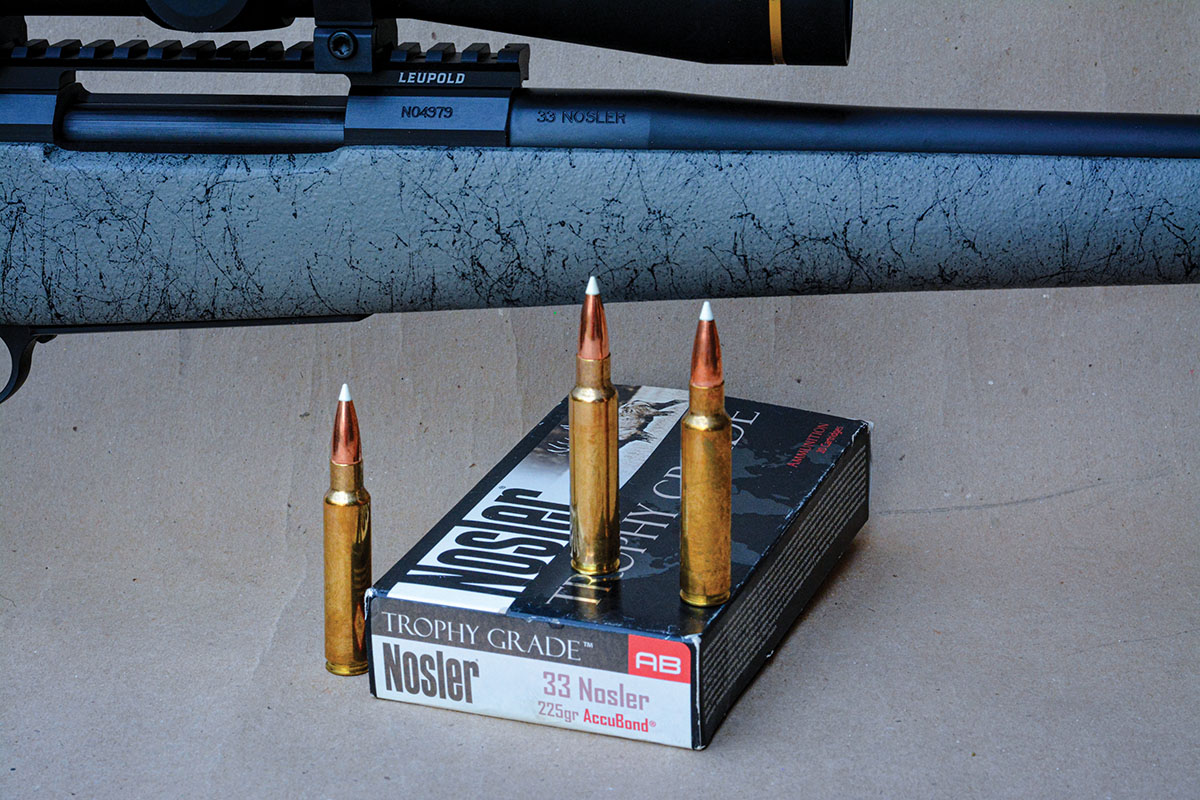
The 33 Nosler is a modern powerhouse with a beltless case, offering unusual efficiency and functioning in standard 30-06 length actions.
The 348 that I first used in the 1970s is one of my favorites for brush and timber hunting. While it can be criticized for a couple of design shortcomings, it is nonetheless a very capable cartridge that hits large game hard and is especially reliable with heavyweight premium bullets such as the 250-grain
Barnes Original.
Winchester still offers a traditional 200-grain flatpoint at 2,520 fps, while
Hornady offers their excellent 200-grain FTX LEVERevolution at 2,560 fps.
Starline offers new cases, so it is a long way from becoming obsolete.
In 1978, recognizing the void in their product line for a medium-bore lever gun, Winchester developed a stronger receiver for the Model 94, calling it the Big Bore 94 and chambered it for the 375 Winchester that listed 200- and 250-grain bullets at 2,200 and 1,900 fps, respectively. Marlin quickly chambered their Model 336 (known as the Model 375) for it. The 375 was essentially a modern version of the 38-55 WCF, but with a thicker case to withstand higher pressure of 52,000 copper units of pressure (CUP) and standardized with .375-inch bullets (rather than the .375 to .382 inch used for the 38-55). The Winchester carbine was equally as handy as the Model 94 chambered in 30-30, but offered notably better performance on large black bear and elk. When stoked with properly designed cast bullets, it still performs well on game, which is a fun and economical option.
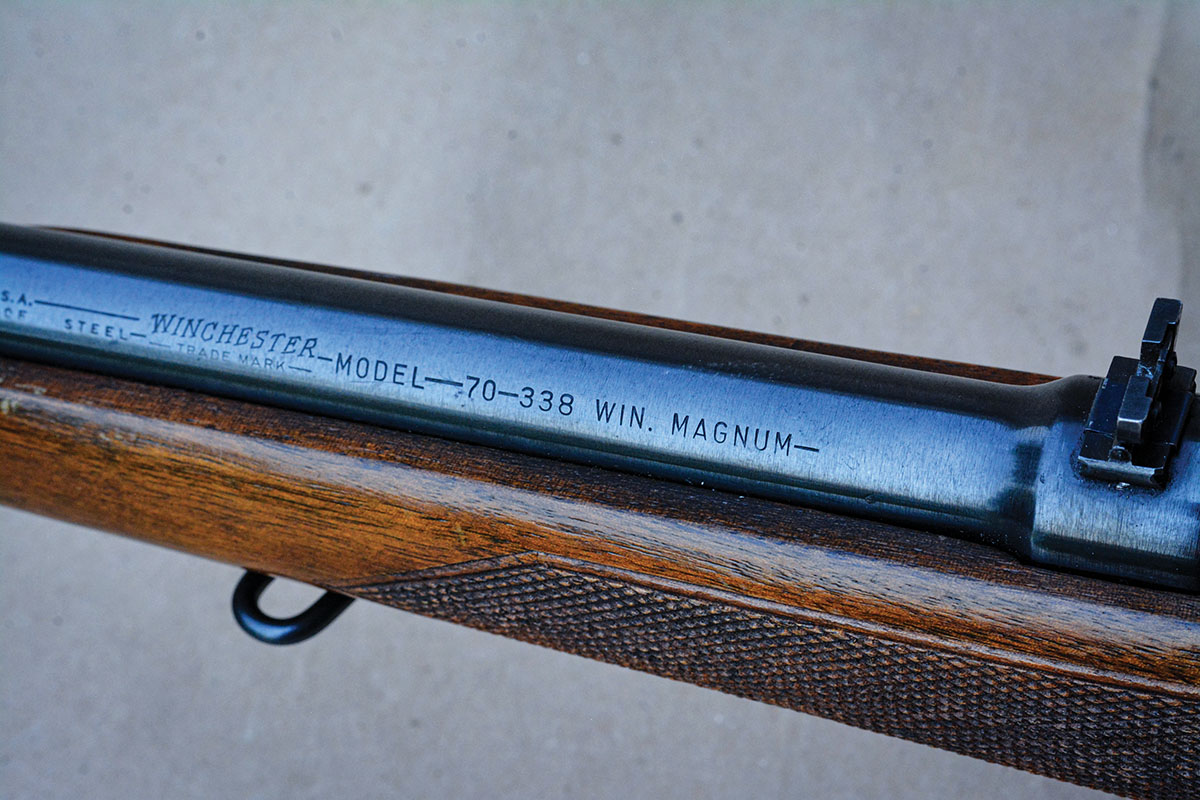
Winchester developed the 338 Winchester in the 1950s, and it remains the most popular cartridge of this caliber.
Sales for the 375 Winchester were respectable but eventually tapered off. Using the Big Bore action, Winchester developed an even more potent lever action cartridge in 1982 known as the 356 Winchester, which was based on the 358 Winchester, but with a semi-rim added and loaded with flatpoint bullets for use in tubular magazines. Factory ballistics listed a 200-grain bullet at 2,460 fps from a 20-inch barrel. This was a fairly potent cartridge that nearly duplicated the legendary 348, but housed in a lighter, handier rifle. Hunters who put the 356 to work in brush and timber swear by its outstanding performance.
In 2009, Hornady and Marlin worked together in developing the 338 Marlin Express that was based on the 376 Steyr case with a semi-rim added and shortened slightly. Factory ballistics pushed a 200-grain FTX bullet at 2,565 fps that exceeded both the 348 and 356 Winchester cartridges. With the rubber-tipped FTX bullet boasting a BC of .430, it produces a unique combination of power and flat trajectory. It might be hard to believe, but this load closely resembles the same trajectory at 400-yards as the 30-06 with traditional 180-grain lead-tip spitzer bullets at 2,700 fps. The beloved Marlin 336, actually known as the Model 338MXLR, was capable of taking deer, elk and black bear at distances far beyond the boundaries associated with traditional lever guns with tubular magazines. Unfortunately, with some of the problems that Marlin suffered under Remington ownership, the cartridge was put on the back burner and never returned. This was unfortunate, as it is a truly modern lever gun cartridge. However, Ruger/Marlin is at least considering reproducing it due to continuing demand.
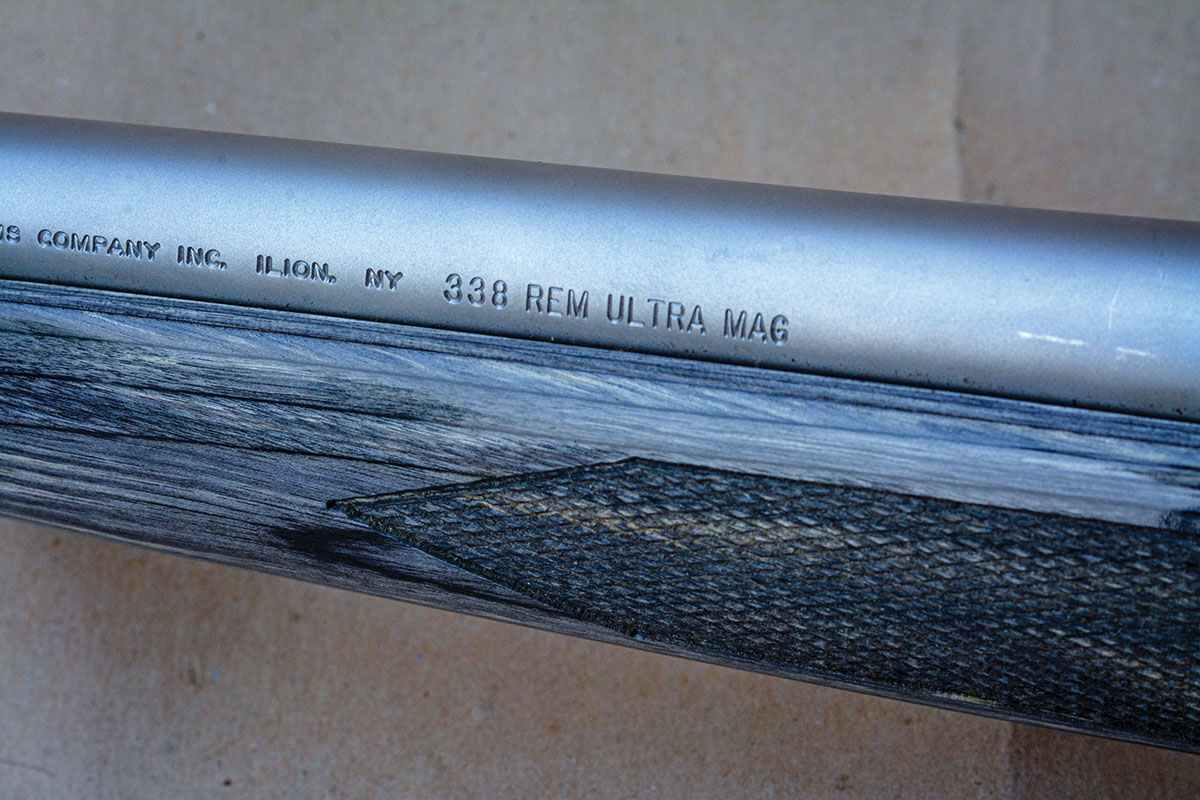
The 338 Remington Ultra Magnum is a powerful, long-range medium bore cartridge that is suitable for heavy, thin-skinned game.
This brings us to the 358 Winchester that was introduced in the Model 70 in 1955 and listed to push 200- and 250-grain bullets at 2,530 and 2,250 fps, respectively (but reduced slightly today). It was based on the short action 308 Winchester case necked up and offered unusual efficiency. While ballistics fall short of the 35 Whelen, like other cartridges in this category, it offers significantly greater power and terminal performance than its paper ballistics suggest. In addition to having several friends that use it regularly on larger species, I have used it on elk in both the Ruger M77 and Winchester Model 70. More recently, I have been working with a handy Browning 81 BLR, which is a great brush and timber carbine. Ruger is currently offering the Model 77 Hawkeye with a threaded barrel for a new generation to discover just how good this cartridge really is.
Moving up to cartridges in the second category, this field is very crowded with some outstanding versions that never need apology. The 338-06 A-Square is a modern version of the 333 OKH and is based on the 30-06 necked for .338-inch bullets and generally pushes 200-grain bullets at 2,775 fps, 225-grain bullets at 2,675 fps, or 250-grainers at just over 2,500 fps. It offers a blend of power, respectable trajectory, efficiency, moderate recoil, increased magazine capacity and can be housed in a lighter rifle. While the lighter bullets are good choices for deer and elk in open country, a heavily constructed 250-grain version such as the Nosler Partition or Swift A-frame is a top choice for taking large bears.
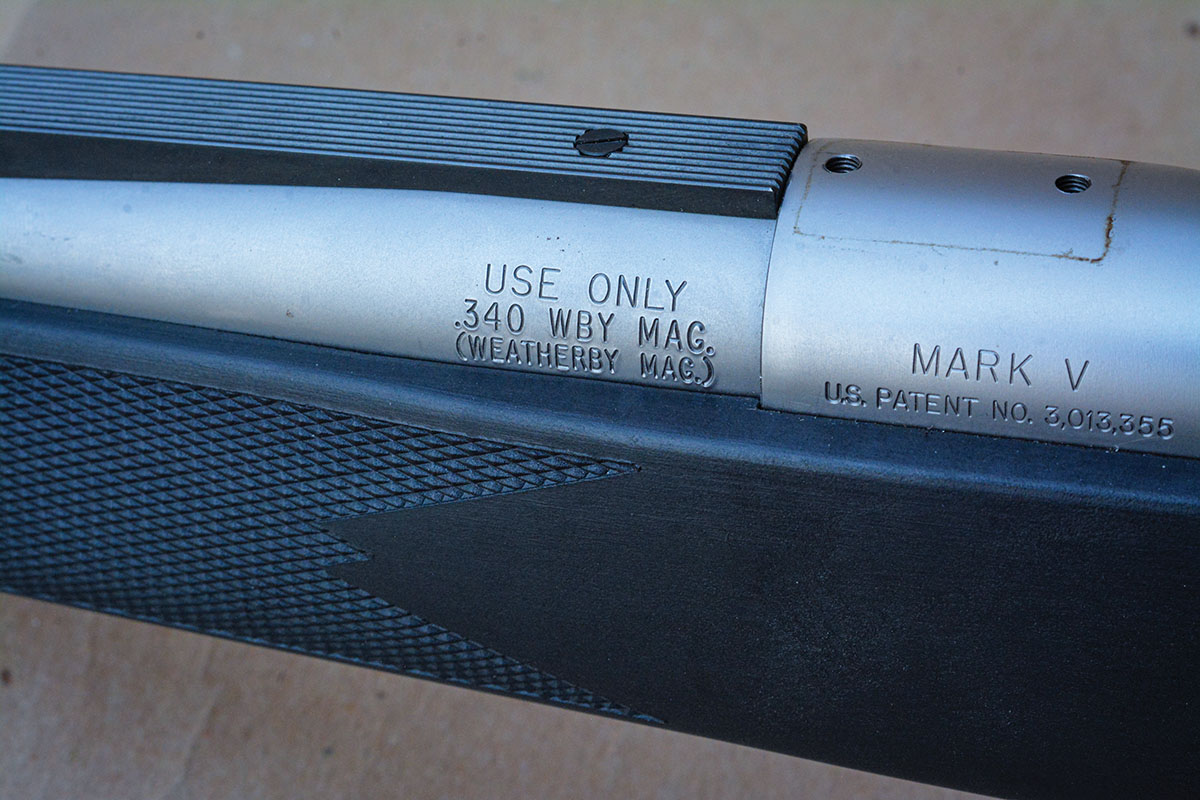
The legendary 340 Weatherby Magnum offers a long-range trajectory similar to the 7mm Magnum, but delivers much greater terminal performance.
Another favorite medium-bore cartridge based on the 30-06 case is the 35 Whelen that boasts of excellent feeding and increased magazine capacity over cartridges with larger diameter cases. I’m always amazed at how close the Whelen comes to the performance of the 375 H&H Magnum with 270-grain bullets at 2,690 fps, but boasts of greater efficiency, reduced recoil and added magazine capacity. While factory loads vary, handloaders can push the 225-grain
Nosler AccuBond at 2,850 fps or the 250-grain Partition just over 2,700 fps. It is truly an impressive cartridge that I have had a long-running appreciation for because of its reliable performance on heavier species, plus it is remarkably comfortable to shoot. Frankly, it is a much better cartridge than most shooters realize. Ruger is currently offering their excellent 77 Hawkeye in 35 Whelen.
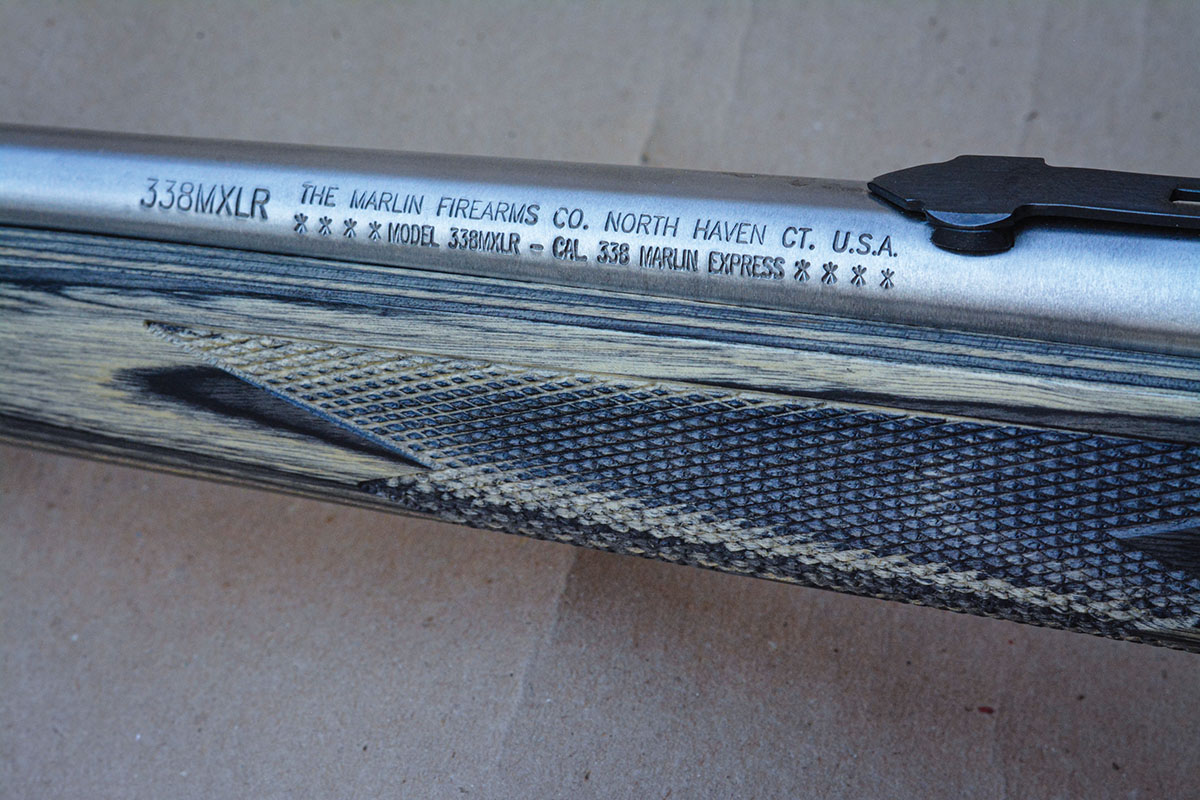
The 338 Marlin Express was designed specifically for the Marlin 336 action and can push a 200-grain Hornady FTX bullet at 2565 fps, which is 30-06 level performance.
This brings us to the various magnum capacity 338s, which is a fairly long list and are truly remarkable big game hunting cartridges due to their versatility. By far the most popular and a personal favorite is the 338 Winchester Magnum that was introduced in 1958 and was influenced by the 333 OKH Short Belted Magnum wildcat (that utilized .333 inch European bullets) dating back to the 1930s. Winchester’s version utilized .338-inch bullets, the same as the 33 WCF, and was based on a shortened and blown-out 375 H&H Magnum case with an overall cartridge length of 3.340 inches to function in 30-06 length actions. While ballistics have changed since the 1950s, handloaders can push 200-grain bullets at 2,975 fps, 225-grain versions at 2,800 fps, or 250 grainers at nearly 2,700 fps. Space will not allow a detailed discussion of ballistics, trajectories and downrange power, but suffice it to say that most 200- and 225-grain bullets share a similar trajectory at 500 yards as the 30-06 loaded with sleek 150- and 165-grain bullets. When loaded with premium 250-grain bullets at around 2,675 fps, it is ideal on large bear, moose etc. The majority of guides and outfitters in Alaska use the 338 as standard equipment even when following up wounded grizzlies in the alders, or when moose are wounded and traveling fast in open country where hits must be made at 400 to 500 yards. At those distances, the 338 offers a flatter trajectory and higher impact velocities than the great 375 H&H Magnum, while boasting of being chambered in lighter-weight rifles. In spite of its performance, the 338 can generally be mastered by most shooters.
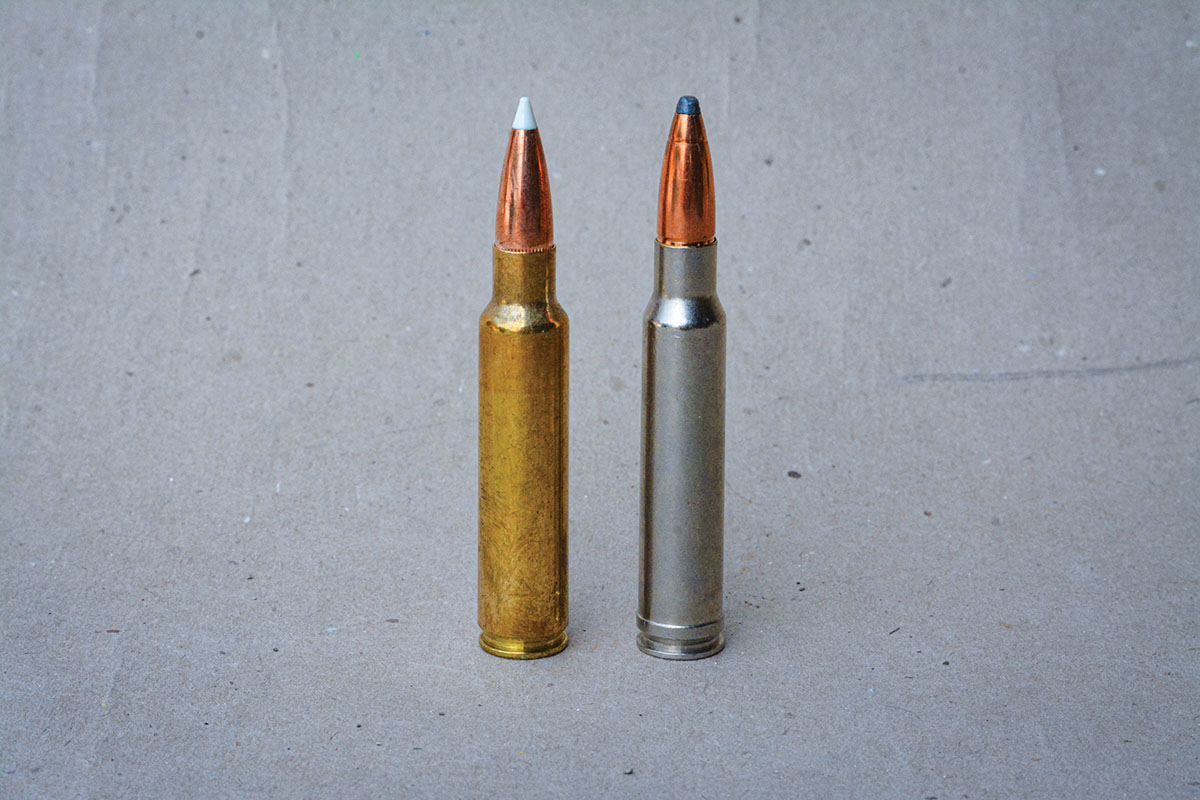
The 338 Winchester Magnum (left) and the 33 Nosler (right) have a maximum overall cartridge length of 3.340 inches, allowing them to function in 30-06 length actions.
Moving up to other favorite 338 Magnum cartridges with greater powder capacity, we have the 340 Weatherby, 338 Remington Ultra Magnum and 33 Nosler. (Note: There are many other high-capacity 338s, but they are often for long-range tactical use, or are overbore and don’t qualify as favorites.) Frankly, these three cartridges are all very close in ballistic performance and can generally push 200-grain bullets at 3,200/3,300 fps, 225-grainers at 3,000/3,100 fps or 250-grain bullets at 2,850/2,950 fps from 24-inch barrels. These are truly remarkable cartridges that more or less duplicate 7mm Magnum trajectories at 500-yards and retain high impact velocities for reliable bullet expansion. Who said medium bores don’t offer long-range power and flat trajectory? In fact, few sporting cartridges can match their blend of power, flat trajectory and sheer long-range muscle from popular sporting-weight rifles.
In my opinion, the 33 Nosler is clearly the most efficient and boasts of a modern design; however, because the 340 has been around since 1962, I have used it the most in the field. There was a time when I hunted elk extensively in some very tough mountainous country wherein two custom-built 340s were used across large canyons. It was amazing then, and it still is! Today, with improved long-range bullets, these three 338s are better than ever.
In addition to burning more powder, the largest drawback with the above three 338 powerhouses is recoil. All of that performance is not free, and recoil is notably greater and faster than the more humble 338 Winchester. However, if a shooter can master them, they are extremely worthy medium bores for heavier species at any practical distance.
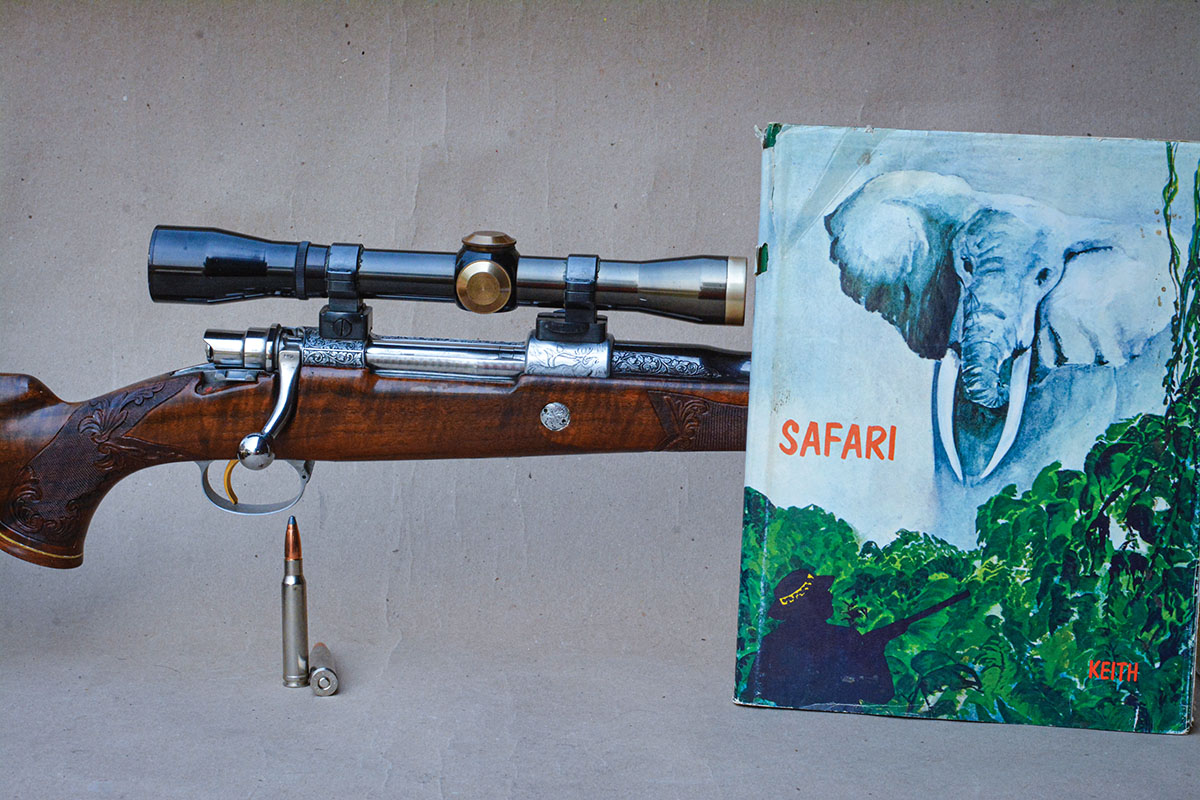
From the Elmer Keith collection is this amazing Browning High-Power Olympian Grade chambered in 338 Winchester Magnum, which is the first one produced in 1959. While Keith hunted Idaho, Montana and Colorado with it, the rifle was also taken on an African safari, where it accounted for a lion, which is a testament to the effectiveness of the 338 Winchester.
This brings us to the third category, starting with the non-belted 9.3x62 Mauser that was introduced in 1905 and is one of our finest medium bore cartridges. It is a technically better case design than the 375 H&H, but ballistics are slightly less. It was designed to readily work in converted military Mauser 98 actions chambered in 8x57. The case is rimless, features a 17-degree shoulder for positive headspace control, and has an overall cartridge length of 3.291 inches, so it works perfectly in 30-06 length actions. Current ballistics (Hornady and Remington) list a 286-grain bullet (solid and expanding versions available) at 2,360 fps, but handloaders can usually bump that velocity to 2,450 fps, which is only around 80 to 100 fps slower than the 375 H&H loaded with 300-grain bullets.
Twenty-five years ago, very few U.S. shooters were familiar with the 9.3x62; however, it has been gaining momentum and popularity, with Hornady, Nosler and Remington offering factory loads, while Ruger, CZ-USA and others offer rifles. While some African countries specify the .375 caliber as the minimum for elephant, cape buffalo, etc., others permit the 9.3x62 (and virtually all allow it anyway). The late Don Heath was a close friend and a highly experienced professional hunter in Africa (and a former writer in these pages). He loved the 9.3x62 and considered a custom Mauser 98 his favorite rifle. While he had double rifles and big-bore bolt-action rifles, the 9.3x62 was his daily working gun and was used to take many buffalo, elephant and other dangerous game. While hunting with Don throughout Europe, he asked if I wanted to borrow his custom rifle, and I gladly jumped on the opportunity. I took more than two dozen heads of European boar, stag and other species with it. Combined with a well-designed stock (for shooting running game offhand), a low-power Leupold scope and premium hunting bullets, it was pure magic.
There are many worthy .375-caliber (magnum) cartridges; however, my favorites still include the 375 H&H and the 375 Ruger. The old H&H boasts of a proven record and colorful history from around the world that began in 1912, but I have used it extensively on game ranging from deer to large brown bear, and its performance is always reliable with correct bullets. The 270-grain (2,690 fps) and 300-grain bullets (2,530 fps) generally shoot to the same point of aim. Recoil is relatively slow, so most hunters can easily master it with a properly fitting stock and a little seasoning.
The 375 Ruger is an outstanding cartridge that was designed as a team effort between Hornady and Ruger and offers around 150 fps greater velocities than the 375 H&H with the same bullet weights and barrel length, or duplicates its ballistics when fired from a handier 20-inch barrel. There are higher velocity 375s such as the Remington Ultra Magnum and the mighty 378 Weatherby, but the substantially increased recoil, larger actions, higher cost of ammo and other drawbacks do not support the small gains in terminal performance. The 375 Ruger is based on a new case with a head diameter that is the same as the belt diameter (.532 inch) found on belted magnum cases, resulting in increased powder capacity. The case is rimless, has a 30-degree shoulder angle, and an overall cartridge length of 3.340 inches to function in 30-06 length actions. This results in reliable function in both push-feed and control-feed bolt actions, increased in-the-chamber burn efficiency, reduced powder charge weights, lower extreme spreads, improved accuracy and higher velocities. From the time I first evaluated and tested the 375 Ruger, it became a favorite. While it may not have as colorful a history as the H&H, it is a better cartridge that has become hugely popular.
Medium bore cartridges may not give dazzling performance in ballistic tables at 1000 yards, but their practical real-world performance in the field on larger species has been proven countless times for more than a century.