

A Backward Glance at the Pinfire Revolver
I’ll Have the Acier Fondu with a Side of Colt
feature By: Art Merrill | December, 26
For roughly the first five hundred years of its development, the firearm, despite improvements, remained a single-shot affair. Yes, there are many examples of early attempts at making repeating arms, but until the 1800s none were successful in a practical sense that saw them employed in anything approaching widespread use. Oversimplifying here for the sake of brevity, whether in warfare or self-defense, it was pretty much fire your shot, then revert to the bayonet or sword.
The key to the first truly, widely successful repeaters might arguably be the cluster of revolving barrels such as found on the pepperbox firearms and which did see considerable commercial success, but emphasizing “widely successful” and adding “still successful in small arms today,” we must consider instead the invention of the cylinder of revolving chambers. Though not the original thinker to come up with it, there exists in a
Providing the user six rapid shots was revolutionary firepower at the time, but percussion revolvers are painfully slow to reload with loose powder, ball and percussion cap.
The next step in the development of repeaters was to create the device permitting rapid reloading – the fully self-contained cartridge – but it wasn’t really the next step, as it was actually concurrent with Colt’s revolving pistol but ignored by him.
For the first 15 years, Lefaucheux made his pinfire cartridge cases of cardboard; when his patent expired, a Parisian named Houllier and then another Frenchman named Chaudun patented improved pinfire cases made of copper and brass, which became the standard. Some pinfire cases were reloadable by pulling the firing pin outward, then prying out and replacing the fired percussion cap; tools (mostly of wood) for reloading metallic pinfire cases were commonly available back when the pinfire was popular.
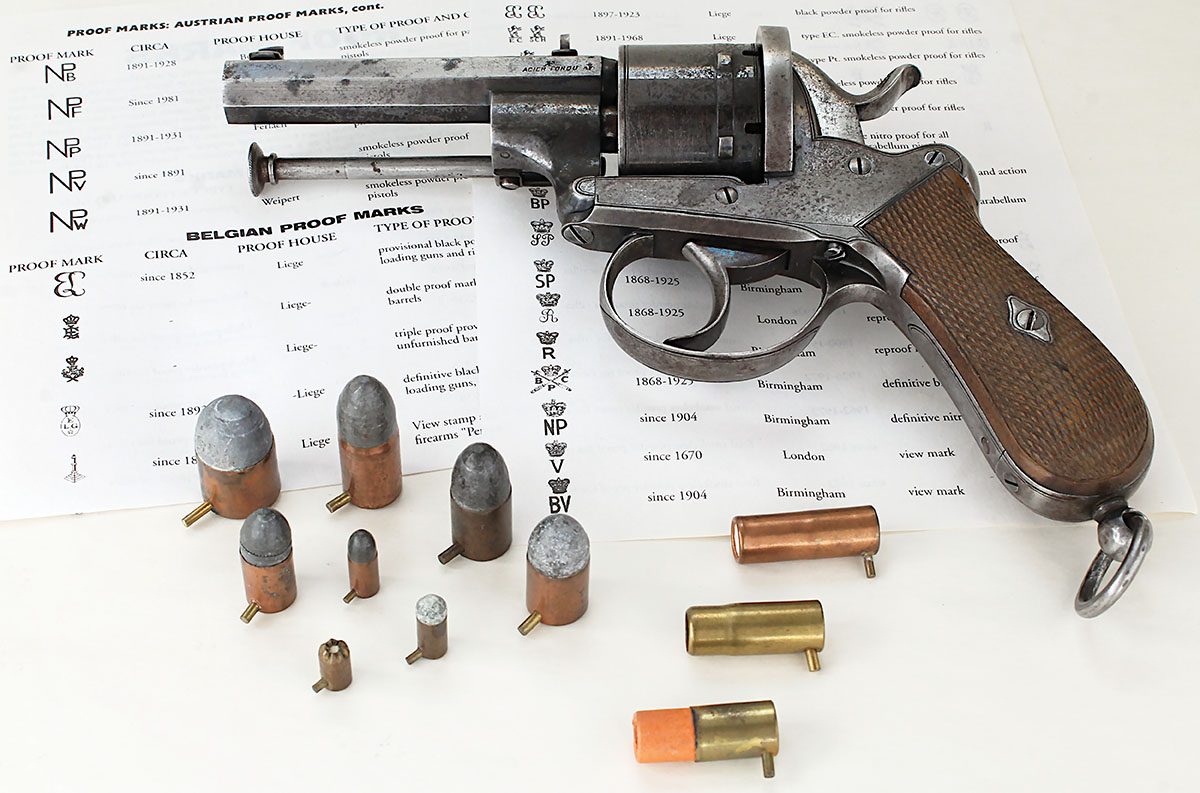
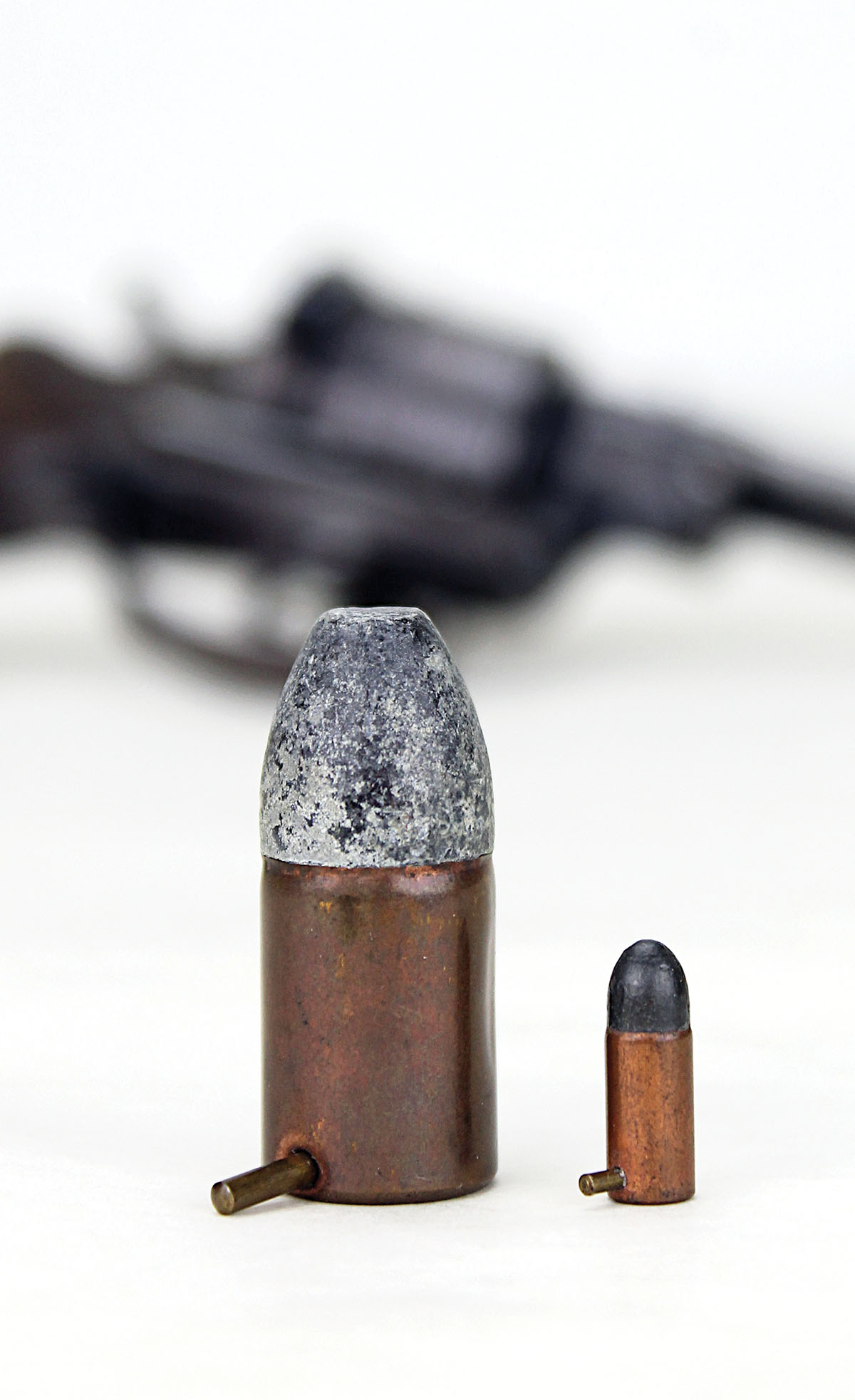
Pinfire cartridges caught on quickly in Europe, where they were made for revolvers, rifles and shotguns, and used for everything from jewelry (11⁄2-inch long “trinket” guns firing a 2mm bullet) to parlor guns and hunting, self-defense, law enforcement and military arms. To illustrate, pinfire cartridges borrowed from the collection of my shooting buddy Ken to photograph here run from 5mm to 15mm, and include a few brass-and-paper shotshells that appear intended for revolvers. Full-size pinfire shotgun shells of cardboard and brass were also popular and, except for replacing the pinfire system with the centerfire primer, shotgun shells remained pretty much unchanged until the advent of plastic shotgun shell hulls.
Many countries, most especially those of Europe, adopted pinfire revolvers for military and police work. While military combat revolvers were what we can consider full size and typically fired bullets of 11mm, 12mm or 13mm, officers (and some police) often carried smaller pinfire revolvers chambered for 9mm and 7mm cartridges. This may be the commencement of a small handgun worn on the hip, indicating the carrier had a position of authority or prestige rather than being carried for serious combat, though of course it could still be employed to deadly effect. In Brazil, for example, officers carried smaller 9mm pinfire revolvers; the cartridge case was just over a half inch long, and seven grains of black powder launched a 120-grain conical lead bullet.
The pinfire system held on for surprisingly longer than one might think, given that superior rimfire and centerfire metallic cartridges were coming into wide use post-Civil War. The Sears, Roebuck & Company catalogs still listed pinfire cartridges at the turn of the 20th century for roughly a penny apiece, depending upon caliber. In contrast, pinfire cartridges today are collector items fetching upwards of $25 and more for a single, primo specimen.
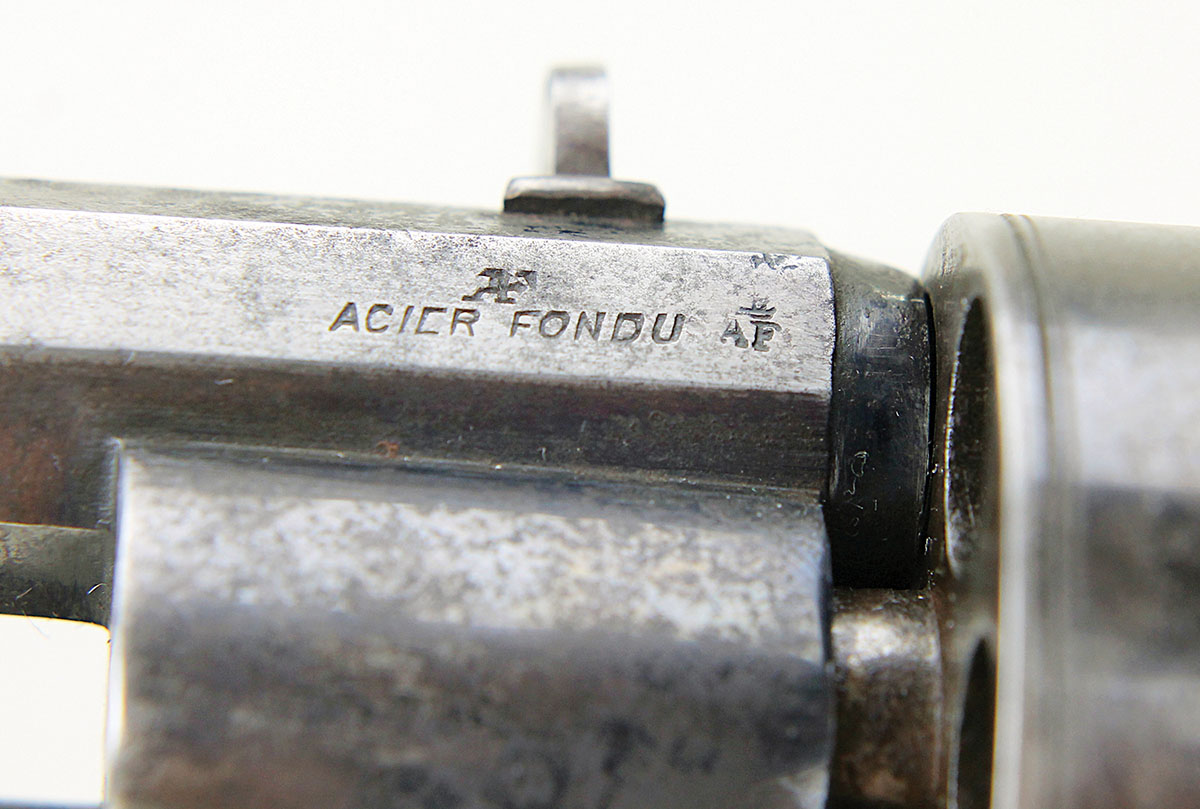
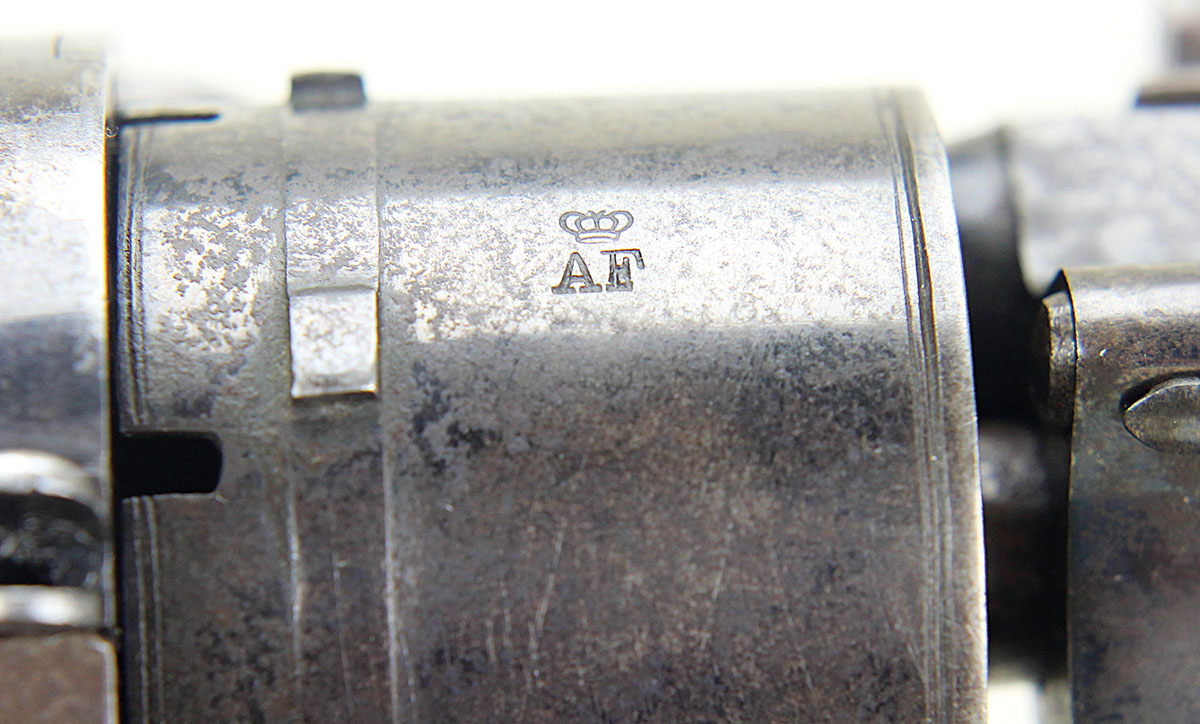
Determining who made a specific pinfire revolver can be an exercise in futility, as uncounted numbers bear only proof marks, and sometimes no markings at all, particularly those churned out by the scores (or hundreds?) of makers in France, Belgium and other European countries. The pinfire revolver here bears two marks, the meanings of which became illuminated after a bit of research.
Many French and Belgian pinfire revolvers (and other arms) bear the stamp, “ACIER FONDU.” While I know what fondue is at a wedding reception, I had to look this one up and found acier fondu isn’t nearly as palatable, as it translates into English as “Cast Steel.” Interestingly enough, some resources list “Acier Fondu” as a manufacturer, which is a lesson in always cross-referencing information when possible.
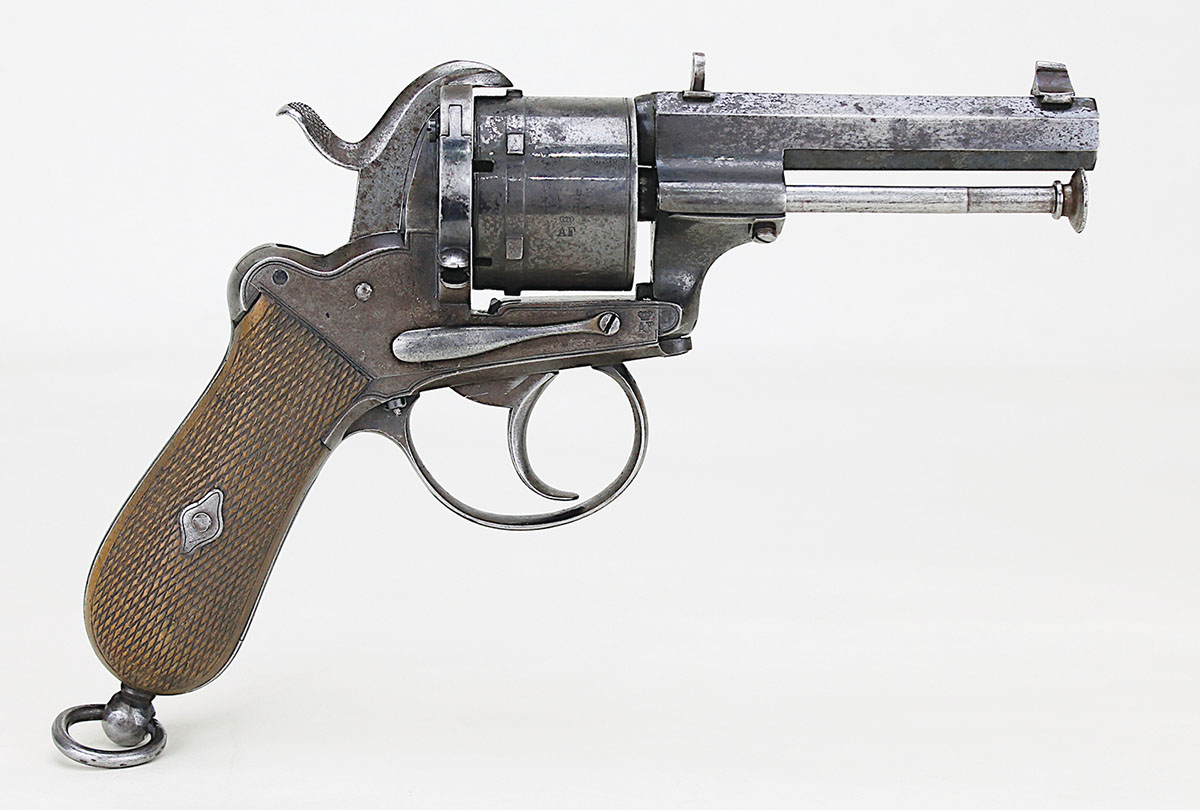
Other than wearing patches of patina, this 9mm double-action-only Auguste Francotte revolver is in pretty good shape and, mechanically, it functions fine other than the trigger not automatically returning forward after firing. A complete disassembly for cleaning and oiling gave me a tour of the innards and an understanding of its mechanics, yet no amount of puzzling over the trigger-hammer-pawl assemblage could invent a place for a missing trigger return spring (needless to say, there is no schematic for this revolver). I finally concluded that downward pressure of the pawl’s flat spring serves to both lower the pawl and simultaneously, via linkage, return the trigger to its forward position, and that the spring is age-weakened and lacks the vigor to thrust the trigger fully forward.
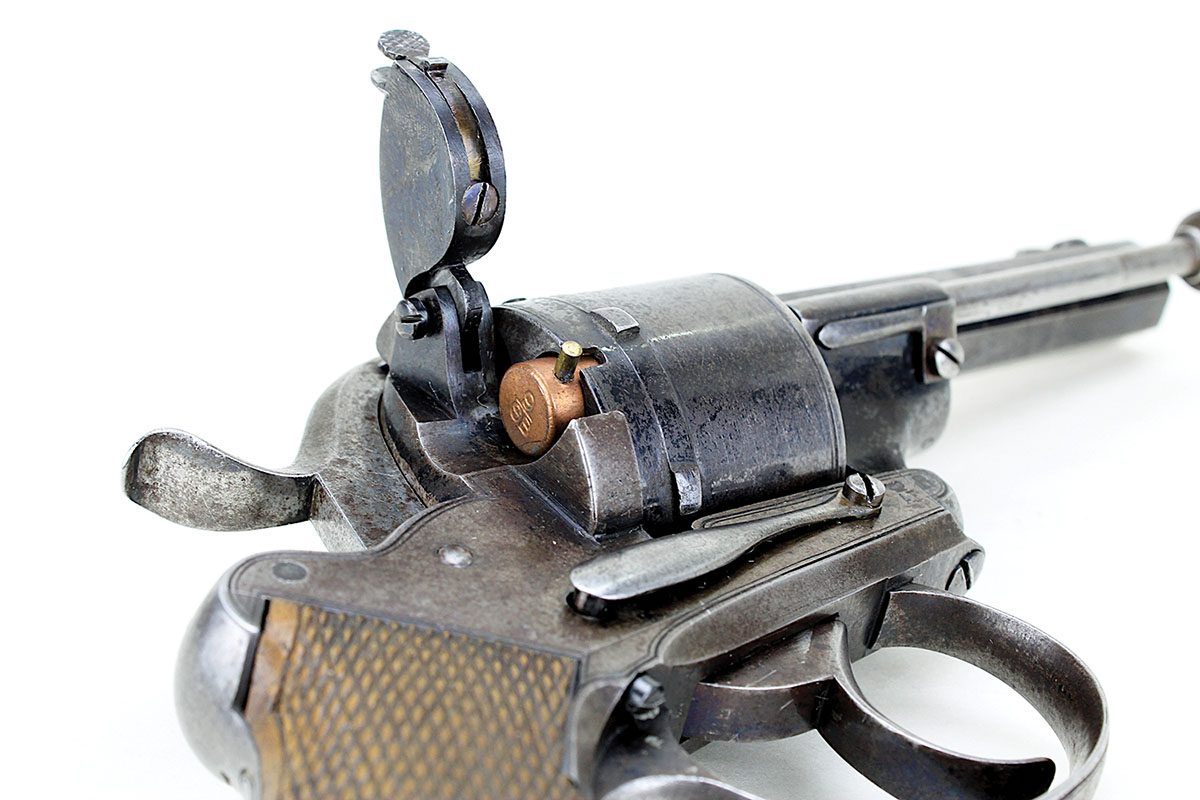
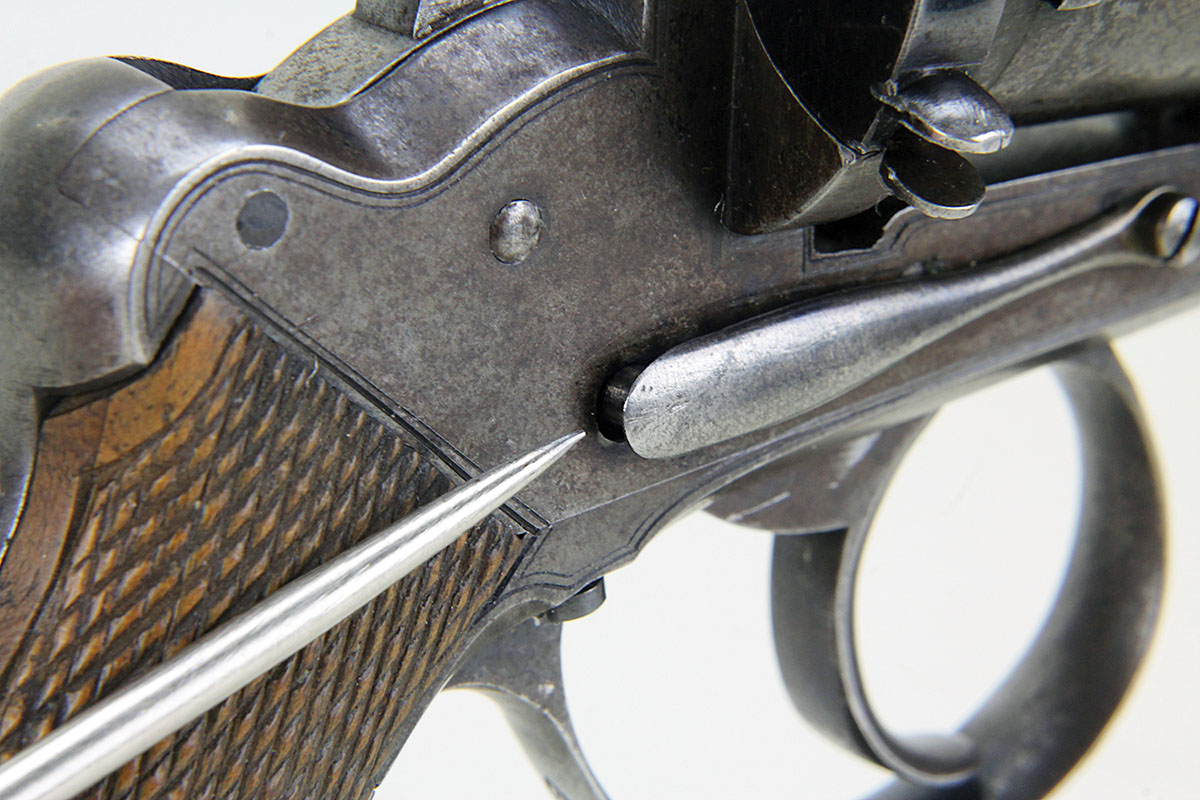
Francotte’s solution is in the flexible bar seen screwed to the right side of the frame just above the trigger guard. Raise the hammer slightly, just enough to clear the firing pins, and push the back end of the bar inward with the left hand’s thumb; a small protrusion on the bar then blocks hammer rotation to hold it in place while loading or unloading.
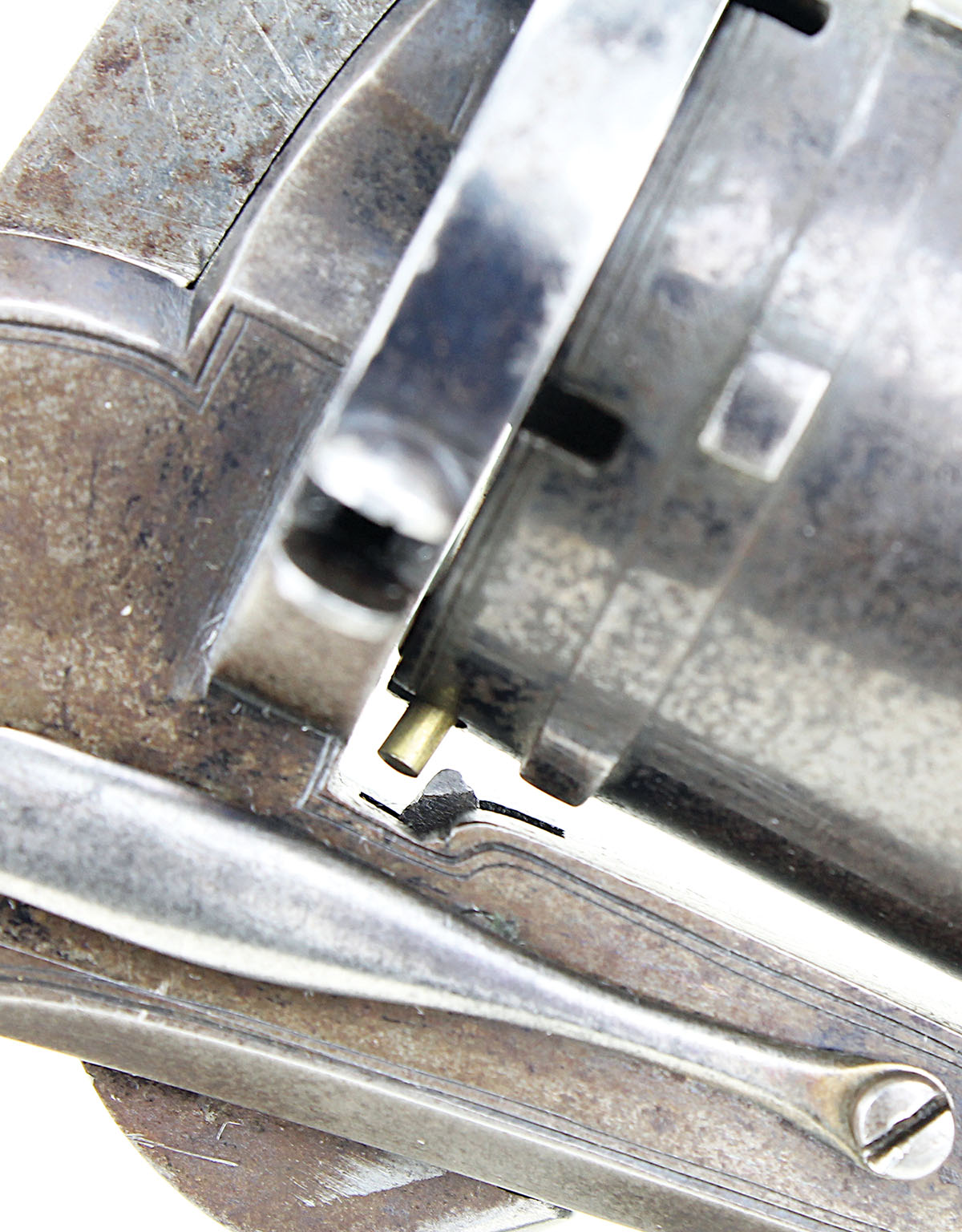
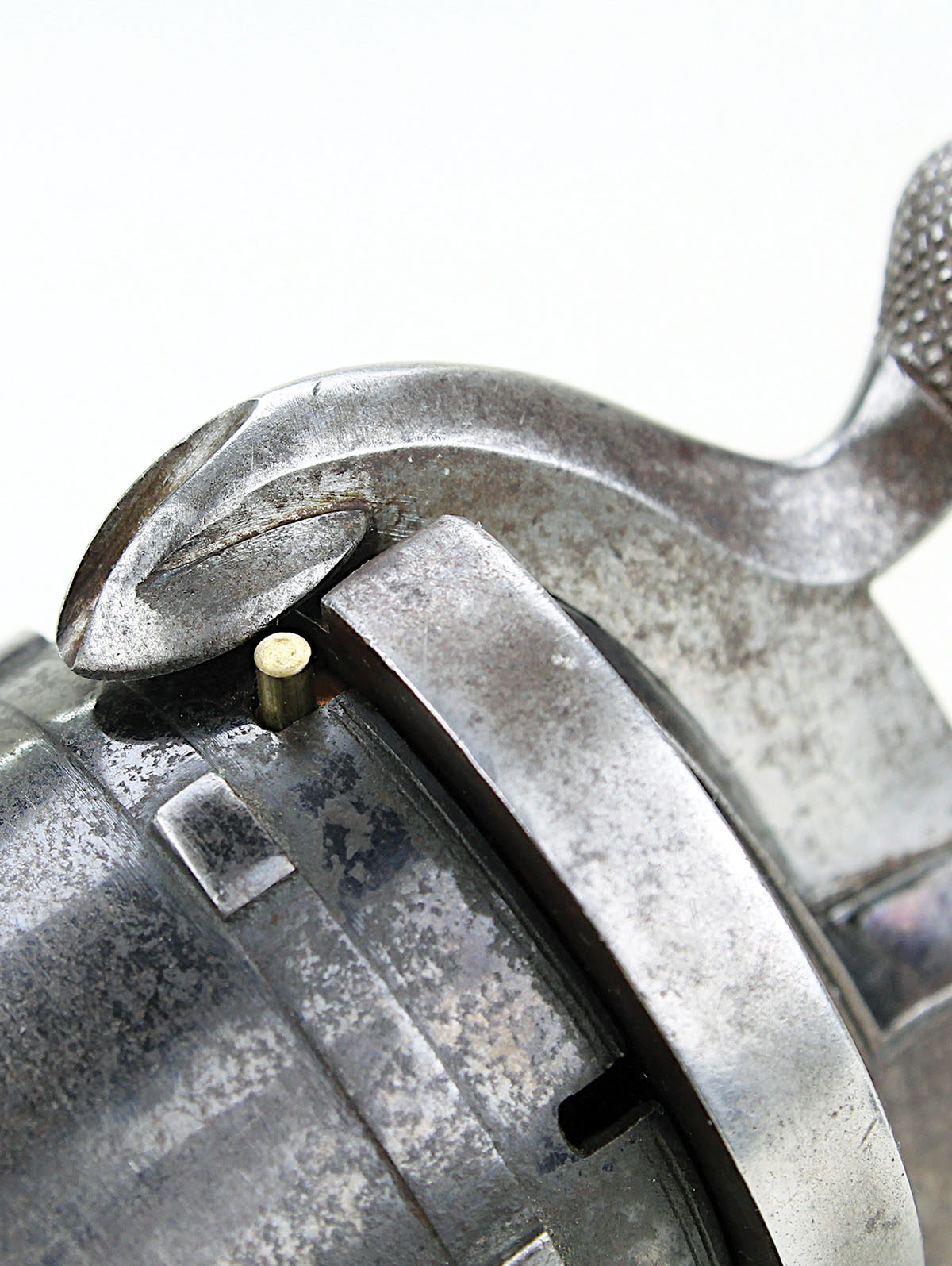
The frame below the cylinder is relieved to allow passage of the firing pins during cylinder rotation. Cylinders on modern revolvers have notches into which the cylinder lock rises to engage and lock the cylinder. Instead of a notch, this pinfire revolver has raised protrusions which the cylinder lock engages to lock the cylinder in place for firing.
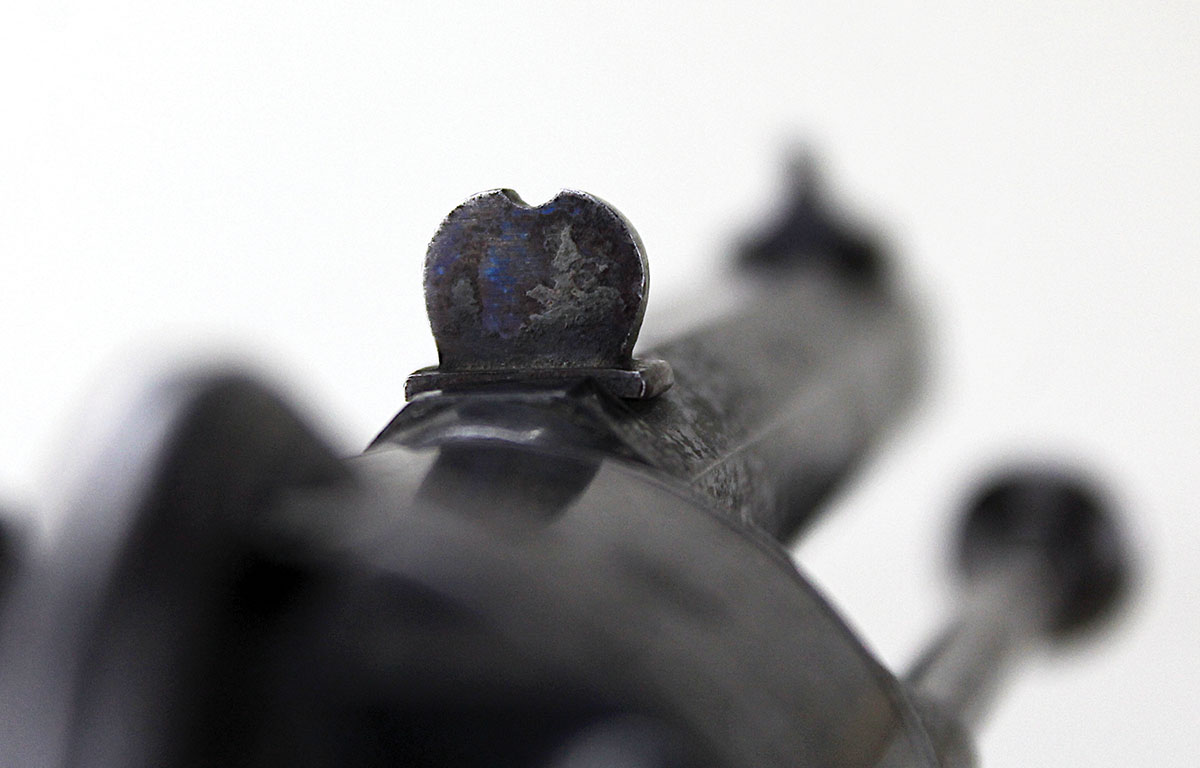
Because this is a double-action open-top revolver lacking a top strap, where to put the rear sight? Colt cut a groove in the hammers of his percussion revolvers to serve as a rear sight, visible only when the single-action revolver is cocked (as did Lefaucheux). Francotte elected to mount a fixed rear sight blade onto the barrel, necessarily tall to be visible over that large diameter back plate. I’m not sure why, but its shape appears rather Art Nouveau to me.
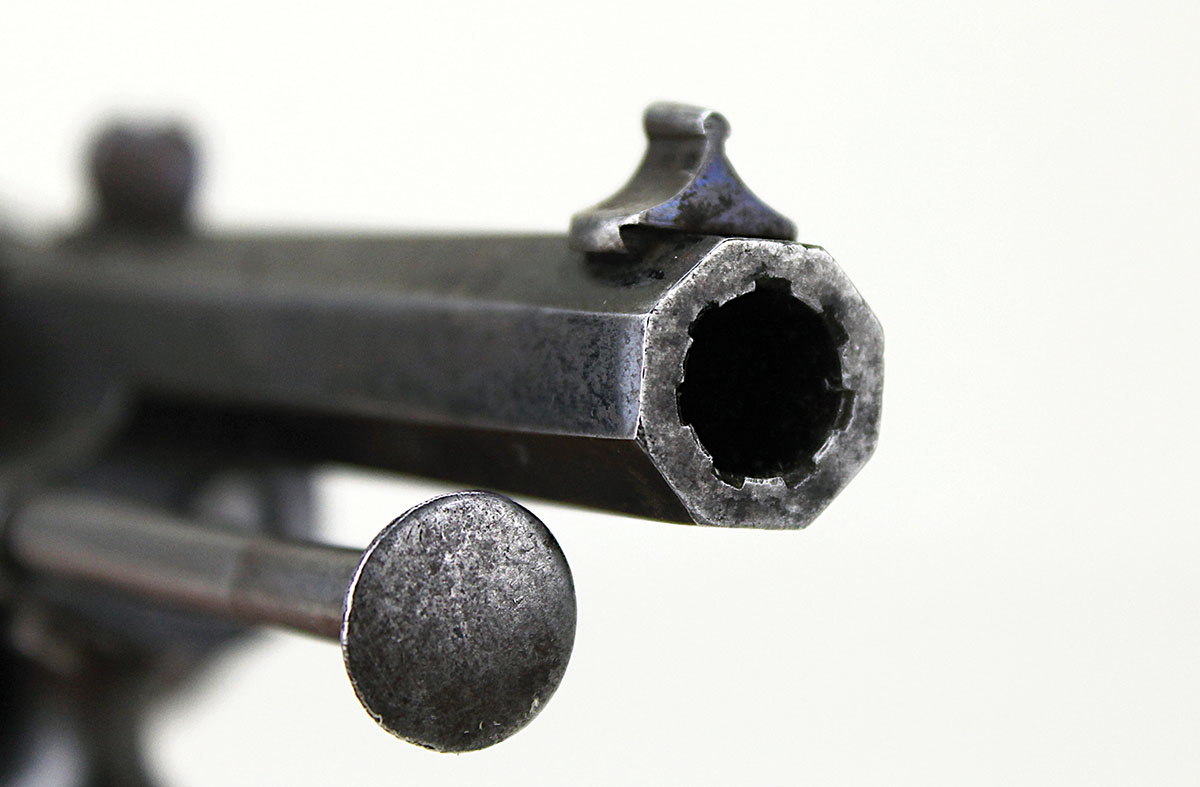
Examining the muzzle reveals deep-cut, very pronounced rifling of the bore, made obvious by the lack of any crowning. The uneven number of rifling lands and grooves (seven) makes measurement imprecise but, for what it’s worth, the diameter from groove bottom to land top measures 9.22mm while the diameter of the bullet driving band on the lone example 9mm pinfire cartridge here measures 9.45mm.
Surprisingly, reloading cartridges to shoot in this pinfire revolver is not absolutely out of the question. A patient, full-cuppa-coffee internet search eventually turned up a small company in France (hc-collection.com) that markets a 9mm pinfire cartridge reloading kit, including reloadable cartridge cases and extra firing pins. And one sharp, creative fellow has posted a step-by-step instructional YouTube video, very well done compared to most amateur YouTube stuff, on making 9mm pinfire cases from 9mm Luger brass and small brass rods. These videos can be found on the YouTube channel Rakum Projects. Both the kit and the DIY instructional utilize common No. 10 or No. 11 percussion caps and, of course, black powder.
While a careful inspection shows this Francotte revolver appears otherwise sound and I have confidence in the strength of its acier fondu containing the force of a small black powder charge, it is foolish to shoot any firearm known to have a mechanical problem of any kind. When one tempts the Fool Killer, one should not be surprised at a possibly unhappy outcome. This revolver, then, will remain retired unless and until I can resolve the issue with the non-resetting trigger, and how likely is it to find parts for a 150-ish-year-old Belgian pinfire revolver?