

Mostly Long Guns
Nosler’s Partition, Ballistic Tip and AccuBond Hunting Bullets
column By: Brian Pearce | December, 26
In 1946, Nosler was on another remote Canadian moose hunt with his beloved Winchester Model 70 chambered in 300 H&H Magnum. John suddenly found himself very close to a large bull moose in a willow swale. He wasn’t just close; he was too close, and John worried the bull would charge and gore him with its massive antlers. The bull was caked with black mud, which is common when they come out from feeding in the ponds, swamps and marshes, as they roll in the mud and it sticks like clay. Nosler pushed the safety forward on his Model 70, settled the crosshairs on the pocket behind the front leg, and fired the 180-grain bullet. The bull seemed undaunted and stepped forward while looking directly at John. He fired again, but there was still no reaction as he didn’t stagger or show any signs of being hit. The bull neither bellowed nor charged; instead, he turned away and trotted into the trees. John shot him again and again and finally saw him stumble slightly from the hit from the fourth bullet! Nosler reloaded his 300 H&H and fired again and again (and maybe more), but the bull finally succumbed. Upon skinning the old bull, it was clear that each shot was placed correctly, or should we say, exactly in the right place to hit the vitals, but most of the bullets had failed to penetrate and had literally splattered on the mud-caked shoulder.
The above experience was very disturbing to John, and he quickly realized that the jackets of conventional bullets combined with a soft-lead core were simply inadequate to provide the necessary penetration when pushed to magnum velocities on large animals. When you coat a 1,500-pound bull moose with clay-like mud, the problem is even further exacerbated but there was more to the story, as John reflected on some of his previous moose hunts wherein bullets did not expand and penetrated full length through moose and failed to kill in a timely fashion.
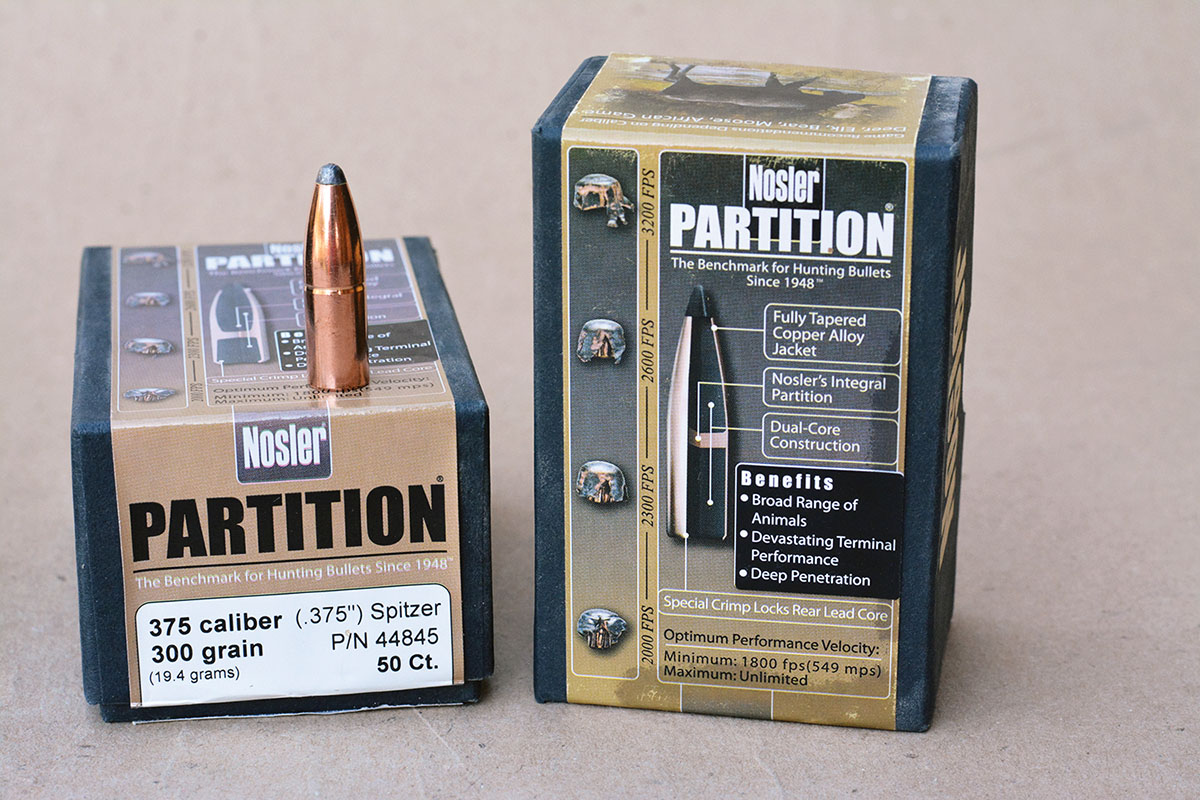
John was in business for himself, running trucking enterprises and related operations. He already had a lathe and a milling machine. John then purchased a screw machine and immediately began figuring out small details of making bullets. He began using a 5⁄16-inch copper rod, filling the cavities after machining with molten lead. They didn’t shoot very well, but they were good enough that in 1947 he and friends took these crude bullets hunting. They performed well on moose and offered the penetration John wanted. Nosler summed up the new Partition bullet performance by saying, “one shot, one moose.”
John tried to get major bullet and ammunition companies to make his bullet, but either it was too complicated for them to make, or the terms were not favorable. Ultimately, John realized that he would have to make them himself, applied for a patent, and began tooling up to make bullets. The Nosler Partition Bullet Co. was officially founded in 1948 and the rest is history!
The Nosler Partition soon earned legendary status among hunters, especially those taking larger species such as elk, moose, large bears and African plains game. It performed exactly as designed by offering the benefits of both rapid expansion and reliable deep penetration. It became the first truly premium big-game hunting bullet and remains hugely popular worldwide. It has been loaded by several European ammunition companies and became a standard offering in Weatherby factory ammunition during the early 1960s and remains a mainstay to date. Federal Cartridge began offering the Partition in the 1970s in its Premium Ammunition line, and it remains a widely popular load today. Winchester and several others have also offered the Partition in factory loads. You could say it has become the standard by which other hunting bullets are judged. To be clear, John corrected the accuracy issues associated with his pre-production test bullets, and over the past 78 years the Partition has been regularly updated in the manufacturing process, technical aspects of the design and materials, and precision.
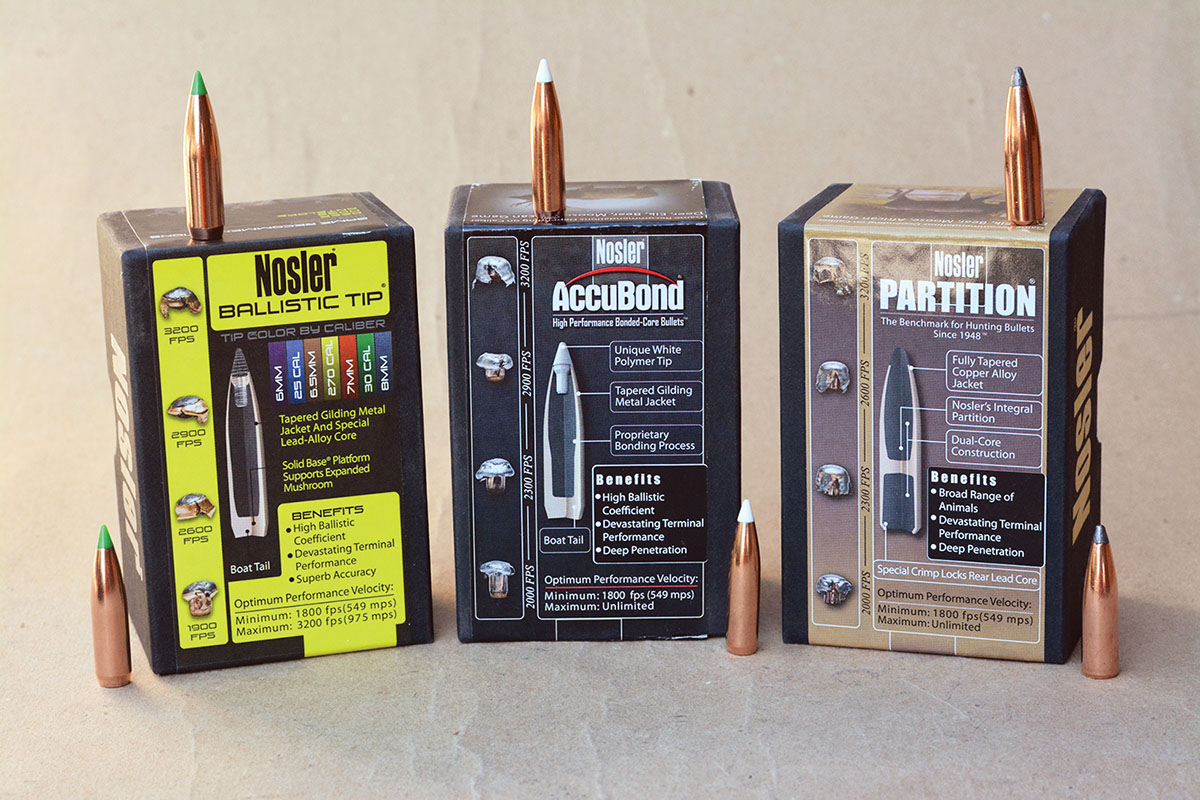
Despite its gold standard status, the Partition had a couple of drawbacks. First, it was not inexpensive and certainly not a plinking or practice bullet. Second, on lighter species such as whitetail deer, hunters wanted a bullet that expanded even faster and more dramatically. In 1972 Nosler, to meet this demand, introduced the Solid Base bullet that was not of conventional design; rather, it featured a tapered jacket and boat-tail with a thick solid-copper base. It was made with precision, proved very accurate, offered rapid expansion on deer-sized game, cost less and quickly became very popular.
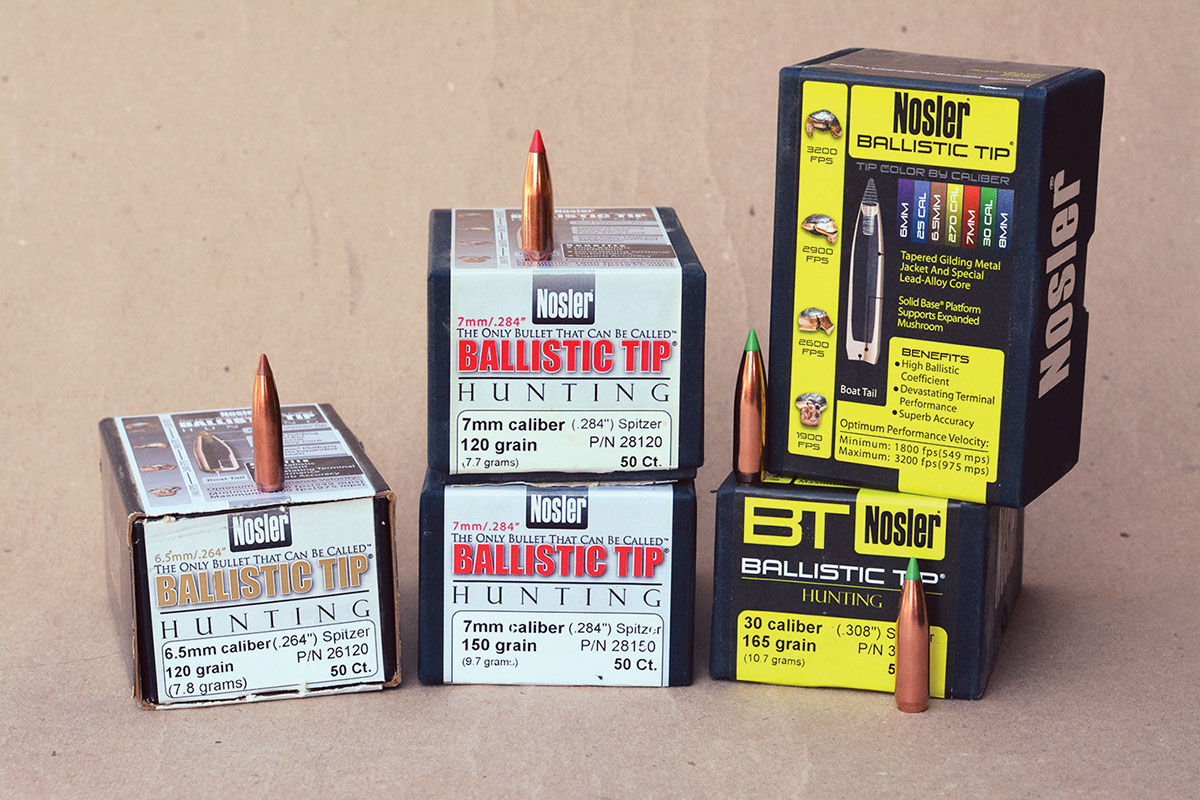
Technology is continual, and in 1984 Nosler redesigned the Solid Base to become the Ballistic Tip that featured a polymer inserted tip to prevent the spitzer profile from being battered in the magazine. This feature also increased the ballistic coefficient (BC) and made it more consistent from bullet to bullet, which is important for long-range work. The polymer tip also facilitated rapid expansion even at lower velocities. The jacket was also tapered to control expansion and increase weight retention, and it retained the solid base design with a boat-tail. Not only was accuracy outstanding, like a match bullet, but the new Ballistic Tip has become overwhelmingly popular with deer hunters. With a typical broadside shot on deer, antelope, and similar game, it is absolutely devastating to the soft tissue such as heart and lungs and results in incredibly fast, lightning-like kills.
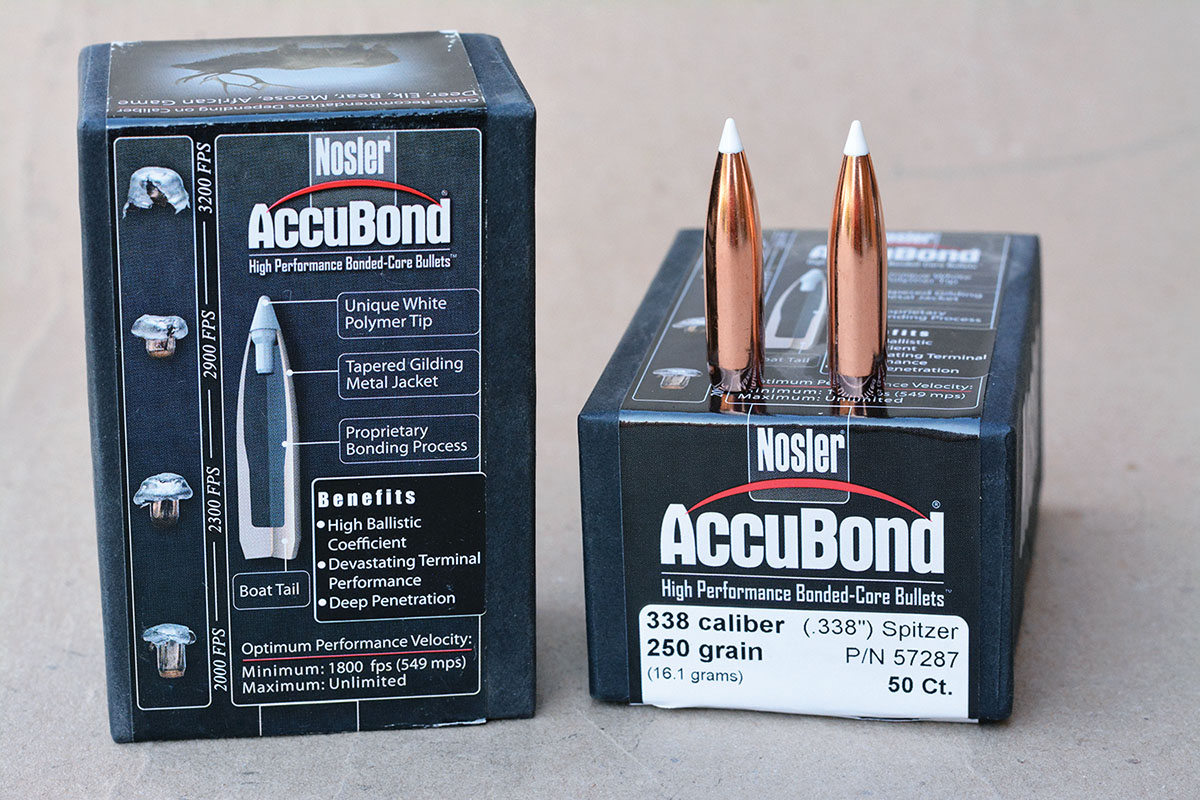
The difference between the performance of the Partition and the Ballistic Tip left something of a gap. In other words, a bullet that would offer better penetration than the Ballistic Tip, but still do severe damage to the lungs and offer a similarly high ballistic coefficient (BC) would be a great option for hunters. If it could accomplish these things, it would be a candidate as the ideal all-purpose bullet for taking thin-skinned animals under a variety of conditions and distances. This became the AccuBond in 2003. As its name indicates, the core and jacket are bonded together to prevent bullet fragmentation and achieve deep, straight-as-an-arrow penetration. To further assure deep penetration, the rear portion of the shank is notably thicker, which, combined with the bonded core, gives excellent penetration. Like the Ballistic Tip, the
AccuBond features a polymer tip, but is only offered in white, whereas the Ballistic Tip’s polymer tip is color coded by caliber. It retains the solid base design with a boat-tail and provides a high BC that mirrors the Ballistic Tip.
In early 2003, I was forwarded samples of pre-production AccuBond bullets and promptly loaded them in several different .30-caliber cartridges and found them to be consistently accurate; in mediums they showed great promise. I was excited to try the new bullet in the field and loaded a quantity of 200-grain samples in my old Winchester Model 70 chambered in 300 H&H Magnum that would stack five shots into under a half inch at 100 yards with my handloads. I headed to Africa, where they were used on many baboons at distances over 500 yards with great success. They performed well on zebra, wildebeest and warthogs, all known to be tough, as well as impala, jackal and other species. Their performance on game was very interesting, as they offered a blend of significant soft-tissue destruction and respectable penetration. For example, they fully penetrated several impalas and wildebeest, with penetration hovering at 18 to 20 inches.
While the AccuBonds worked very well on a large variety of game, perhaps the most memorable was an 11- to 12-foot-long black mamba that was shot at the longest distance that I ever killed a snake!
I was hunting greater kudu but had passed on the bulls we were stalking. My Professional Hunter (PH) and I found ourselves on the top of a very rocky and brushy mountain, glassing for game. A den of hyraxes were running around playing on a large rock (about the size of an average house with a flat top) 120 yards below us. Suddenly they all disappeared. The PH thought a lion was coming, but suddenly we spotted a large snake quietly making its way up the offside of the rock. I really don’t care for poisonous snakes, especially those that are aggressive, with venom that works on your nervous system and can shut down your vitals in minutes when bitten. To make it worse, the black mamba is generally considered the world’s fastest snake, with sources claiming speeds of 15 mph! I asked if they were legal to shoot, and the PH responded, “Yes, but I have no idea how we would go down there to shoot it.” I might not always have a high level of self-preservation, but I sure as heck was not going to go nose to nose with a black mamba.
I rolled up my coat and went prone, while the PH laughed at my comments and realized I was absolutely going to kill that snake at 120 yards. I put the crosshairs about 2 feet below his head and squeezed the trigger. The AccuBond flew true and crumpled the snake, flipping him sideways off the backside of the rock. The ticklish recovery is a story in itself, but this was the farthest I have ever killed a snake, and that mamba is a special trophy in my front room.
With growing interest in ultra-long-range cartridges, the AccuBond Long Range was developed, featuring super high BCs, but it does not replace the original version.
I became friends with John Nosler during the 1980s. He was genuine, energetic, highly intelligent, friendly to everyone, and in spite of being a living legend, was very humble. He was truly a remarkable man who pioneered premium hunting bullets and built a family-owned and operated business that is world renowned for ultra-high-quality products that now includes ammunition, rifles, cartridges and many other innovative products. John remained very active – working, hunting and innovating new products virtually all of his life – and passed away at the age of 97 (1913-2010).