

Walnut Hill
Grass Before Breakfast
column By: Terry Wieland | December, 26
The name Walter Winans is not on everyone’s lips these days, but 120 years ago he was a well-known competitive pistol shooter, author and general self-promoter of a type that infested the late Victorian era.
Winans’s claim to fame was Olympic pistol shooting in the early years of the Olympic revival, and he rode the publicity, cashing in with books on, first, revolvers (1900) and, later, semiautomatics. In the latter case, he became a devotee of the Colt 1911, and in 1917 predicted that the day of the revolver was over, that in ten years they’d be out of production, and it was pointless to learn to shoot one.
If he was a committed futurist in one way, however, he was definitely an anachronist in another. In The Modern Pistol And How to Shoot It (1919), he devoted six of its 63 chapters to the practice of duelling, beginning with “Is Duelling Wrong?” and concluding with “How to Prepare a Novice in Half an Hour for a Duel.”
In another of his seven books, this one on deer hunting, there is a chapter called “In defence of duelling.” Obviously, it was a subject Winans felt strongly about. He was all in favor.
“Just as war is necessary, so is duelling necessary,” he wrote. “Duelling is to the individual, what war is to the nation.”
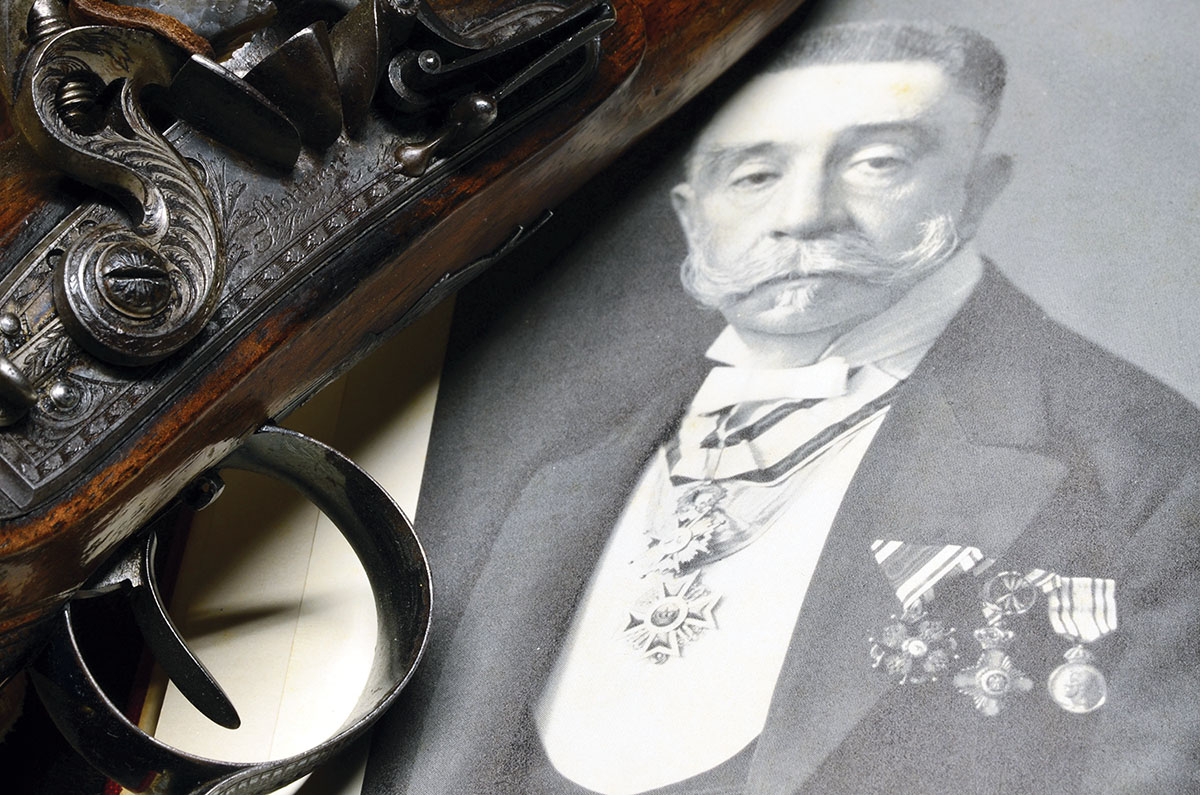
Suggesting that war is necessary was not a popular opinion in 1919, with troops coming home from the hell of the trenches, scarred for life, and entire countries in ruins, but Winans was never afraid to voice an opinion. Although he was an American, from a wealthy railway family, in his photos he appears very European with a bushy, carefully manicured mustache and wearing his every medal, of which there were many, including Olympic gold and various awards from different Euro
pean monarchs. He seems to have modeled his appearance on Emperor Franz Joseph, and some of his views on society would not have been out of place in imperial Vienna. One concerned duelling, a practice that was tolerated on the continent long after it fell into disapprobation in the English-speaking world.
Winans felt that a simple, man-to-man confrontation with pistols in hand was a vastly better response to an insult than hiring a lawyer and going to court.
At the time, the two favorite weapons for duelling were the pistol and the sword. In the case of the sword, much more skill was required, skill gained only after years of practice. The pistol, on the other hand, could be mastered to a suitable level in a relatively short time, and so was usually chosen by the injured party, who had a choice of weapons.
So common were duels in Europe that training academies prepared young men for the inevitable. At some point, they figured, he’d accidentally insult a lady or laugh at the wrong time and would find himself up before dawn and transported to a secluded venue, there to face “grass before breakfast.” Any prudent youngster, it was felt, should learn to handle a pistol, just in case.
The most famous such academy was Gastinne-Renette in Paris. It was a well-known gun shop off the Champs Elysées, founded in 1810 by Albert Renette and Louis Gastinne.
It bought and sold guns, had guns made under its own name (Gastinne-Renette), and had a shooting range in its basement. Gradually, it expanded into hunting guns, pistols for self-defense, and rifles for target shooting. It never, however, lost sight of its roots, and those roots were pistols, duelling and the practice thereof.
Around 1950, American writer Lucian Cary flew to Paris with a photographer to pay Gastinne-Renette a visit and learn about the state of duelling in modern France. Cary was gun editor of True, and the fact that a magazine would pay for a writer and photographer to fly to Paris on such an assignment says something about both the magazine business back then and Cary’s stature in the industry.
At any rate, he spent considerable time with the then-director, named Gastinne Renette (it became a family custom to combine both names, and you see it both hyphenated and not) who advised him on the state of duelling in France, and provided the wherewithal to practice the shooting. This involved traditional duelling pistols (blackpowder muzzleloaders) as well as protective clothing and targets in the profile of a man one would see when fighting a duel.
Cary also found a man named J.J. Renaud, a novelist and champion fencer, a member of the Legion d’Honneur, and the acknowledged “director of duels” in France. He told Cary he knew of at least 20 duels that had occurred the previous year. There is no law against duelling in France, he said, but if a man died it would be considered murder.
“Ah, but…” M. Renaud continued, if it came to trial and the defence was presented correctly, “there would undoubtedly be an acquittal.” As well, he added, there were circumstances, such as when a lady’s honor was concerned, or a case of a husband killing his wife’s lover, when charges were unlikely and convictions unheard of. Ah, the French, the French.
Entire volumes have been written about duels, duelling and duelling pistols over the past two centuries, and many mistaken beliefs have found their way into the popular imagination. In many ways, though, the truth is stranger than the fiction. For example, the practice of “deloping,” or a duellist deliberately discharging his gun into the air, happened very rarely and, when it did, was often considered yet another insult to be avenged.
In France in the 1950s, seconds, those who loaded the pistols would vary the powder charge, and thereby the force of the ball, commensurate with the outrage being avenged. You scolded another man’s dog? Light load, low velocity, minor wound, if any. You were found in bed with the man’s wife? Full powder charge and curtains if the ball hits in the right place.
Where most duels in England or America were shot at close range – 12 paces being the usual in France – they shot from 25 meters or more, thereby reducing the chance of hitting anything.
Practice for duelling was as regulated and formalized as the duel itself, using guns loaded with wax balls, and the opponents wearing masks, heavy protective clothing, and a guard on the pistol similar to that of an epée. As with many such activities, fencing being a prime example, the practice became a sport or pastime in itself. Lucian Cary was a shooting fool if ever there was one, but he found the costumes, customs and even the gun to be uncomfortable. Having done it once, he had no desire to do it again, although he confessed that he would like to have spent the afternoon flinging wax balls at his “opponent” just to see if he could finally hit something.
In the end, Winans and Cary came to opposite conclusions about duelling. Cary ended his article in True, “The muzzle-loading pistol (has) no more place in the modern world than the longbow or the lance. They belong to the past. So does dueling.” Winans, conversely, buried in his six verbose chapters, leaves no doubt that he believed duelling should be not only legal but widely practiced as a quick, fair and final way to settle a dispute, with the threat of such an outcome leading to a more civil society.
Much as I admire Cary, and in spite of my reservations about Winans, I have to agree with him that in many cases it would be vastly preferable to the courts.
One way of judging modern thinking on duels is to look at how duelling pistols stack up in the world of gun collecting. The fact is that cased pairs of duelling pistols by such masters as John Manton and Robert Wogdon are one of the fail-safe corners of collecting, along with Colt Peacemakers and Hawken rifles.
Over the past half century, all three have scaled heights of value with nary a decline in either interest or price. Does this mean gun collectors long to face angry grizzlies in Colorado, or walk the streets of Laredo, or face a chilly morning with the prospect of grass before breakfast?
That’s a question to which I have no answer, but hefting any of the above, I suspect every man would picture himself in such a situation, and wonder exactly how he would acquit himself. I know I do.