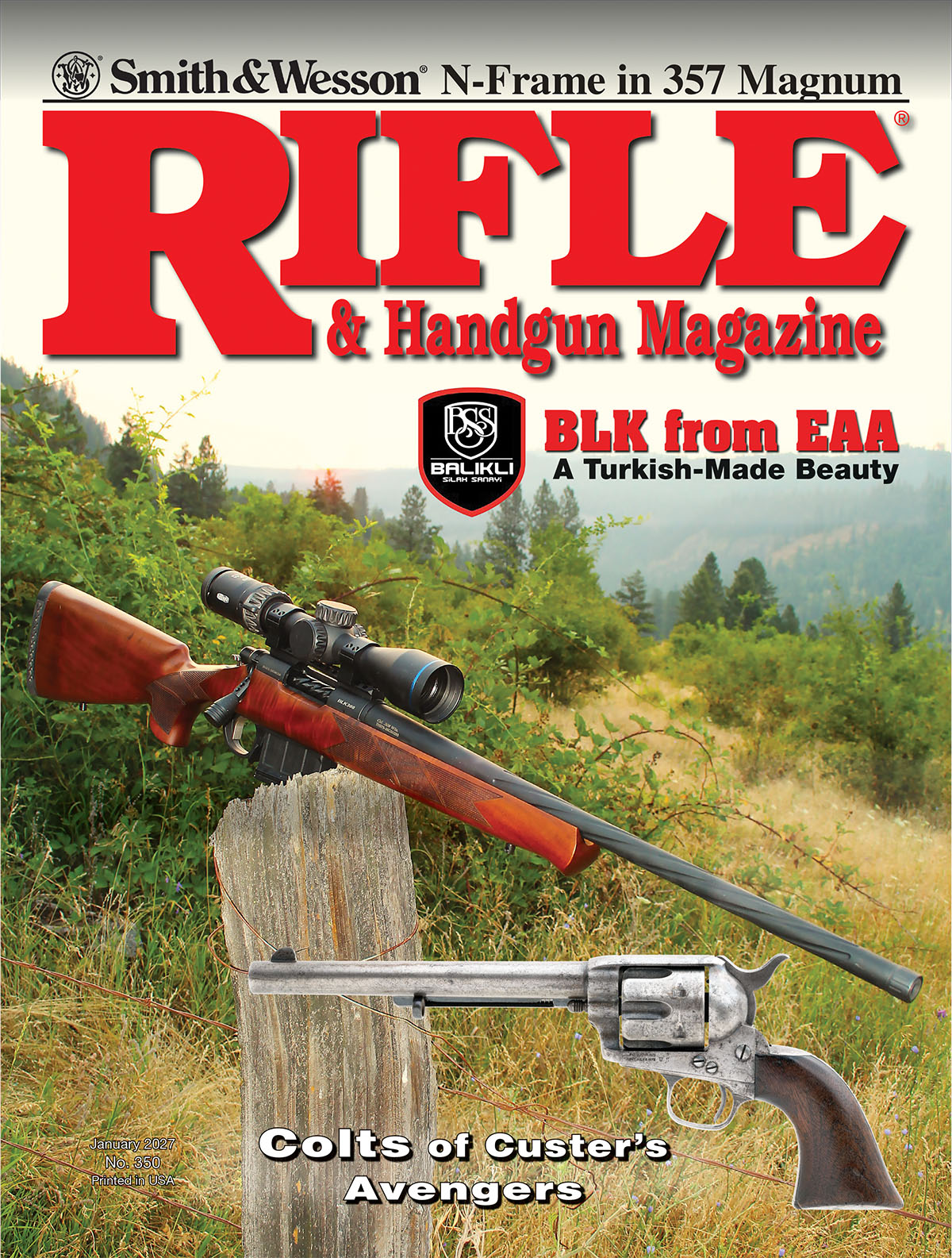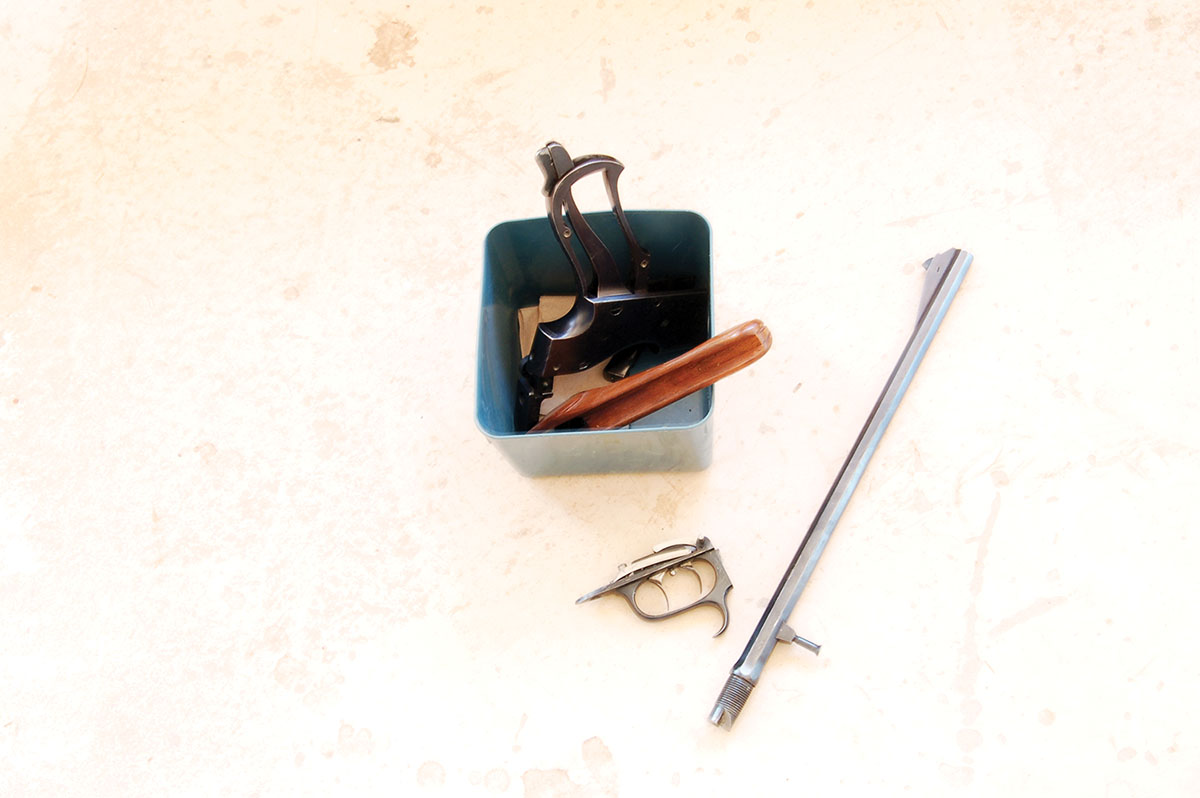
Gil’s pistol was a box of parts and a barreled receiver. The barrel was also loose in the receiver.
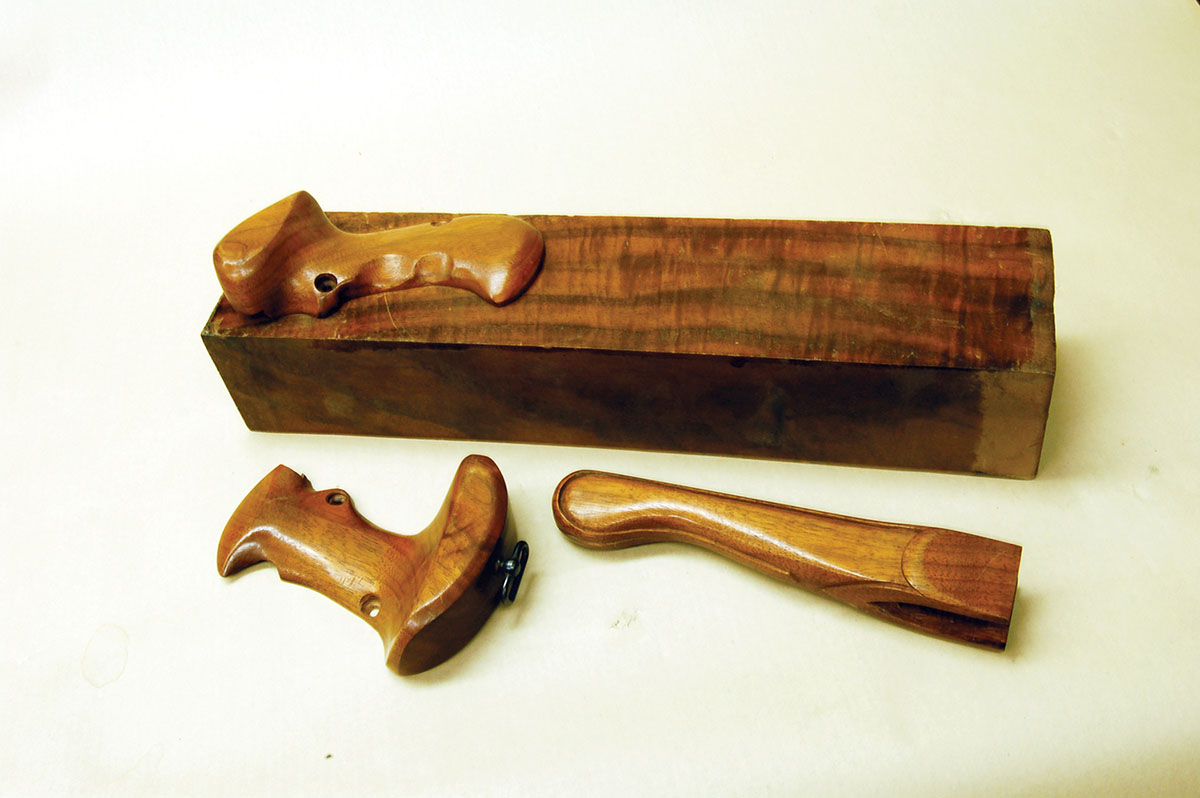
New stocks and forearm will be made from a blank. Stocks shown are not original.
Folks collect, or simply accumu
late old handguns for many reasons. Pistols are small. A couple of dozen, each in its own soft case, easily fit in the bottom of a small gun safe. Then you can easily carry one or two around a gun show, hoping to trade for something else to play with. Handloading rare or no longer available ammunition is great fun as well. Such shooting teaches a lot more about historical guns than the modern idea of a heavier bullet, more powder and higher velocity that can strain or damage revolvers made before World War II.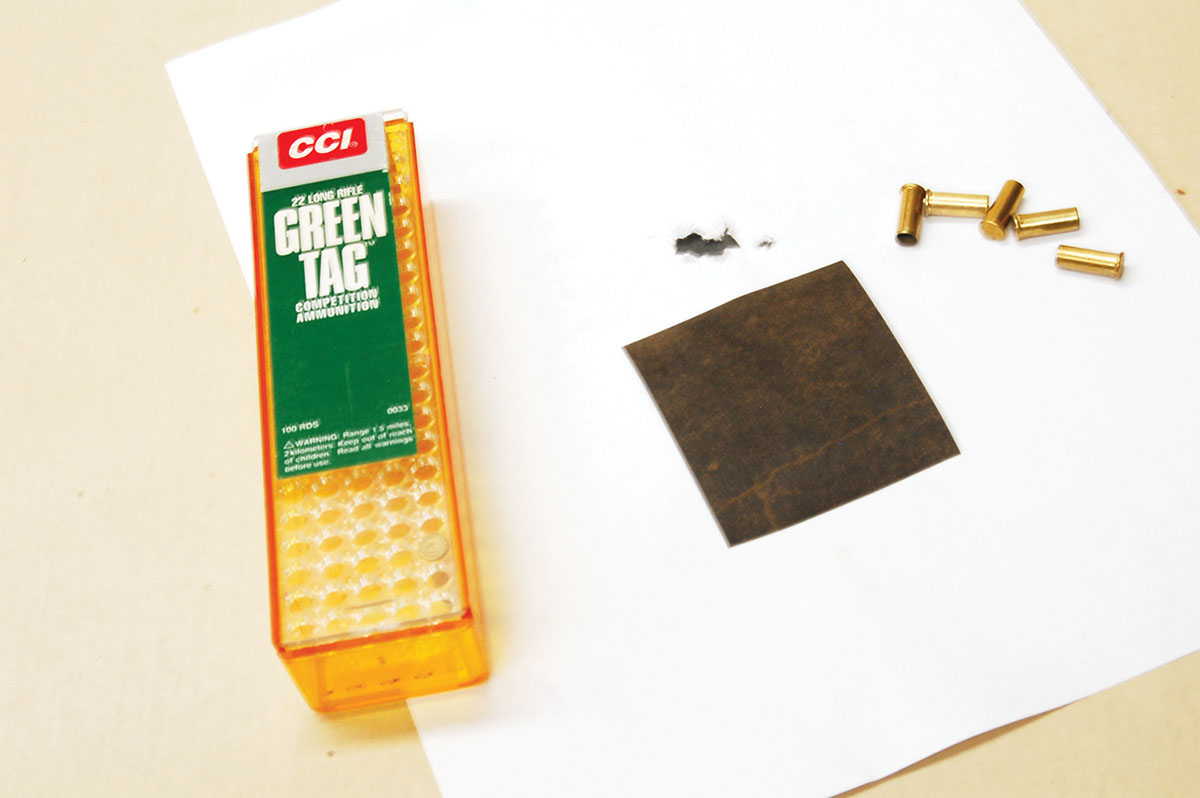
Initial group from Scheibenpistole after assembling the box of parts. The barrel is still loose; note the wild shot.
Many categories exist in antique handgun collecting. One seldom mentioned is that of target guns. When most folks think of such guns, they envision an autoloader, falling plates, bowling pins or some type of run-jump-and-shoot contest. While targets are being shot at here, this is not what is meant by target shooting. Students of handgun history know the targets are sheets of
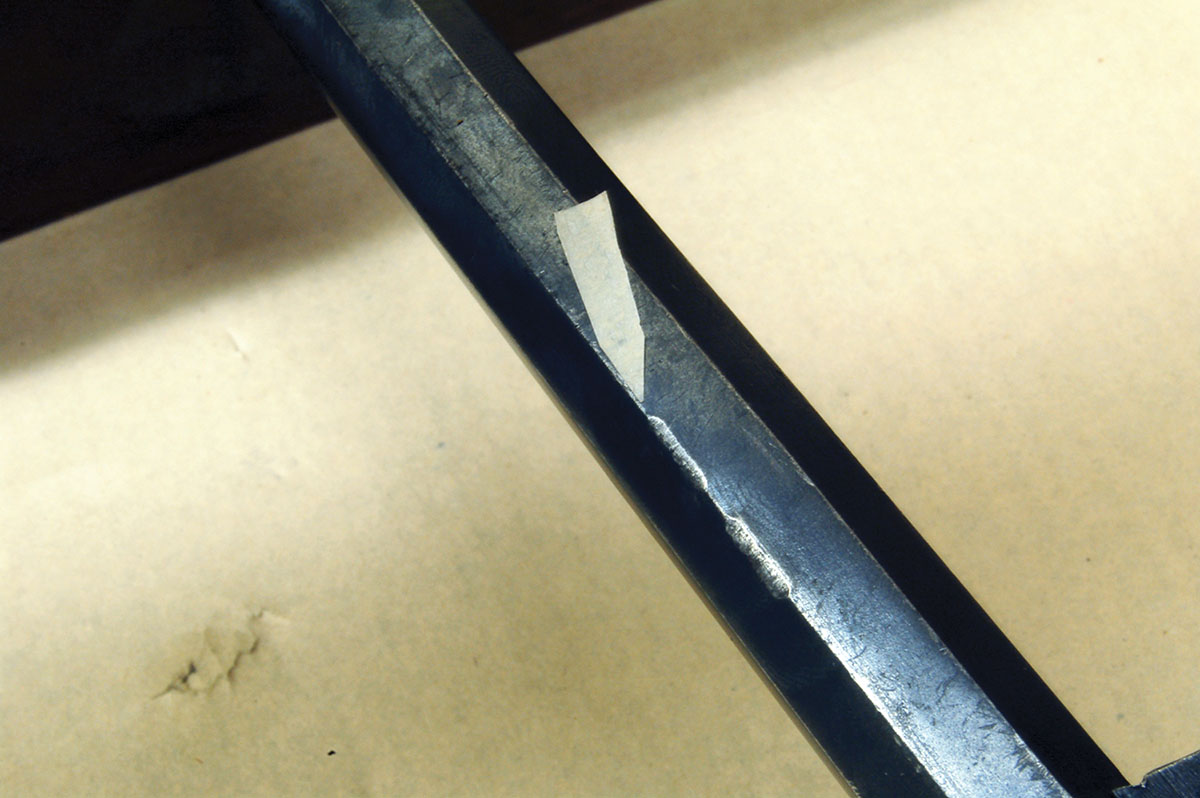
Two flat spots on the edge of the barrel flats indicate trying to turn with a Crescent wrench. The barrel was held by a lock screw.
paper with round, black aiming points printed in the center.
Information on the history of bullseye target shooting with handguns is hard to find, perhaps because its heyday was from 1880 to about 1930. When I was growing up (1950s), the local libraries had at least five feet of shelf space containing
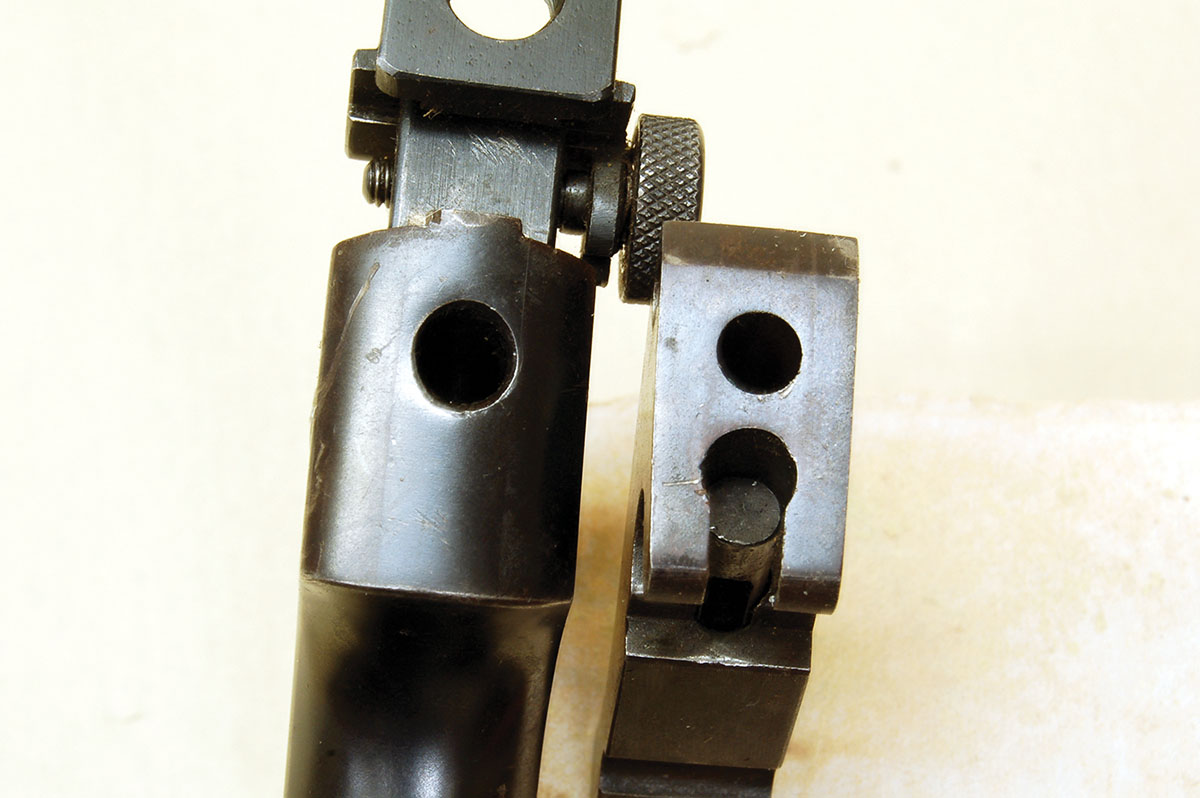
Holes through the rear of the receiver (left) and breechblock (right) allow passage of the cleaning rod when the action is open.
gun-related titles. There was little on handguns except learning to shoot them, early hunting stories and tales of destroying now scarce and valuable revolvers by overloading them in an attempt to gain 100 feet per second (fps) over factory loads. Today the shelves contain twenty feet of graphic novels (comic books) all trying to
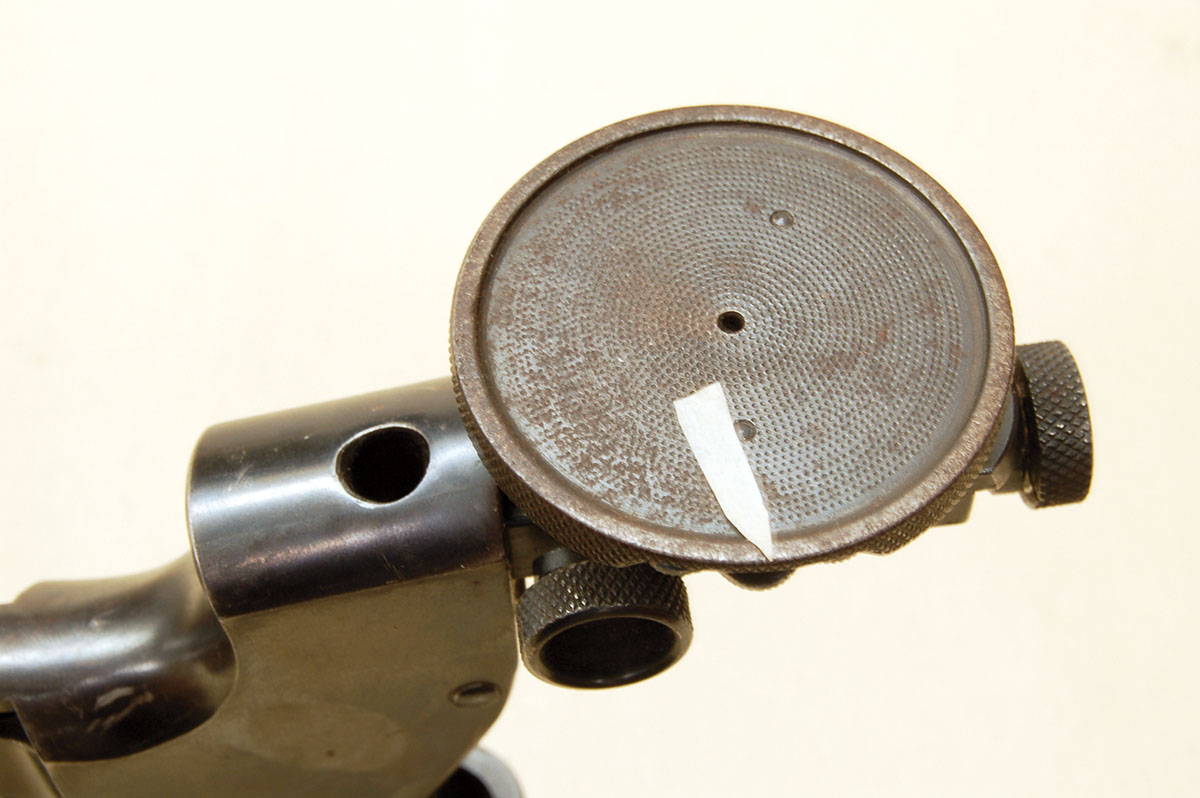
Aperture sight with rotating selector (arrow) gives .040- to .055-inch diameter hole sizes – useless on a handgun! Why is it here?
legitimize behavior normal people consider sick. There are no handgun books.
A lucky find is a copy of a handgun book originally published in the U.S. from about I890 to World War I that contains a little on target competition. It shows a photo or drawing of a standing competitor dressed in a suit, tie and hat, who probably needs a shave. He will have a big S&W No. 2 or Colt Bisley revolver gripped in his hand on an extended right arm. Cartridges will be 44 Russian, 44 Special and 45 Colt. Matches required 20 to 50 shots
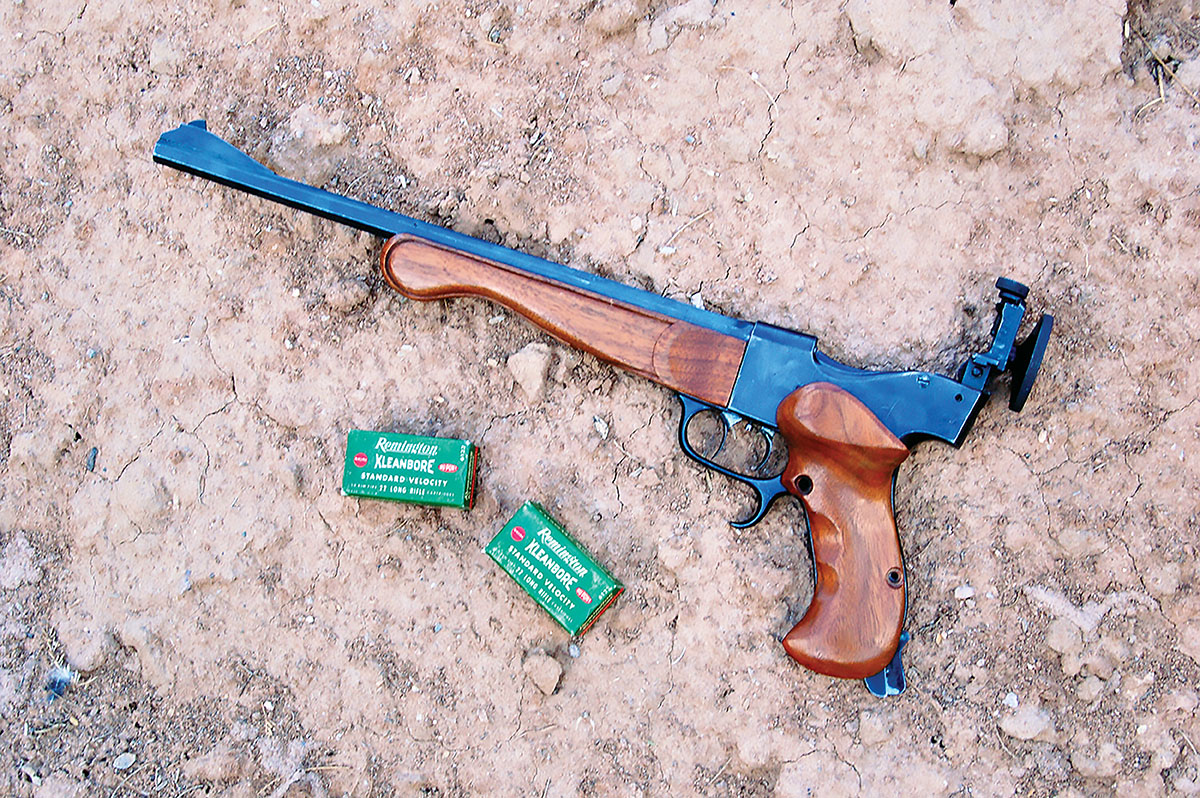
The fully-assembled Scheibenpistole. Fortunately, all parts were in the box except the grip screws.
at 50 yards in any weather. Most shots landed within 1.5 inches of dead center on the target. It was a test of endurance as well as
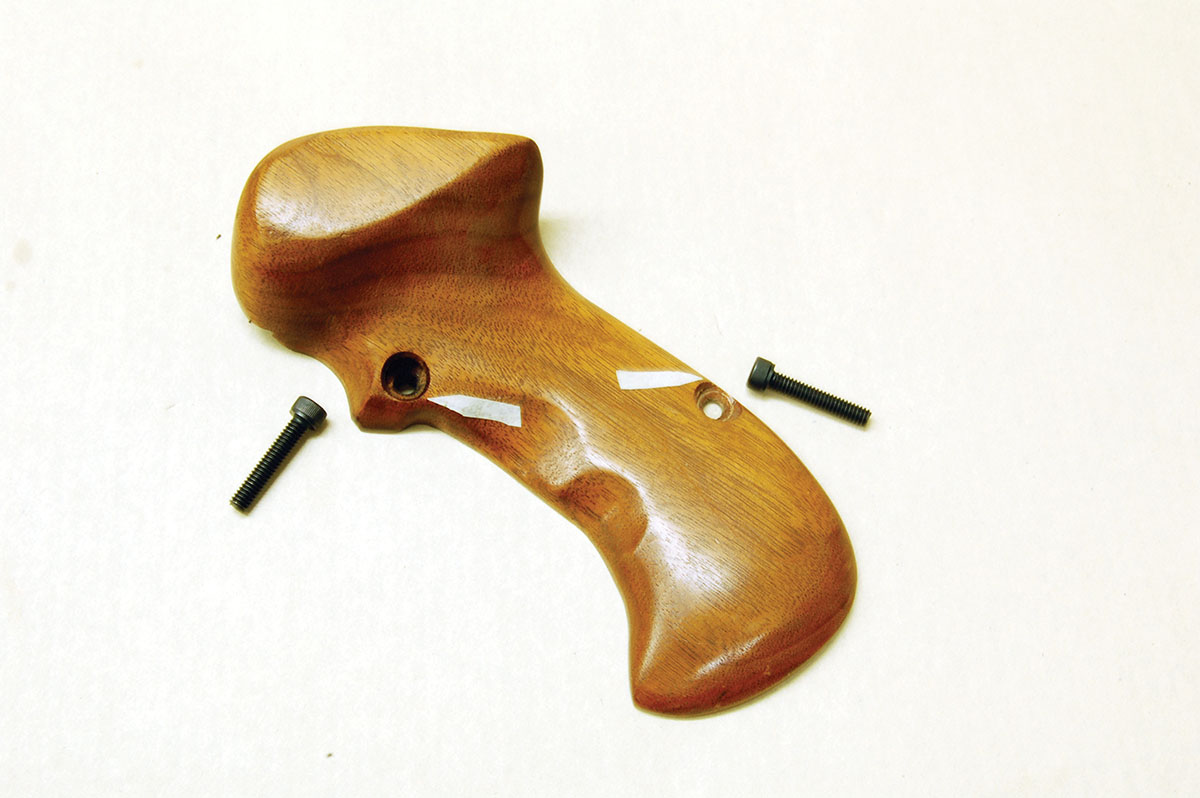
Steel escutcheons (cups to hold screw heads) will have to be made to prevent splitting of wood at the arrows.
marksmanship.
As centerfire ignition was perfected, many other countries began holding shooting matches for handguns. In at least Germany, Switzerland and Austria it was decided that a hole in a paper target was a hole. It didn’t have to be made by a 200-grain-plus bullet from a military cartridge. Yet the only readily available cartridges were the 22 BB Cap (1845) and 22 Short (1857). Both were available only in inexpensive single-shot rifles and pistols that could hardly be
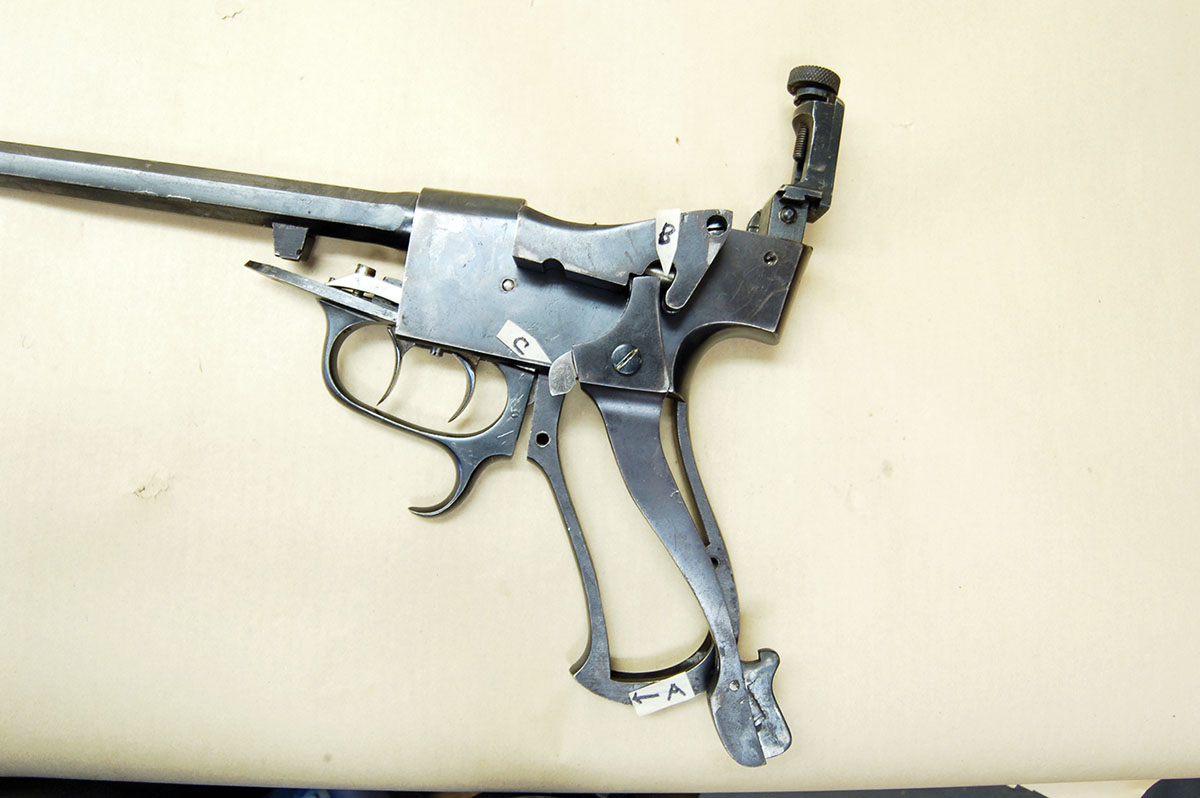
The simplicity of the Martini action can be seen here. Pushing forward on the cocking lever (A) moves the cam (B), dropping the breechblock, cocking the firing pin and engaging the sear (C).
called target arms. Accuracy fell off noticeably beyond 10 meters (yards).
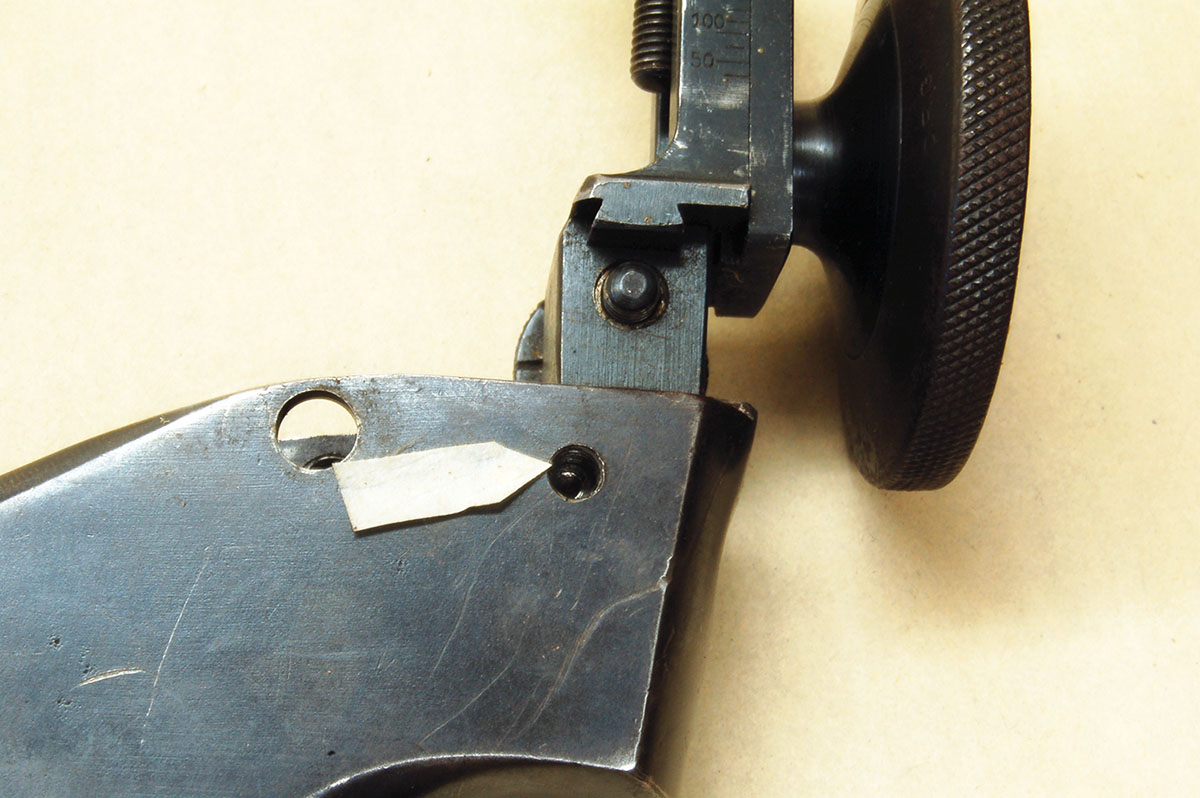
The large aperture rear sight must be original, as it is locked in place by a set screw (arrow) that also twisted off down in the hole.
Everything changed at the turn of the twentieth century. The appearance of smokeless and semi-smokeless 22 Long Rifle rimfire cartridges set off a surge of target-pistol building in the German-speaking countries. Surprisingly, these guns were built on actions that were basically scaled-down copies of full-size Schüetzen rifle actions, complete with double-set triggers. The cartridge was 22 LR only, with no limit on gun weight, barrel length or trigger pull weight. The target was set at 50 meters. Firing was done standing with the pistol held in one hand. This is the gun and discipline that created the free pistol (free of restrictions) in Olympic and international competition. Today, the German word for target pistol, Scheibenpistole, means the
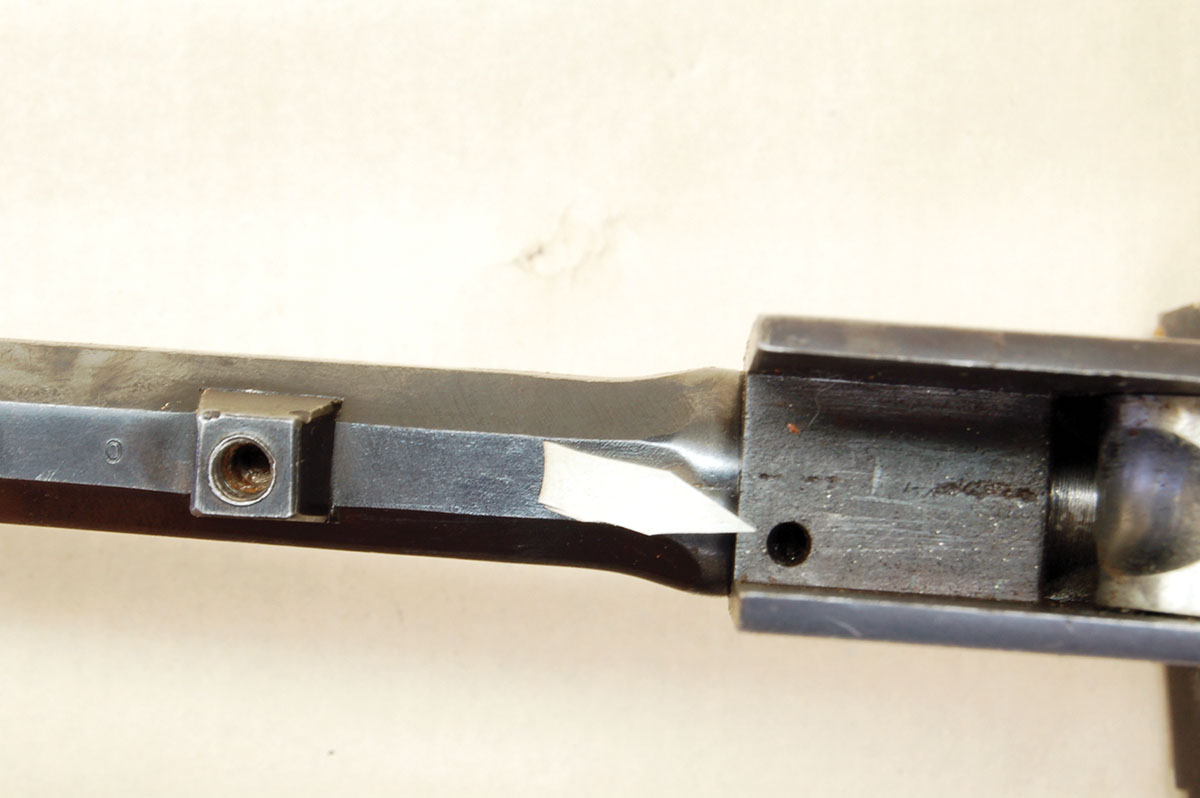
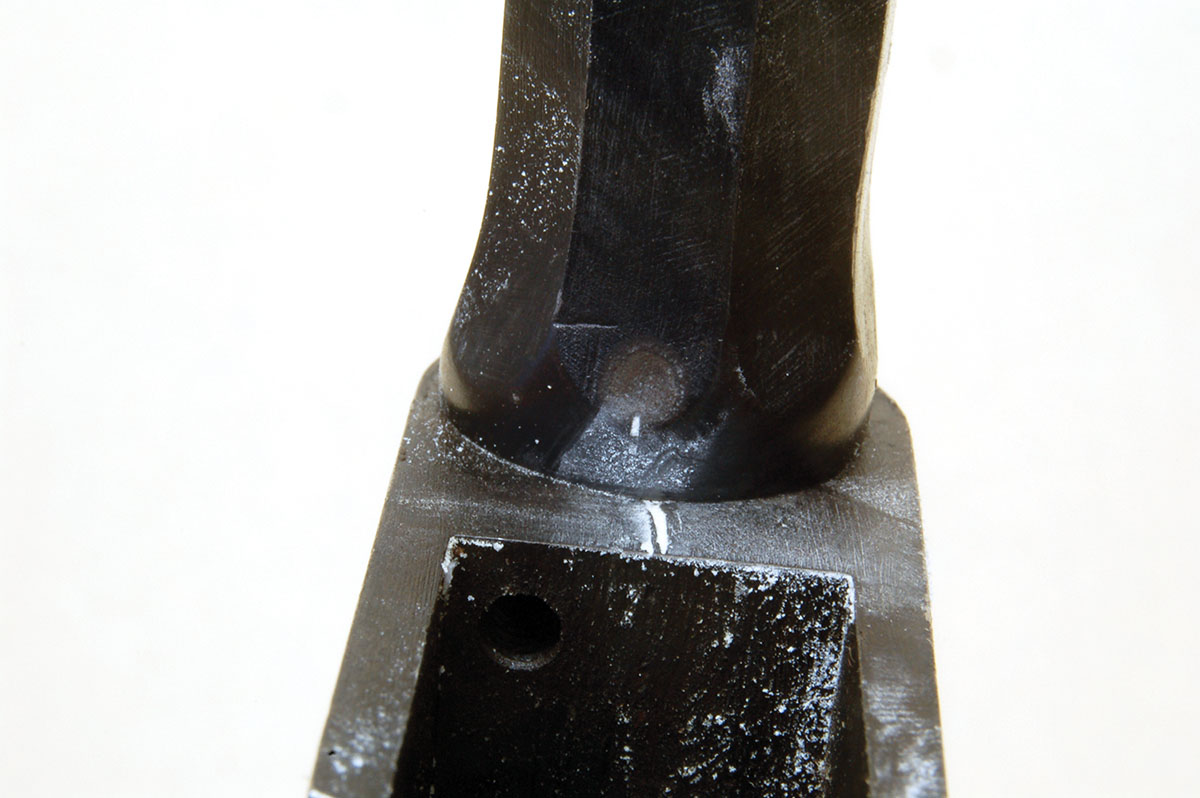
The receiver has a hole for the barrel set screw, which is broken off down in the hole, leaving the barrel a bit loose.
same thing.
This is one of those categories in handgun collecting mentioned
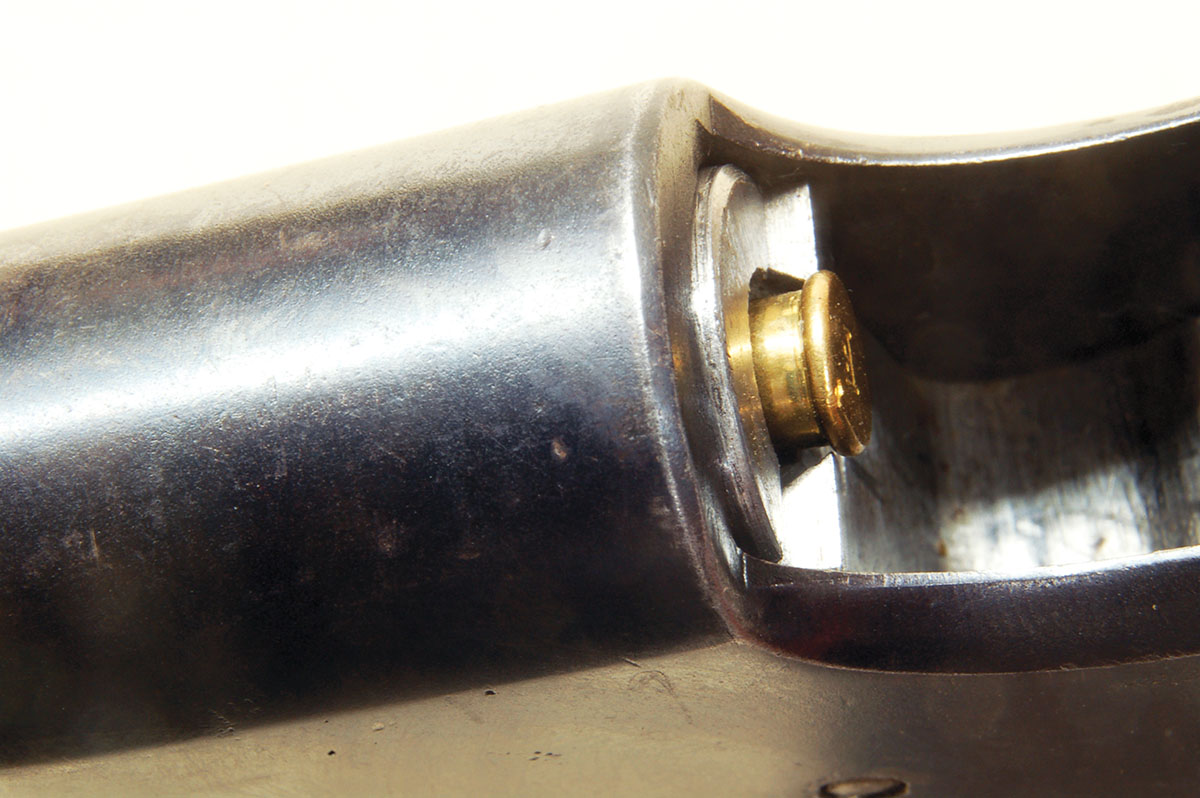
The Martini extractor is strong, smooth operating and contacts one-half of the case rim.
earlier. However, not only is it not popular, but many pistol shooters/collectors have never seen a pre-World War II single-shot German 22 LR target pistol. This is beginning to change as Internet sales expose a huge audience to guns they didn’t know they wanted until they saw them. The pistol shown here, however, was purchased locally from an acquaintance who said he didn’t know what to do with it and that it was “partially disassembled.”
The pistol turned out to be a box of loose parts and a barreled Martini receiver with the front sight off-center to the left, but it
The witness mark on the frame and the dot on the barrel do not line up, the barrel screws into the frame too far and the front sight tilts to the left. Why is this?
was a real custom-built Scheibenpistole with perfect bore and no markings except two German proofs.
The barrel was also loose in the receiver, moving past the witness mark on the receiver about .125 inch. This made no sense until a hole was noticed in the bottom of the receiver ring. In it were threads down to the twisted-off top of what could only be a set screw for the barrel. Was this a switch-barrel gun? Never heard of, or could find any reference to, such a feature on this category of pistol.
After determining all the parts of the gun were in the box, something had to be done with the loose barrel so meaningful accuracy tests could be done. The bore showed no rifling cutter marks, indicating it had been lapped. Lands were sharp, and a tight patch seemed to push tighter at the muzzle. A bit of choke lapped in? Also, the barrel would not screw out! The broken lock screw had to be removed.
Normally, twisted-off screws occur in scope bases or rings. If only the head is broken off, that’s good because the rest of the screws can be removed and the part lifted off the rifle. Hopefully enough of the broken screw shank will remain to get hold of to turn out. If the screw breaks off flush with the receiver surface or ring bottom, then drilling is the only alternative.
My problem lock screw was twisted off about .1 inch down inside the threaded hole, which was .315 inch deep. It could only be drilled out. Of course, the correct way to do this is to make a drill bushing that screws into the visible threads. A hole through its center would, with proper setup, guide the drill that would remove the center of the broken screw.
A simple solution turned out to be not so simple because the broken screw was obviously metric. None of that odd-ball stuff could be found in a small enough diameter; it was almost 8x32 threads per inch (TPI). It will be tapped out to 8x32 TPI because it was later discovered that the holes for the screws holding the wooden grips had been retapped to 8x32 TPI as well.
So a drill bushing was made that fit the threaded hole friction-tight to the inside diameter of the visible threads. The hole in the bushing was made .120 inch (No. 31 drill). This removed enough of the lock screw that, with a bit of heat applied, the rest was easily picked out.
The pistol was then assembled, and a few groups fired using various shim arrangements to hold the barrel tight on the frame. One group is shown with four shots under .5 inch and one opening it to .7 inch at twenty-five yards. Loose barrel?
I want to get the barrel tight before resorting to a lock screw. Next time this will hopefully be corrected, as well as three or four other things. Then, there are the homemade grips and forearm. They have to go. The old custom-built Scheibenpistole is now becoming more than a forgotten box of parts.