Login


Wolfe Publishing Group
    Menu

    A Pencil-Thin Bull Barrel?

    An Innovative Approach in a DIY Barrel Swap

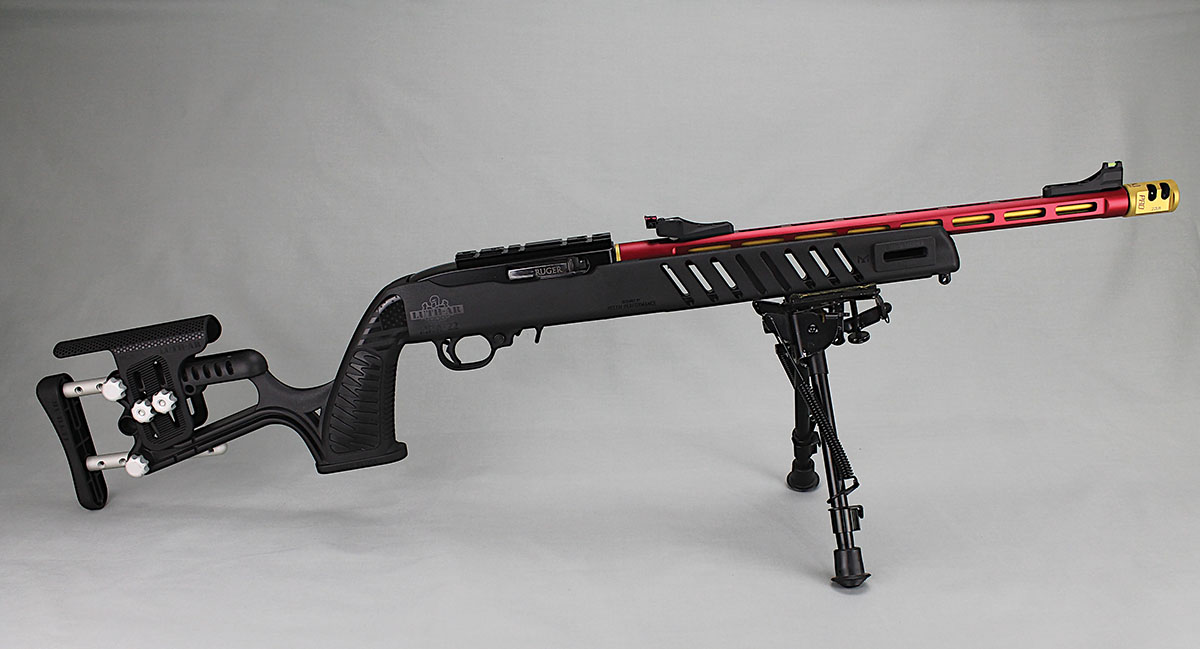
    The stock’s barrel channel must be wide enough to accommodate the  Spitfire’s .920-inch diameter. Here, the stock is a Luth MCA-22, and the  Spitfire is accessorized with TANDEMKROSS Game Changer PRO  compensator and RIM/EDGE Eagle Eye Fiber Optic sights.
    The stock’s barrel channel must be wide enough to accommodate the Spitfire’s .920-inch diameter. Here, the stock is a Luth MCA-22, and the Spitfire is accessorized with TANDEMKROSS Game Changer PRO compensator and RIM/EDGE Eagle Eye Fiber Optic sights.

    What if we could take the “bull” out of “bull barrel”? Is it possible to obtain from a slim, lightweight barrel the bull barrel’s resistance to “walking” shots upon heating? Weight reduction can be accomplished somewhat by cutting flutes or grooves in the outer bull barrel surface, which reduces the barrel’s weight while maintaining adequate stiffness to resist movement as the barrel heats up. But these are by no means slim, lightweight barrels.
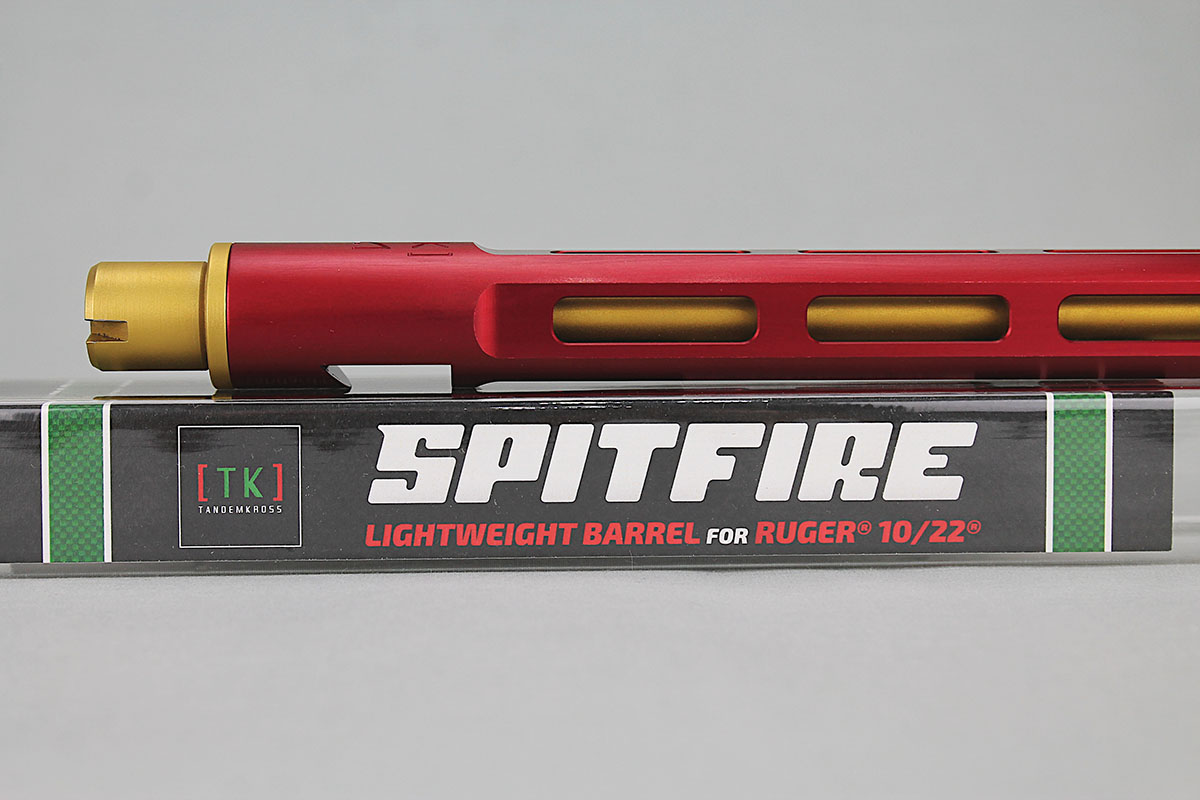
    A pencil-thin bull barrel? TANDEMKROSS accomplishes it with its tensioned Spitfire barrel assembly.
    A pencil-thin bull barrel? TANDEMKROSS accomplishes it with its tensioned Spitfire barrel assembly.
    There’s another approach to resisting that movement caused by barrel heating, recently introduced by TANDEMKROSS: substitute tension for stiffness. TANDEMKROSS’s DIY Spitfire barrel for the Ruger 10/22 bears resemblance to a box girder bridge because it is more than a barrel; it is a barrel assembly. Its heart, of course, is a pencil-slim barrel. Surrounding that and appearing to be nothing more than a typical M-LOK handguard, the barrel shroud, like a box girder bridge, actually supports and applies stiffening tension to the barrel.

    A square shoulder machined into the barrel’s breech end engages a square mating surface in the shroud. Belleville conical spring washers apply tension when a nut is tightened at the muzzle end, and those square mating surfaces at the breech end prevent any rotation between barrel and shroud while tightening. The breech and muzzle are the only contact points between barrel and shroud. 

    Adjusting the Spitfire’s tensioning nut is not a DIY operation as it requires a special tool, and TANDEMKROSS cautions owners not to attempt to adjust the nut. It is factory tightened to a specific torque value, and tinkering with it can negatively affect rigidity and send accuracy out the window. A knurled aluminum cover protects the nut and the muzzle, which is threaded 1⁄2x28 to accept a suppressor or TANDEMKROSS’s Game Changer PRO compensator.
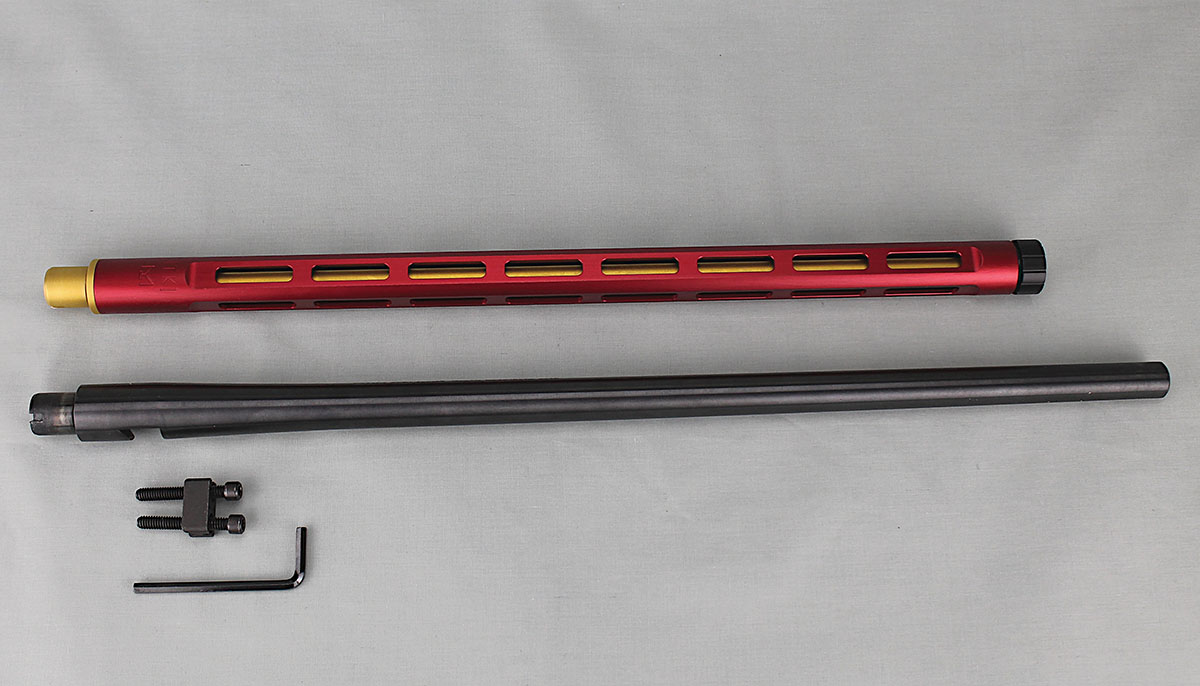
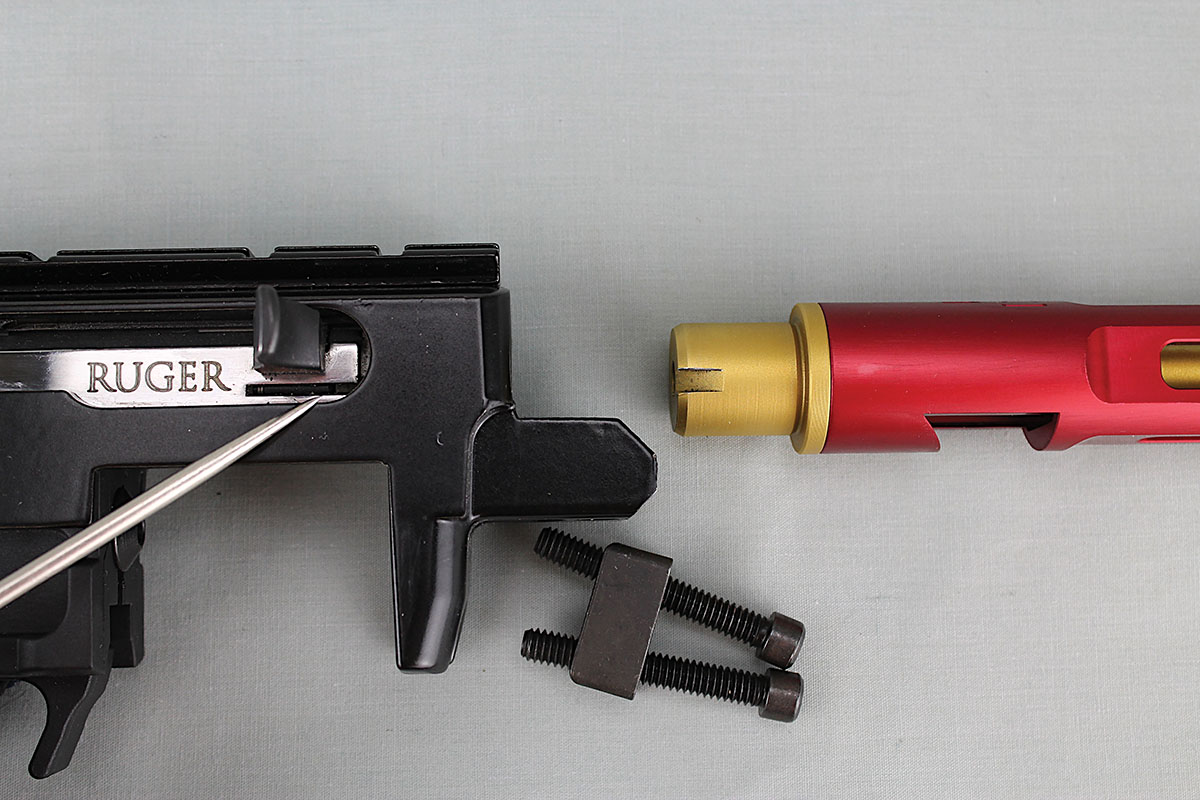
    Barrel swapping is easily done with simple tools.
    Barrel swapping is easily done with simple tools.
    Thirty-two M-LOK cuts encircle the shroud to aid cooling and allow the shooter to mount a wide variety of compatible accessories, from slings and bipods to lights and lasers, wherever the need or fancy strikes. Weighing under a pound, the entire Spitfire assembly is less than half the weight of Ruger’s slim factory barrel. 

    Leave the bolt installed so that the extractor cut on the Spitfire’s breech face can be visually aligned with the extractor.
    Leave the bolt installed so that the extractor cut on the Spitfire’s breech face can be visually aligned with the extractor.
    Swapping out the factory barrel for the Spitfire is definitely DIY. Note, however, that the Spitfire assembly’s outside diameter is .920 inch, the same as many bull barrels, so the barrel channel of a standard factory 10/22 stock is too narrow to accommodate it. No matter – there are many aftermarket stocks available that can do so.

    TANDEMKROSS says the Spitfire may require “minor fitting.” The new 10/22 receiver for this project features a thick, paint-like coating that I at first thought might need to be removed from the top of the ledge where the barrel’s V-block screws in – manufacturing tolerance of the Spitfire is that tight. However, after some careful try-fitting and lubricating the barrel shank, the barrel dropped in. The only tools needed for this DIY are a hex head (Allen) wrench and a soft rubber or leather mallet.

    After pulling the barreled action from the stock and removing the trigger housing assembly by pushing out the two retaining pins, turn out the two hex head screws joining the V-block to the barrel and receiver, and remove the V-block. If the factory barrel can’t be pulled out of the receiver by hand strength, grasp the barrel in one hand and with the soft mallet, tap the receiver front at the V-block projection or the front of the magazine well, until the barrel and receiver part company.
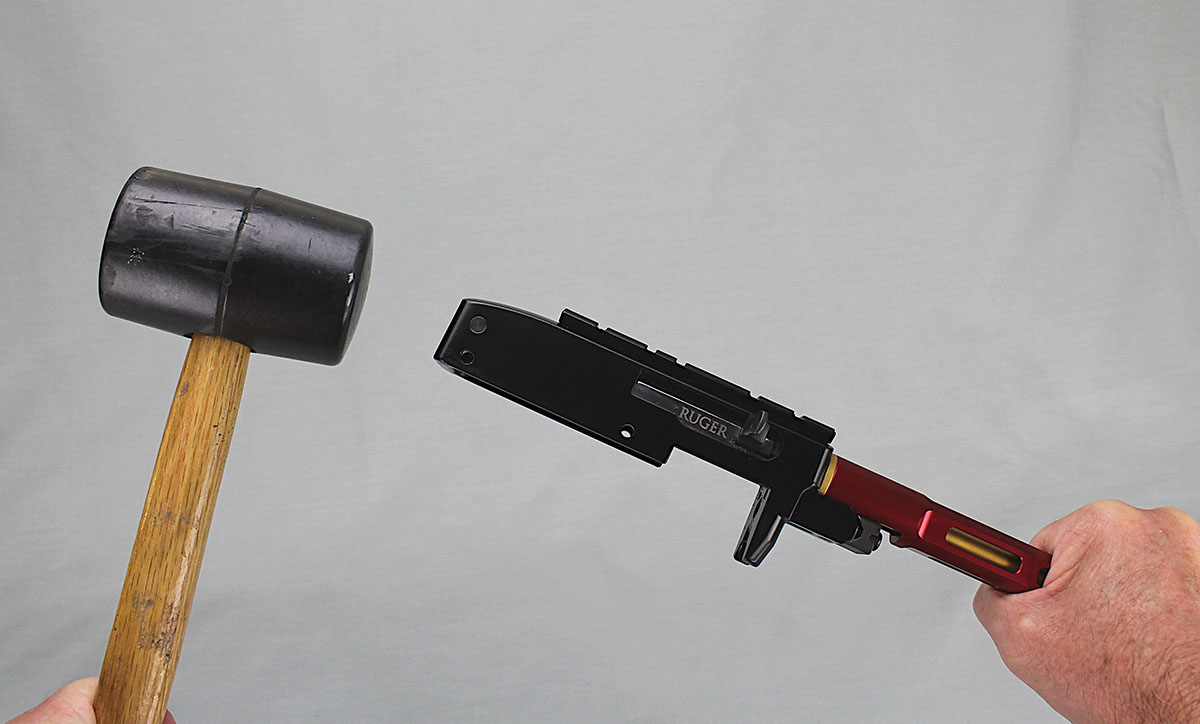
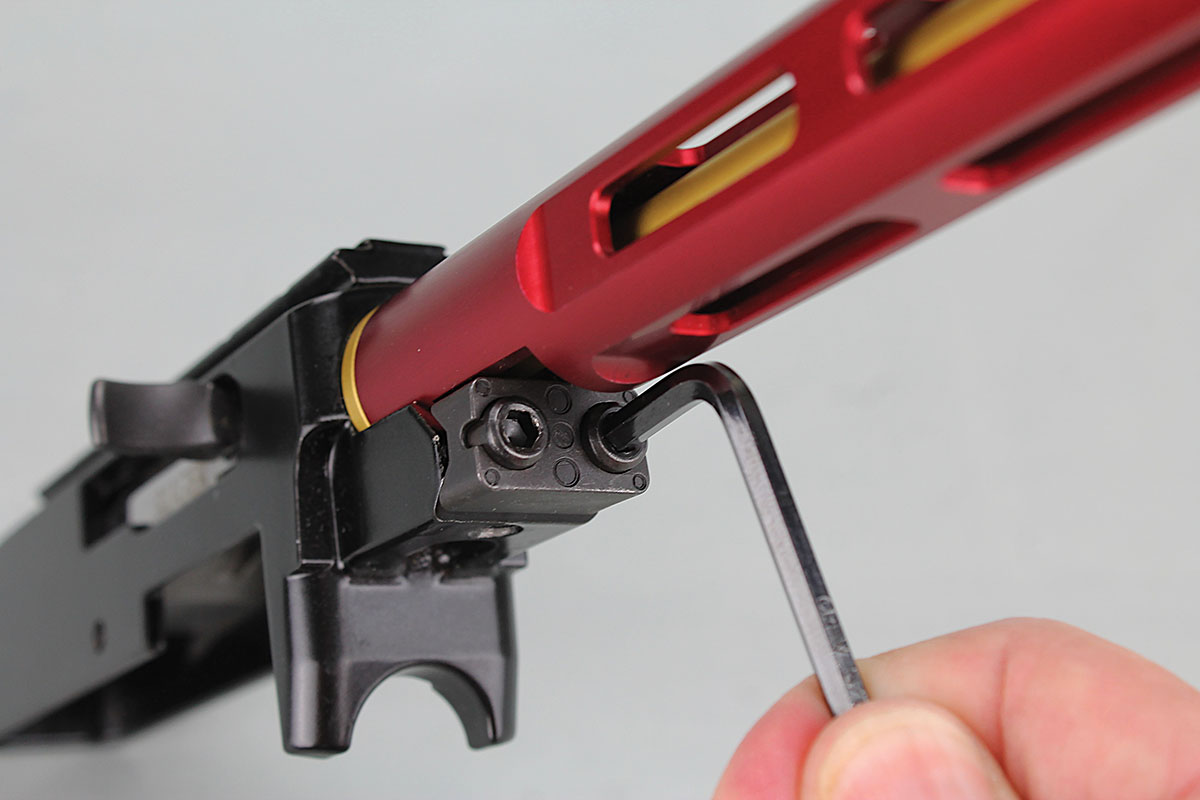
    Don’t force the barrel onto the receiver – rather, use a soft mallet to tap the receiver onto the Spitfire barrel.
    Don’t force the barrel onto the receiver – rather, use a soft mallet to tap the receiver onto the Spitfire barrel.
    Leave the bolt in place, and closed, so that you can visually align the extractor with the extractor slot cut on the Spitfire barrel’s breech face. The fit of the barrel shank in the receiver is so snug that it is impossible to twist the barrel to align the extractor slot with the extractor once the barrel is started – the barrel must go straight in. When aligned, drive the receiver onto the barrel by tapping the mallet on the back of the receiver. Reinstall the V-block and trigger guard, drop the assembly into the stock, and you’re done.

    Tighten down the V-block screws and the barrel swap is complete.
    Tighten down the V-block screws and the barrel swap is complete.
    To test its resistance to “walking shots” from barrel heating, I mounted a scope, zeroed the rifle at 50 yards, and fired several careful 5-shot groups. I followed that immediately with several rapid-fire 10-shot strings, and then immediately shot again for grouping. Before barrel heating, groups measured 2.8 inches, and afterward measured 3.0 inches, with no appreciable dispersion that can be attributed to the heating of that slim barrel. 

    As you probably surmised from the group sizes, despite its bull barrel tensioning, the Spitfire has a standard SAAMI (Sporting Arms and Ammunition Manufacturers’ Institute) chamber rather than a match chamber. Semiauto 22s typically don’t do well with match chambers, the tighter tolerances causing occasional – or frequent – failures to fully chamber rounds. TANDEMKROSS elected to go with the absolute reliability of a SAAMI chamber, instead of the maybe-it-will-and-maybe-it-won’t problem of a match chamber.

    Will we see this TANDEMKROSS Spitfire barrel tensioning applied to larger calibers? The Spitfire’s tensioning approach to stiffening a slim barrel works with the comparatively low pressure and barrel temperature generated by the 22 Long Rifle cartridge, but centerfire cartridges are a different matter. There are always tradeoffs in manipulating physics, and there may be a point where the amount of material needed for enough tensioning to stiffen a centerfire cartridge barrel would weigh as much as a full-on bull barrel anyway, so nothing is gained.

    Yet American ingenuity has a long reputation for dismissing “it can’t be done till it is.” Maybe someone will pick up and run with TANDEMKROSS’s barrel tensioning innovation that, for now, happily occupies the DIY realm.

    Wolfe Publishing Group