

Fouling Shots
Making the AR-15 Shoot Rimfire
column By: Art Merrill | July, 26
While these work well for single-shot or bolt-action rifles, such adapters are less than satisfactory for semiautos for reasons that don’t need explaining to the rifleman, and so are rarely, if ever, used in such rifles. However, one semiauto firearm/cartridge combination proved so appealing that it warranted designing replacement parts to adapt the rifle to the cartridge, and so we have conversion kits to shoot the 22 Long Rifle cartridge in the AR-15 rifle chambered for the 223 Remington/5.56 NATO cartridge.
SAAMI (Sporting Arms and Ammunition Manufacturers’ Institute) standardized the 22 Long Rifle bullet diameter at .2255 inch, close enough to the 223 Remington’s bullet diameter of .2245 inch to be a non-issue for the former’s soft-lead bullet. However, it took a bit of engineering to coax the AR to work with the rimfire ignition and diminutive size of the 22 Long Rifle cartridge, as well as to deal with the AR’s gas system. The solution was to replace the centerfire bolt carrier group (BCG) with a rimfire BCG and bypass the gas system entirely to convert the AR’s action to blowback operation. A special magazine that fits the AR-15 magazine well while feeding 22 Long Rifle cartridges completes the conversion.
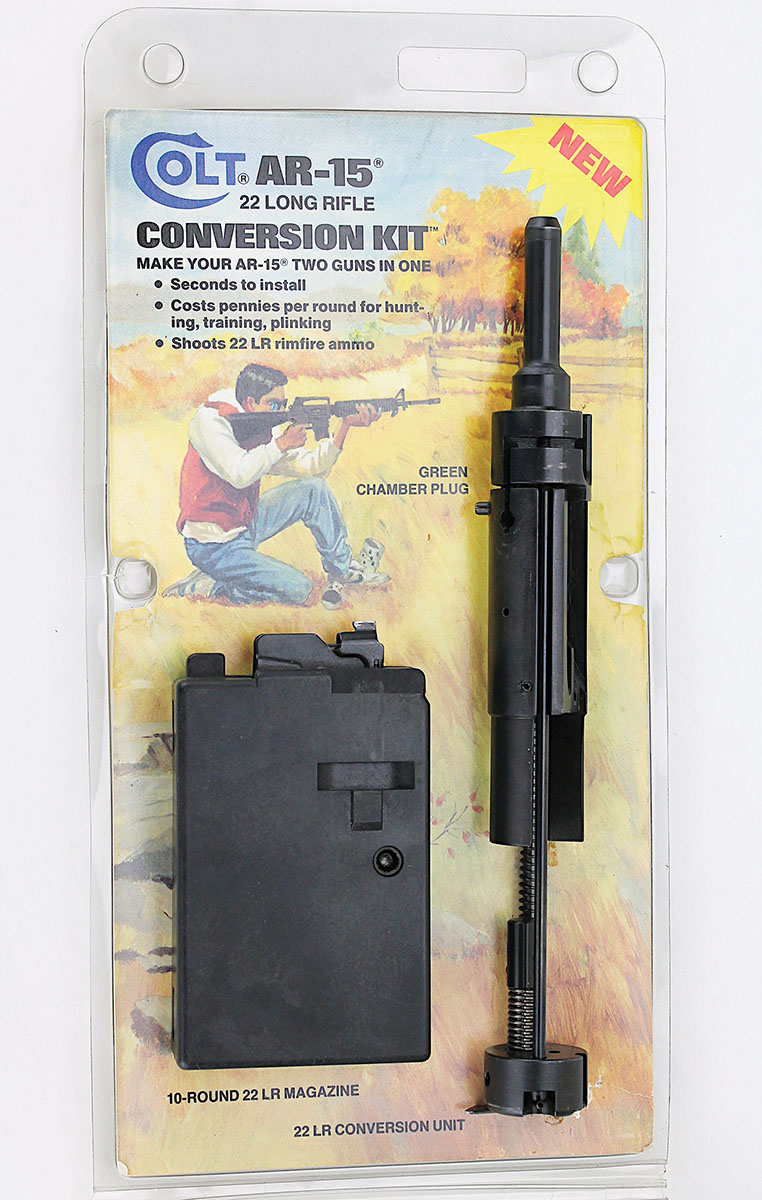
The Colt Conversion Kit here, composed of that rimfire BCG and 22 Long Rifle magazine, is comparatively early, dating to 1989 or earlier. Converting between 223 Remington and 22 Long Rifle cartridges literally takes only a few seconds: push out rear takedown pin, open action, swap BCGs, close and pin action, insert loaded 22 Long Rifle magazine and commence to bustin’ caps.
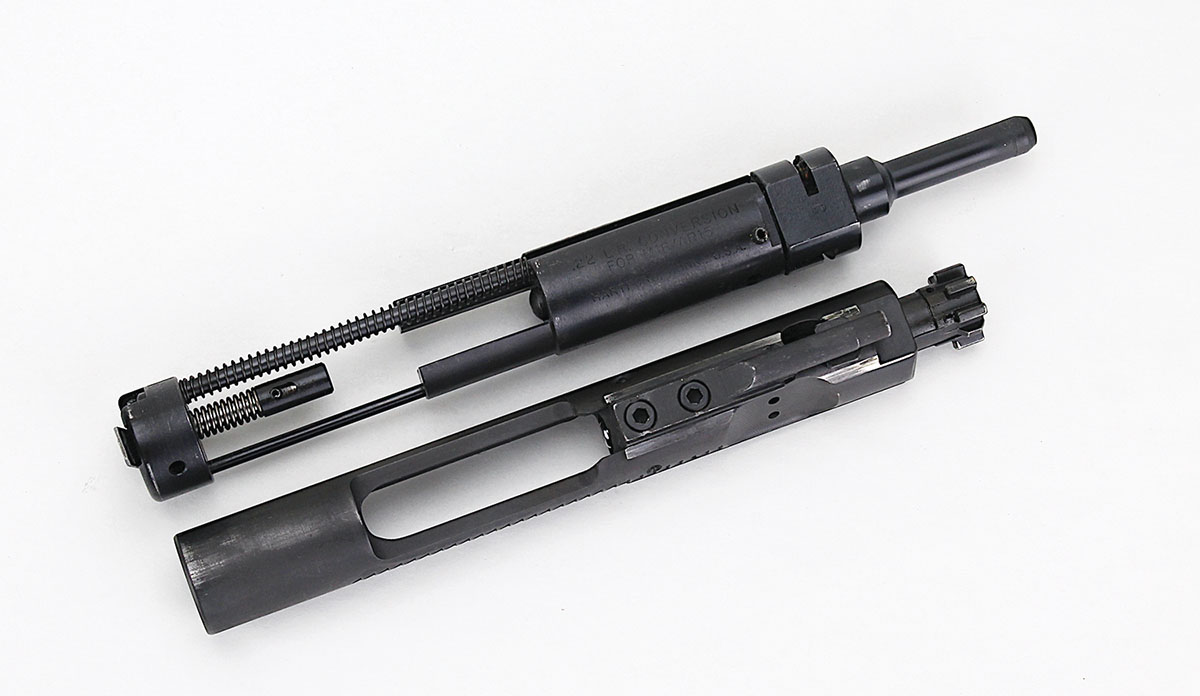
The charging handle engages a pin protruding above the top front of the rimfire bolt; retracting the charging handle retracts the bolt. The bolt is slotted on both sides to ride backward and forward on the dual rails of the carrier. What appears at first glance to be twin extractors is actually an extractor on the right side and a cartridge guide on the left.
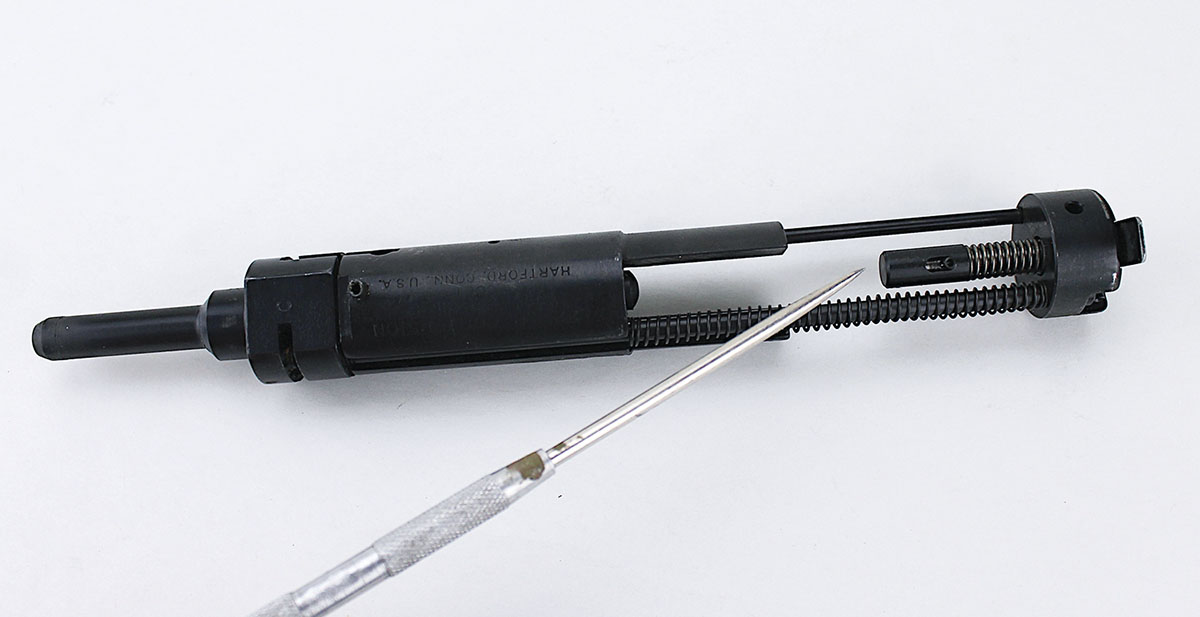
Driving out a roll pin at the back end would begin the disassembly of the unit. The two rails are actually long, slender slot head screws, but the instruction manual accompanying the kit advises against such disassembly, perhaps not because the rimfire BCG is complicated (it isn’t), but because those slender rails/screws could be easily bent.
Because the flat front face of the conversion unit stops against the AR-15’s barrel extension, the 21⁄2-inch tube stretching in front is needed to guide the bullet through the barrel extension and rifle chamber to reach the start of the barrel’s rifling. The interior of this 21⁄2-inch tube is not rifled; for all practical purposes, then, it necessarily creates 21⁄2 inches of freebore, the bullet must “jump” before reaching the rifling – hardly conducive to precision shooting, but good enough for informal plinking and for training. Maybe even for hunting small game at close range.
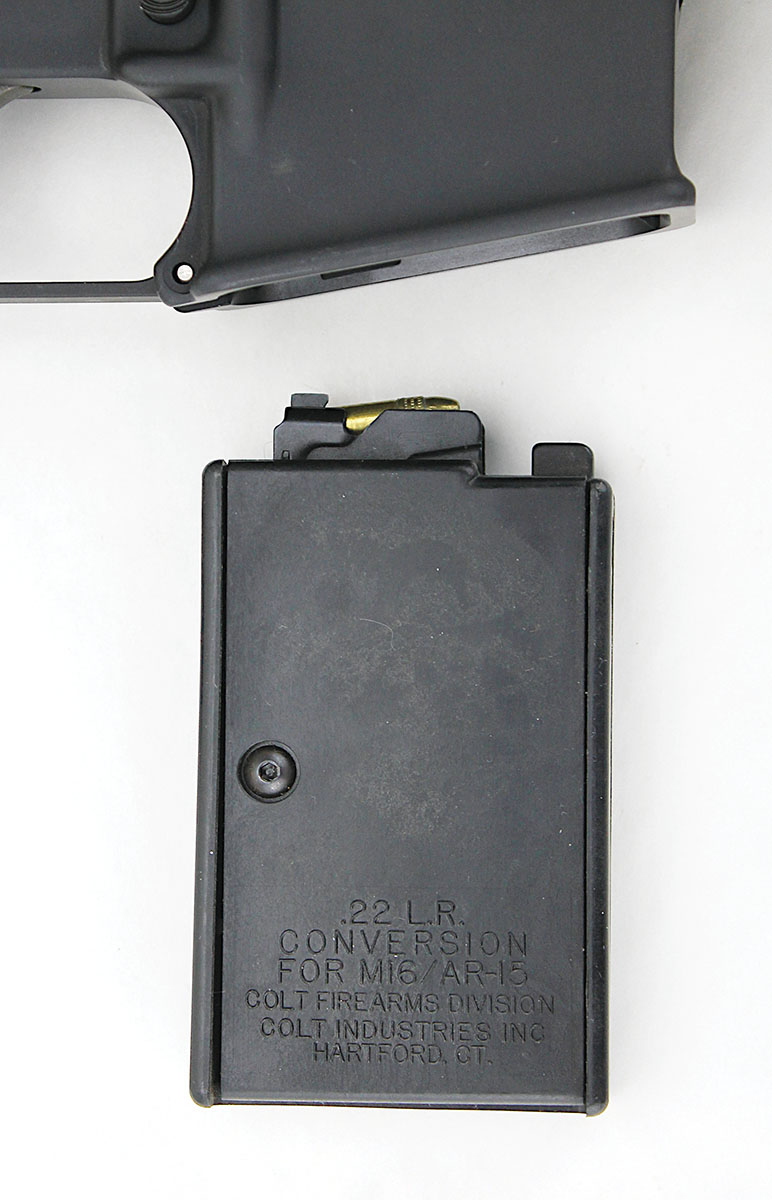
On the positive side, the trajectory of 22 Long Rifle and 223 Remington/5.56NATO ammunition is roughly the same out to about 50 yards (depending upon specific ammunition choices), so sight settings don’t need radical adjustment at typical 22 Long Rifle plinking distance when using the conversion kit. Such conversion kits for the AR-15 enjoyed, and still enjoy, some popularity among High Power competition shooters interested in saving the cost of centerfire ammunition for practice. For this purpose, many competition shooters are now opting for kits with lasers, phone apps and other such integrated, non-firing training devices.
Colt discontinued its own conversion kit years ago, but two or three other companies are making similar conversion kits for the AR-15 today. All appear to have the same basic design as Colt’s, most noteworthy being that the unrifled tube guiding the 22 Long Rifle bullet through the AR’s barrel extension and chamber. These kits retail in the $130-$300 neighborhood, partly depending upon the number of magazines included.
Are they worth it? Well, they’re certainly less expensive than buying a 22 that looks like an AR-15. Conversion kits still have a very viable place in training youth and new shooters in marksmanship and in operating the AR-15, as the 22 Long Rifle cartridge does away with the distracting noise and recoil of centerfire ammunition. The same goes for self-training in rapidly engaging multiple targets; it’s always best to train with the same gun you’ll use in a pinch or in competition.
And then there’s just the fun of plinking with a favorite rifle without seeing dollar signs flying downrange. In the end, that’s the real appeal of these conversion kits, and the reason why they’re still being manufactured today.