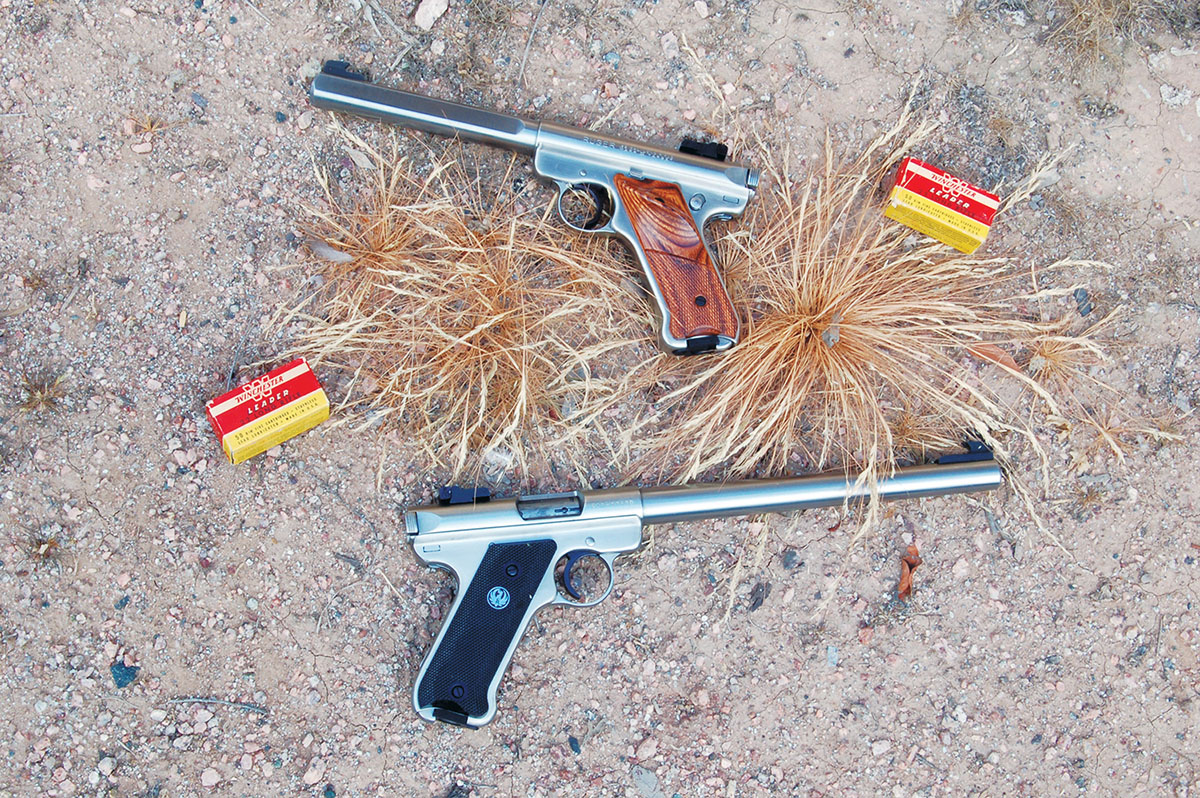
Stainless Ruger Mark II 10-inch Target (bottom) with later 63 ⁄4-inch Government Target Model (top).
When learning that
Rifle Sporting Firearms Journal would change its name to
Rifle & Handgun Magazine, I let out a rebel yell that disturbed the cat’s afternoon nap and scattered the chickens in the front yard. The magazine could now cover virtually anything with a rifled barrel. There are many fascinating mechanisms that are ignored today simply because they are not black and hold at least thirteen rounds of 9mm.
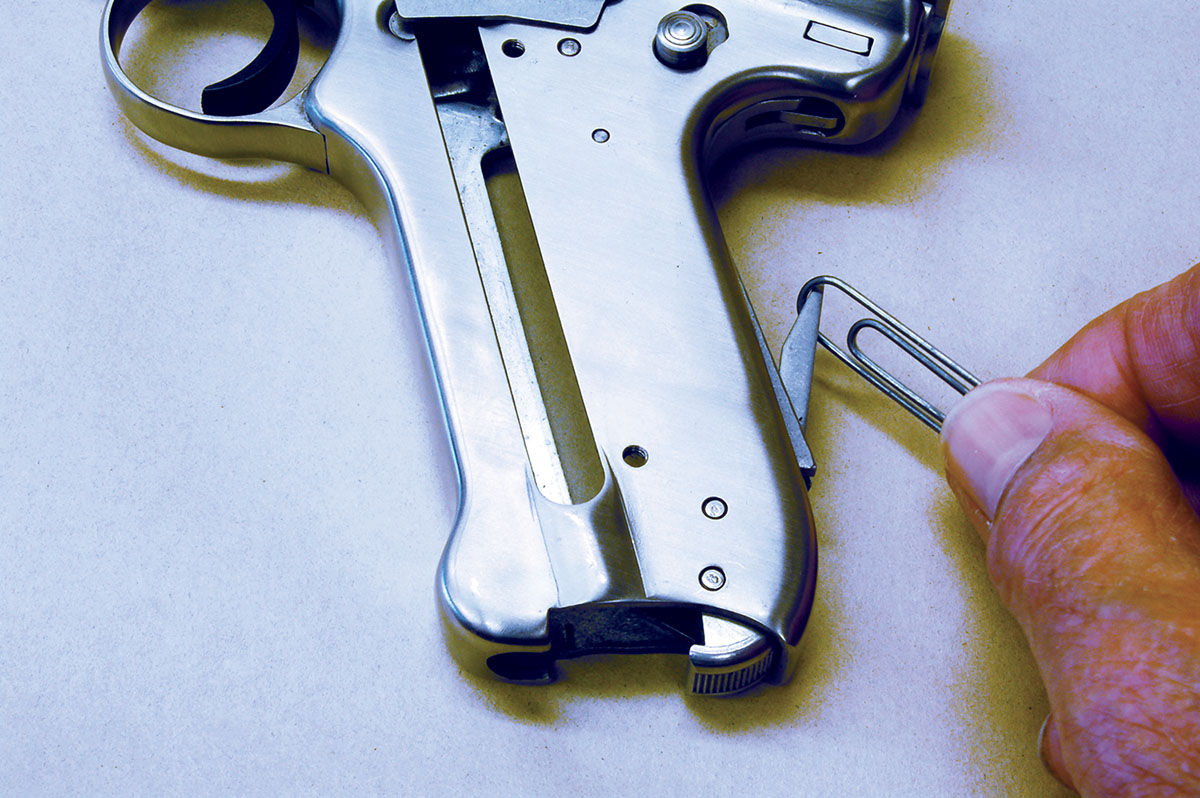
To begin disassembly, remove the magazine, grips and make certain the gun is not cocked. Then pull out the bolt stop assembly lever using a large paper clip.
This brings up the main reason for the vocal excitement. It would be possible to do a piece on my favorite plinking handgun, the Ruger MkII 22 LR autoloader. Everyone needs a 22 plinker. The Ruger is solid (no separate barrel flopping around inside a frame and slide assembly), accurate and reliable. Any issues are traceable to individual magazines or inferior ammunition. Unfortunately, the design has one serious fault involving reassembly after cleaning. A couple of solutions will be suggested when we get to that point.
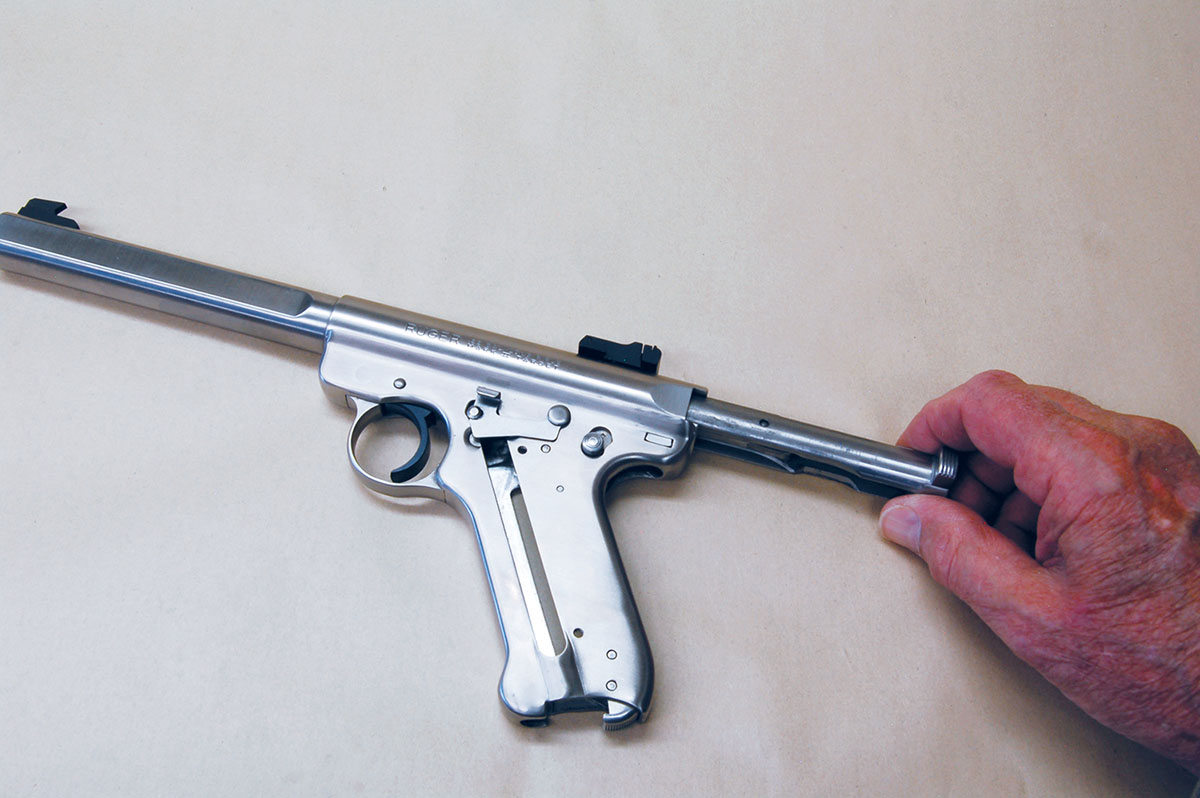
The breechbolt is now simply pulled out of the rear of the receiver.
As a kid, I shot a 22 Rimfire revolver at anything that looked like a target, from gophers to rats to fish in the creek. Rarely, Dad’s Smith & Wesson K22 Masterpiece was available; if he was there to supervise, it was an old H&R Sportsman. Then, one Saturday, a regular at our gun club range showed up with a pistol no one had seen before. He said it was made by Ruger. The gun generated some interest because, in my part of rural Illinois, new shotguns were common while new handguns were quite rare. Some there that day had probably never heard the name Ruger before.
As the year was about 1960, and the gun was new, it had to be a Mark I. To show what a fine fellow he was, the owner allowed everyone to fire a clip through the gun, even the kids.
The gun felt odd to me, being much lighter than Dad’s target guns. Recoil seemed sharp, though that could have been ammunition. Trigger pull was really different. There was a noticeable take-up, like a military trigger, but it required almost no finger pressure. The actual let-off was too heavy for
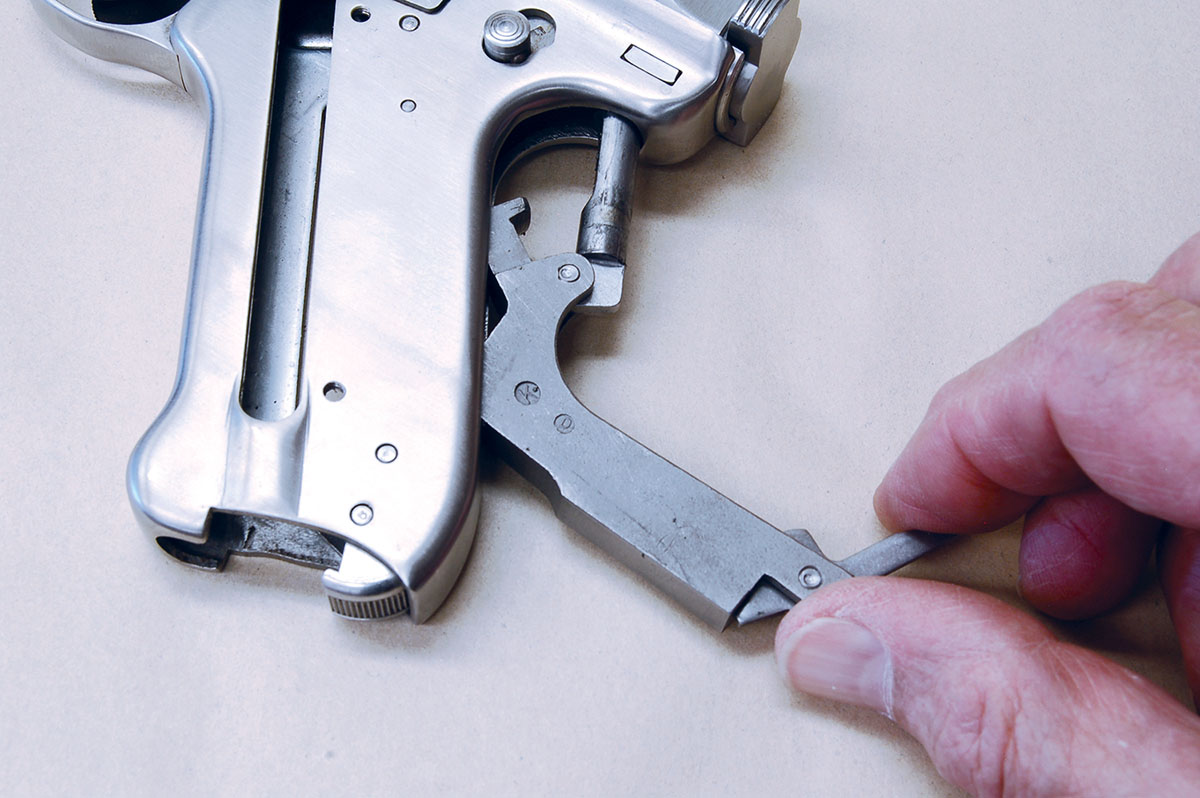
Pull out and down to remove bolt stop/mainspring assembly.
such a light handgun. Then there was the stubby, rapidly tapered barrel that looked like the spout of a farmer’s oil can. Also, the bolt didn’t lock open after the last shot was fired, which annoyed everyone.
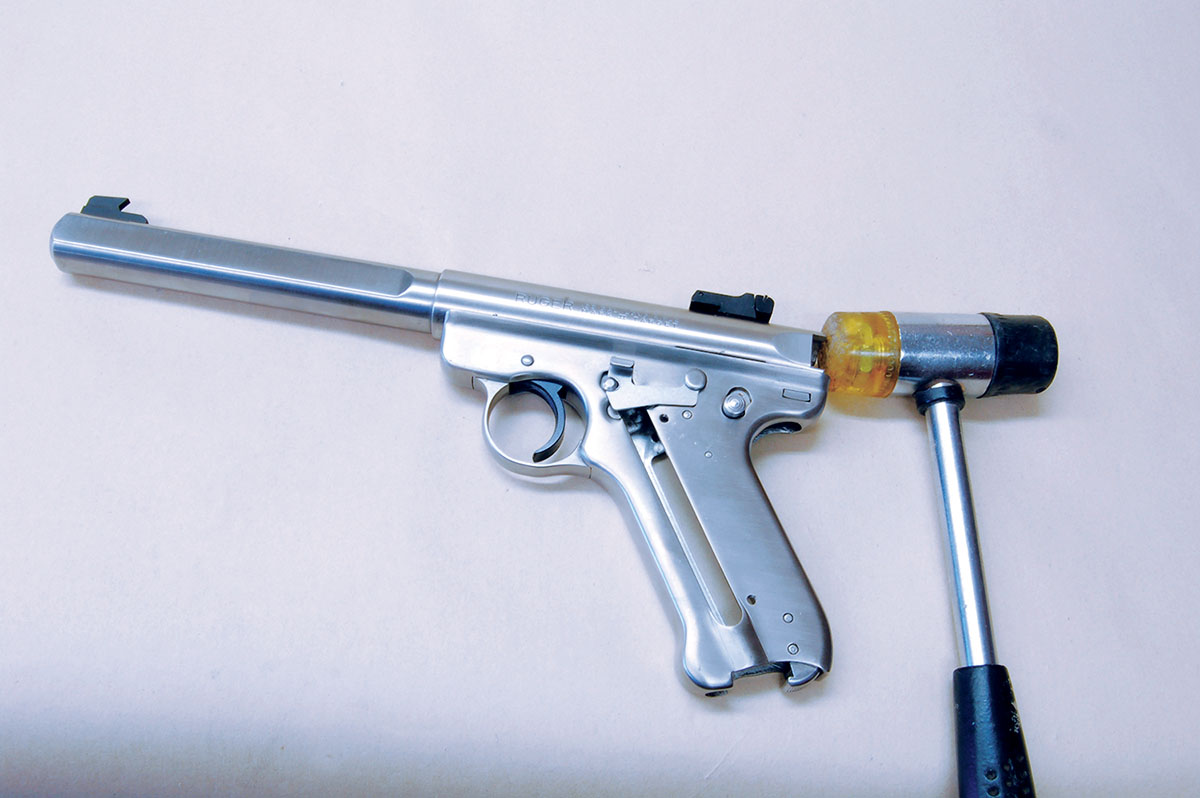
The barrel/receiver is tapped forward off the frame using a soft-faced hammer.
The Ruger automatic had not been thought about, or even seen, until about 1985, when a shop where I was working got in two. They had .875-inch diameter barrels, ten inches long, and were stainless-steel models. Now here was a solid-feeling .22-caliber automatic; far too muzzle-heavy, but the barrel could easily be shortened to fix that. Best of all, they were Mark IIs, meaning the bolt stayed open after the last shot, capacity increased to ten shots, and cutouts at the rear of the receiver made grasping the bolt easier when loading or unloading. I had to have one despite the boss’s warning, “Don’t take it apart, you’ll never get it back together.” He was almost right.
Groups got smaller as the barrel got shorter. At 7.5 inches, the gun was still muzzle heavy for a one-hand hold, but perfect for two hands. Dad could make inch-and-a-half groups at 50 yards, which I thought was fantastic. I could never do as well myself, yet the chronicles tell us that even greater accuracy was possible. The guns were rebarreled using 13 and 14-inch rifling twists combined with tighter chambers. Groups of one inch and smaller were reported at 50 yards using only iron sights.
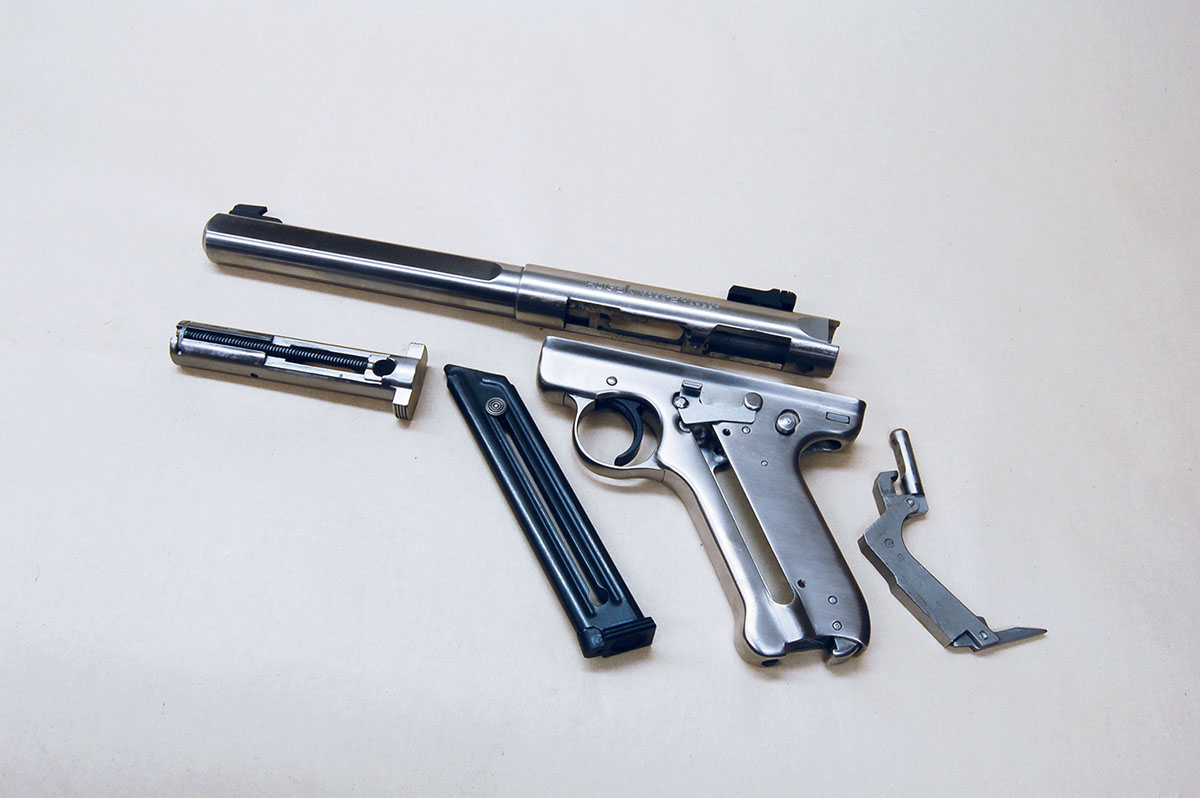
Now, in five subassemblies, no more needs to be done.
The Ruger Mark II with its 7.5-inch barrel has become my only 22 rimfire plinker. It has been shot at least once a month for nearly forty years. It has been disassembled and cleaned many times. This will be the next topic because of the gun’s reputation (deserved) for difficult reassembly.
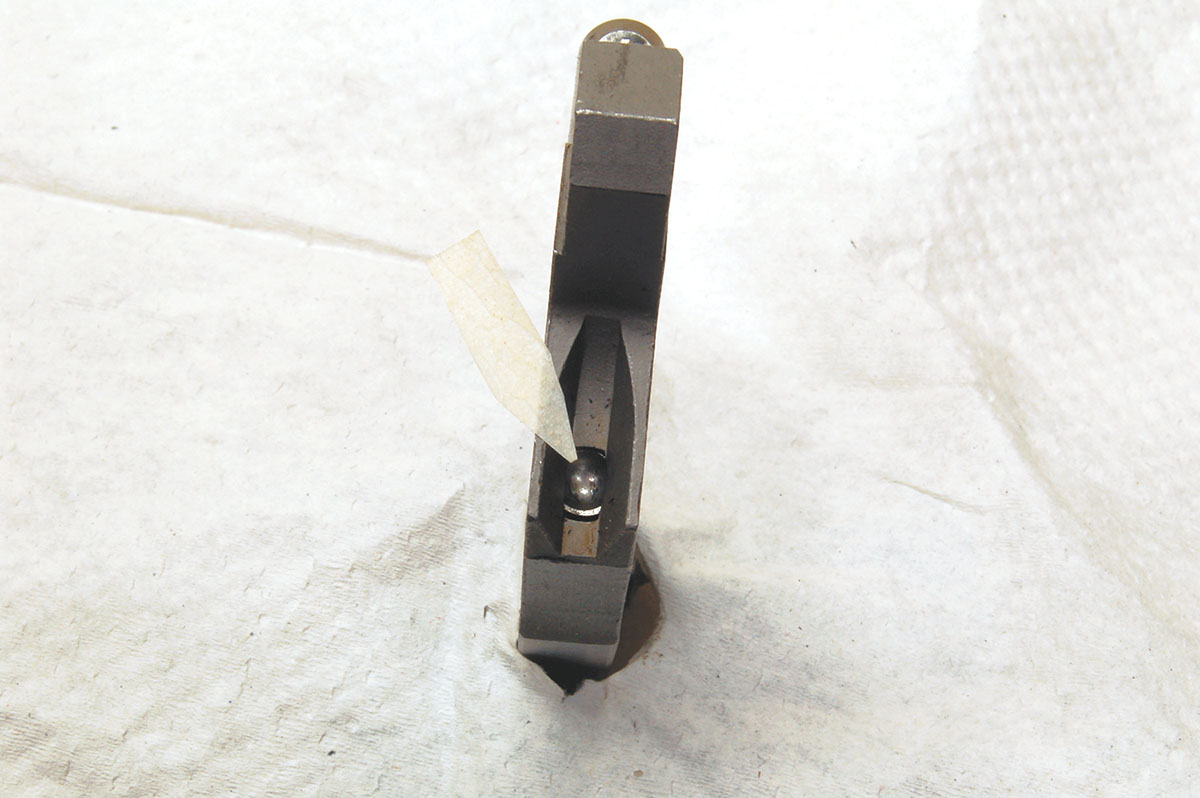
Though a bit hard to see, the mainspring plunger (arrow) has a concave face to match the hammer strut.
Breaking the gun down into its five subassemblies is easy. Start by removing the grips and magazine. The gun must not be cocked. Next, lift the mainspring housing latch using a paper clip (see photo). If it’s not possible to get the paper clip under the latch, it may be necessary to pry the latch up a bit using a small screwdriver. When the latch moves enough to free the mainspring housing, pull the housing down out of the frame and note the large-diameter pin attached to the opposite end. This is the bolt stop.
The breechbolt will now slide freely out of the rear of the receiver. Notice that the bolt stop passed through three reamed holes: one in the frame, one in the bottom of the receiver and one in the top. These are now perfectly aligned, but the barrel/receiver assembly is held to the frame by the friction of two tapered surfaces lightly driven together. When they are separated, the bolt stop pin holes go out of alignment. The only way to get alignment back is to measure the amount the barrel/receiver protrudes past the rear of the frame (in thousandths of an inch) before disassembly and duplicate when reassembling.
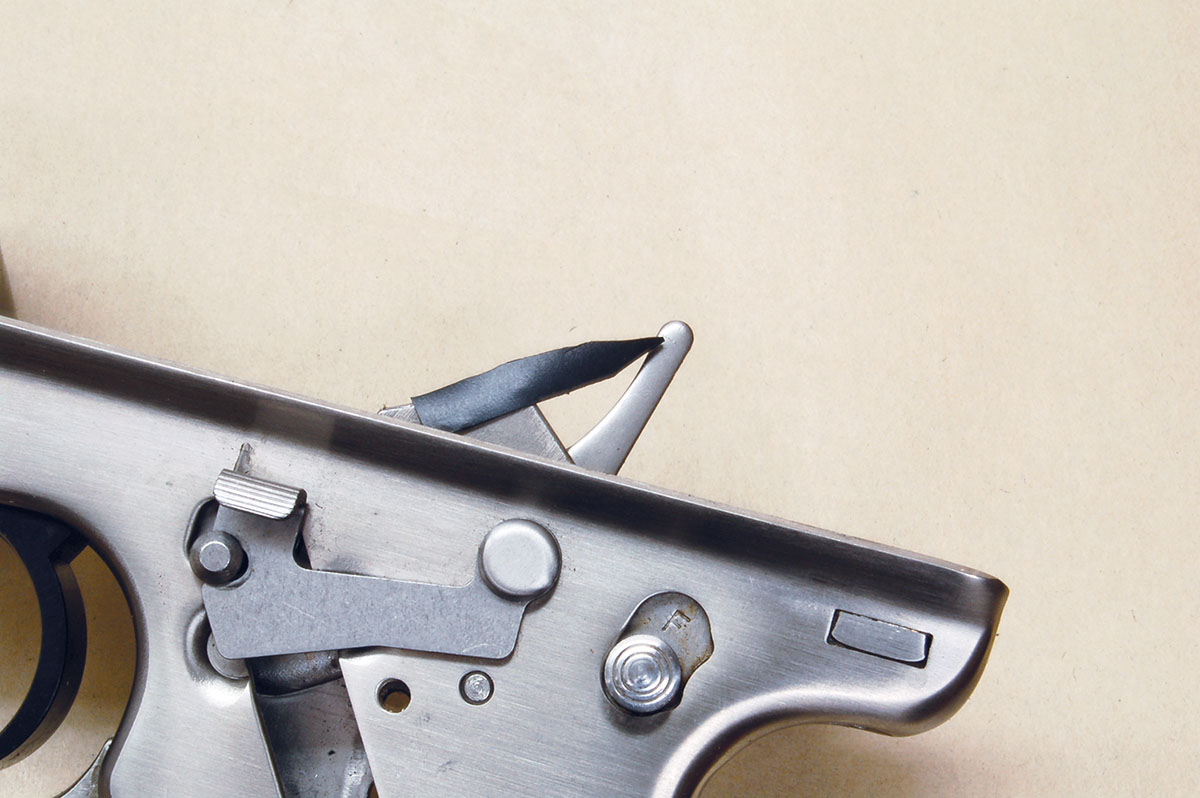
Here is the rounded end of the hammer strut (black arrow) that fits the mainspring plunger when reassembling the gun.
With the gun now in its five major subassemblies of barrel/receiver, frame, breechblock, mainspring housing and magazine, all parts are in plain view. Cleaning and lubrication can be done without further disassembly.
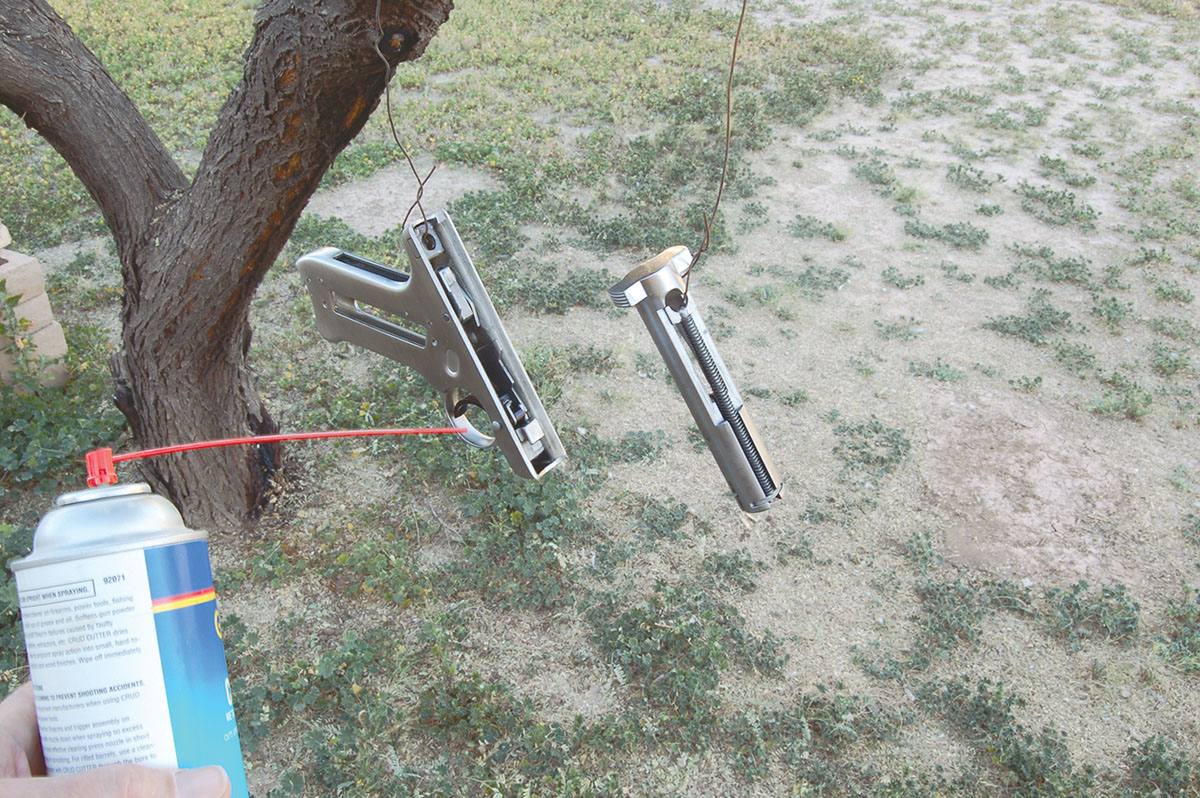
Hang subassemblies on a wire (if gun is disassembled) and spray liberally with modern one-shot cleaner/lubricant.
Reassembly is uneventful, providing the bolt stop pin holes are realigned as described. Then we come to the problem. It has been the cause of much anger towards Ruger since the .22 caliber automatic appeared. It should be a simple operation. Just allow the hammer strut to fall against the mainspring plunger. Then snap the mainspring housing in place. Unfortunately, this takes place in the confines of the frame where it can’t be seen. After the 147th failed attempt, the fun is gone. Yes, there are supposed to be a couple of gadgets available to make this easier, but I couldn’t obtain either.
Ruger’s explanation in an owner’s manual from 1986 takes four paragraphs. In the first, the hammer is placed “in its fired position” (muzzle down). Later, “Some users find reassembly best by holding the barrel generally in a vertical position.” For what it is worth, I have had my own pistol fall together with barrel pointed up, down, horizontal and while being shaken violently, moderately and not at all. Even if the gun does snap together, if the breechbolt only moves a little or not at all, it’s still not correct, and you get to try again!
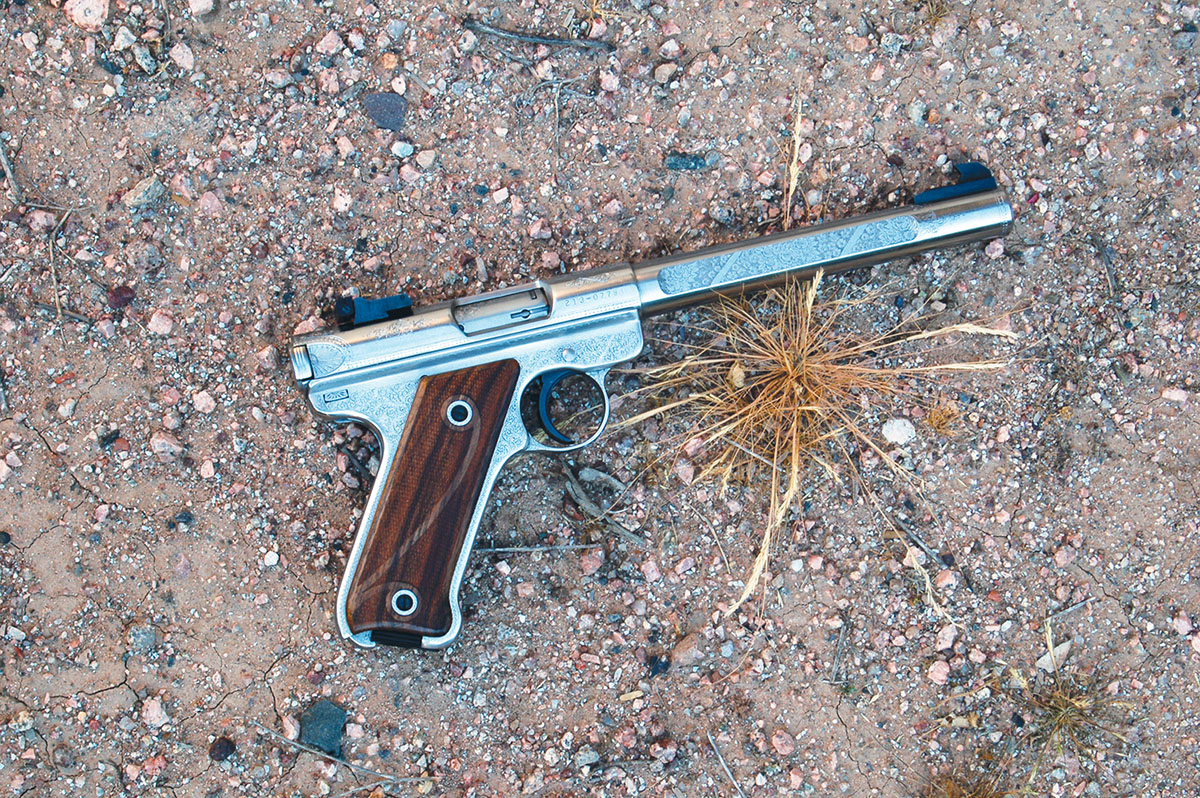
Gil’s early Mark II 71⁄2-inch perfect plinker balanced by shortening the barrel 3⁄4 inch at a time.
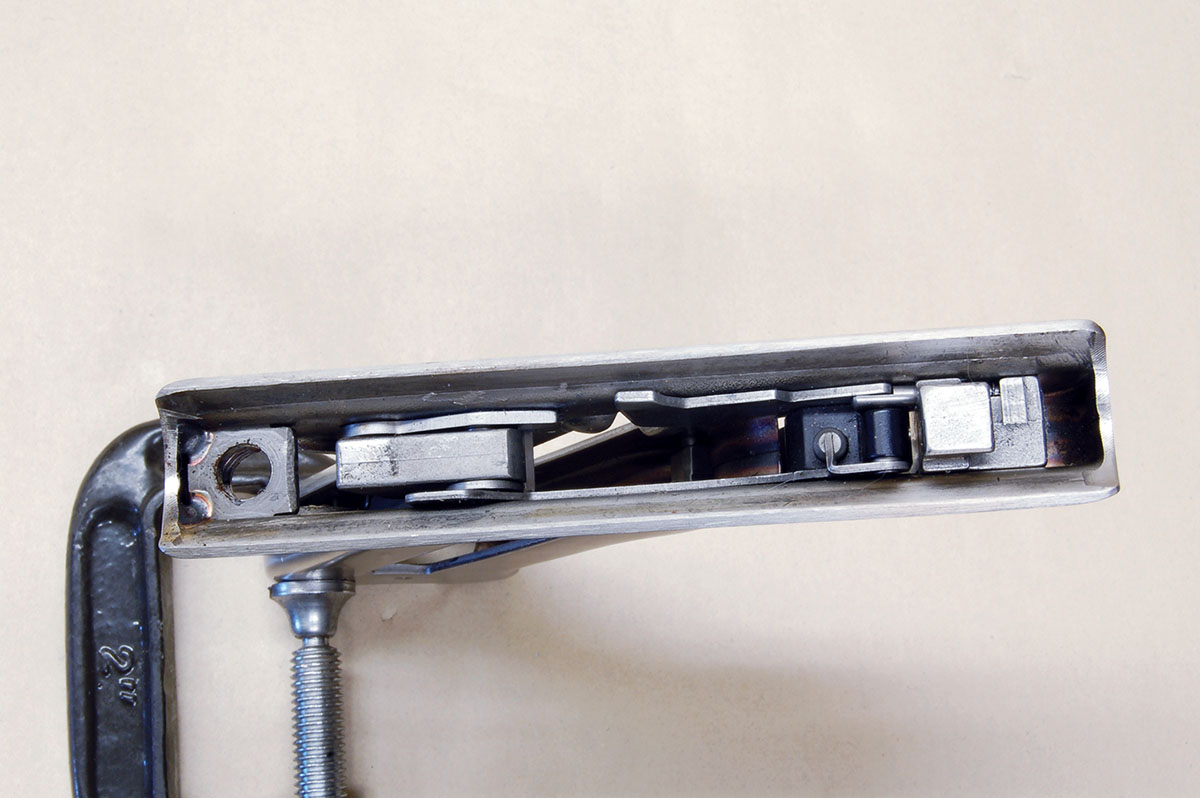
The Ruger frame is a stamping with parts hung on pins, perfect for spray can cleaning and lubing without disassembly.
This design defect should never have made it to production. It could have given Ruger a bad reputation from which it would not have recovered. Yet it didn’t, probably because ammunition companies had been advertising their “rustless” and “non-corrosive” rimfire cartridges for years. Few owners bothered to clean the bores of their MKIIs let alone take them apart for cleaning. Ruger’s problem was not noticed by many people.
Owners of Mark IIs and Mark IIIs need not despair, however, because there is an elegant solution to our problem. Several years ago, I was talking to a gunsmith at a SHOT Show about the new one-shot cleaner/lube compounds sold in spray cans for AR-type rifles. He said they seemed to work well so long as the mechanism is sprayed long enough that the liquid runs out clear. That gave me an idea.
When my Mark II needed cleaning, the five subassemblies were hung on a wire over a bucket and sprayed with a clean/lube product. It worked perfectly, but it was still necessary to reassemble the thing. The next cleaning saw only the grips and magazine removed. The rest was hung on a wire and sprayed with clean/lube liquid until the liquid dripped off clean. A light touch of compressed air finished the job, though the gun was allowed to hang a few days to be sure all liquid had evaporated. Such treatment is only necessary every year or so. This is really light gunsmithing.
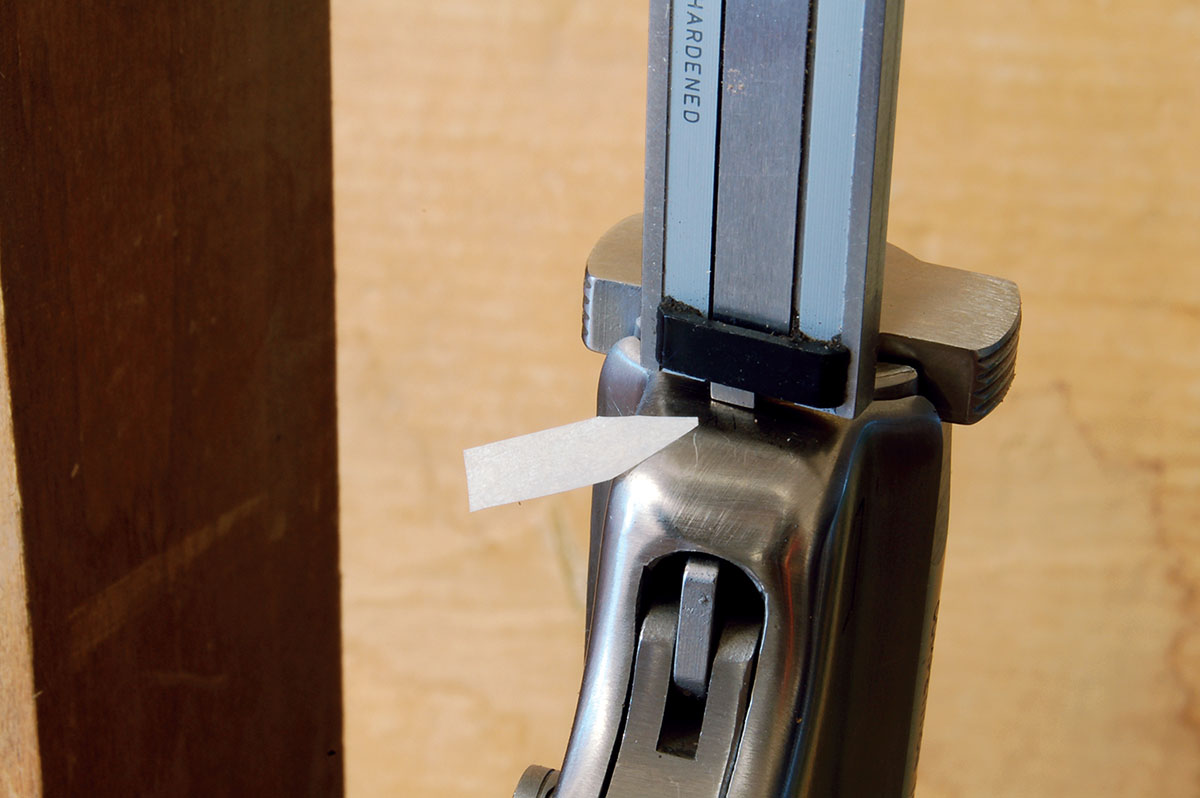
Barrel/receiver assembly protrudes past the frame some .015 to .040 inch before disassembly. This is measured with a dial caliper (arrow) and must be duplicated when the gun is reassembled.
Of course, the Mark II could have been traded off for a Mark IV, but why trade a beautiful pistol for an ugly one? With its heavy barrel and classic magazine heel-catch, the Mark II is the best of the bunch. If it was good enough for Bill Ruger, it’s good enough for me.