

Walnut Hill
The Great Suppression
column By: Terry Wieland | July, 26
To say international opinion on the use of suppressors is mixed is putting it lightly. It would be more accurate to call it contradictory and baffling. The word “logic” is rarely applied.
In Europe, I am told, to hunt with a rifle that does not have a suppressor is considered rude and inconsiderate at best; while in densely populated parts of southern England, overrun with small deer who devour the lavender blooms, bylaws insist a suppressor be fitted, or you can end up in jail.
Then we have the United States of America, home of the Second Amendment, where few houses in rural parts can be found without a rifle of some kind, and where, until this year, you needed a federal tax stamp and two hundred bucks in cash even to possess a suppressor of any kind. What’s more, if you wanted a second one for another gun, that was another two C-notes.
I should clarify right here that, as of January 1, 2026, the fee is waived, so that obstacle is gone. You still need the tax stamp (ATF Form 4), which requires photos, fingerprints and multiple background checks. At least it did as of this writing. Of course, laws vary from state to state.
The federal law dates back to 1934, to the infamous National Firearms Act (NFA), which also banned widespread ownership of fully automatic weapons. It was aimed specifically at submachine guns, and very specifically at the Thompson, hero or villain of a hundred clashes between gangsters and cops, and gangsters and other gangsters. Probably its most notorious exploit was the Saint Valentine’s Day Massacre in Chicago in 1929, in which some of Al Capone’s mob wiped out seven members of Bugsy Moran’s gang.
Regardless of its undoubted prowess as a military weapon, the Tommy gun was ineluctably linked with Machine-Gun Kelly, Prohibition, Pretty Boy Floyd and Bonnie and Clyde. After the NFA, you could still own one, but it required a special federal tax stamp.
Exactly why suppressors, also known as silencers, were thrown into the mix is unclear. Capone’s crowd certainly didn’t care how much noise they made, but presumably, they were judged to be instruments of crime simply because you could fire a shot and not be heard by the neighbors. The whole mystique of silencers became a mainstay of Hollywood movies: When you were being worked over by a bunch of hoods, and one of them pulled a long cylinder out of his pocket and started slowly screwing it onto the barrel of his Woodsman, you knew you were not long for this world.
For reasons best known to members of Congress, a silencer was defined as a firearm in itself, which accounts for the $200 fee and ATF approval.
All of this is contradictory and confusing because suppressors can accomplish several things at once. They can mitigate recoil as well as noise; the additional length can increase velocity slightly, and the extra weight on the barrel contributes to stability. All of which is positive if you don’t mind the extra length and bulk.
Oddly, traditional muzzle brakes, which reduce recoil and muzzle jump, increase the blast dramatically as far as the shooter is concerned, and shooting any rifle equipped with a brake without wearing ear protection is a sure recipe for deafness.
I had my first real encounter with brakes in 1990, when I got a then-new 416 Weatherby in a Mark V equipped with a detachable brake. Shooting that thing with the brake in place was ear-shattering, even outside, never mind in an enclosed range. It wasn’t just the noise: Even wearing both plugs and muffs, shooting from an enclosed bench created a concussion like a blow on the head, as dust and cobwebs rained down around.
I also discovered, the hard way, that the brake changed the rifle’s point of impact by up to 18 inches, which is not a lesson you wish to learn while hunting Cape buffalo. I came out of it alive and with my hearing intact, but it established a prejudice against brakes that has endured to this day.
It’s been my experience that the laws of physics are immutable, and there are no easy, cost-free fixes for any of the problems of rifle shooting. The energy coming out of the muzzle has to go somewhere, either in the form of louder muzzle blasts or wall-shaking concussion. It has also been my experience that muzzle blast can cause flinching every bit as much as sheer recoil does, and sometimes even more.
My first experience with suppressors was in England in 1998, when I set off to reduce the muntjac population of Surrey with a semi-professional hunter and pest-control specialist. Since we were attempting to ambush the muntjacs in their favorite haunt, suburban flower beds, having a suppressor on his 243 Winchester was imperative.
Steeped as I was in the illegal, if not immoral, nature of silencers, the expedition was a revelation. Shooting that rifle, I discovered that when you drastically reduce muzzle blast, felt recoil also seems milder, and with the extra weight out front, suppressors were much longer and heavier back then, muzzle jump was almost nonexistent.
Along about the same time, there also occurred a brief mania for muzzle attachments that could be adjusted to accommodate barrel harmonics for optimum accuracy. This began with Browning’s Ballistic Optimized Shooting System (BOSS) and soon spawned any number of after-market products that purported to do the same thing. The craze did not last long except among die-hard accuracy nerds, probably because we all quickly discovered that finding the optimal setting required a lot of shooting, measuring, fine-tuning and more shooting. Even when you got a decent setting for one load, it did not necessarily apply to another, and there was always the nagging psychological doubt that you’d really achieved the absolute best setting.
In Canada, by the way, suppressors were and are illegal under federal law. When the law was being revised in the 1990s, muzzle brakes and all other muzzle attachments came under scrutiny. In favor of suppressors, shooters suggested that suppressors and the resulting noise reduction would allow shooting in some areas where it was outlawed only because of the noise.
The counterargument was that, by allowing suppressors, excessive noise would be removed as justification for a gun ban; we must have noise to prohibit noise. Worse, it would allow bullets to fly hither and yon in built-up areas, and no one would know, and hence could not have the police put a stop to it before someone was killed. Ah, the logic, the logic.
Technology marches on, and a great deal has changed in the last 35 years relating to brakes and suppressors. Now, the two are converging to the point where, very soon, I suspect, they will be mostly one and the same thing.
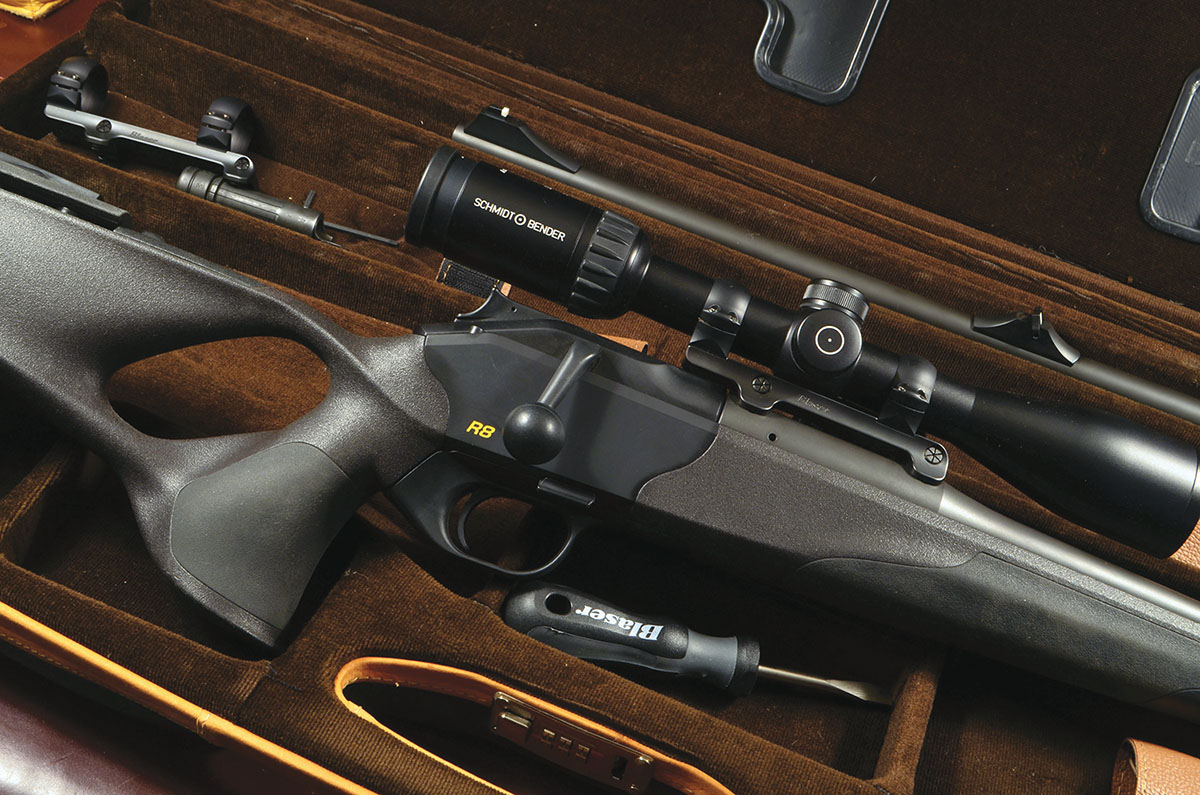
Blaser has just announced an addition to its R8 family of rifles in the form of a barrel that combines the functions of a suppressor with those of a brake, all in compact form that merely resembles the familiar bull barrel.
As with all the other R8 barrels, stocks and accessories, the “Silence Barrel” will fit any R8, although it requires a “Silence Forend” to accommodate the greater diameter. Both will be sold separately.
The Silence Barrel consists of an internal steel barrel surrounded by its noise-reduction apparatus, all enclosed in a titanium outer sleeve. The first calibers offered are 308 Winchester, 30-06 and 300 Winchester Magnum. List price is about $3,500 for the barrel, $500 for the forend.
For me, at least, this arrangement eliminates one of my pet grievances against most muzzle brakes and all suppressors, and that is aesthetics. Having a bulbous beer can hanging on the barrel just looks horrible. Blaser’s Silence eliminates that problem while making the rifle handier, and the R8 is very compact and handy in any configuration, while at the same time reducing noise and dampening recoil.