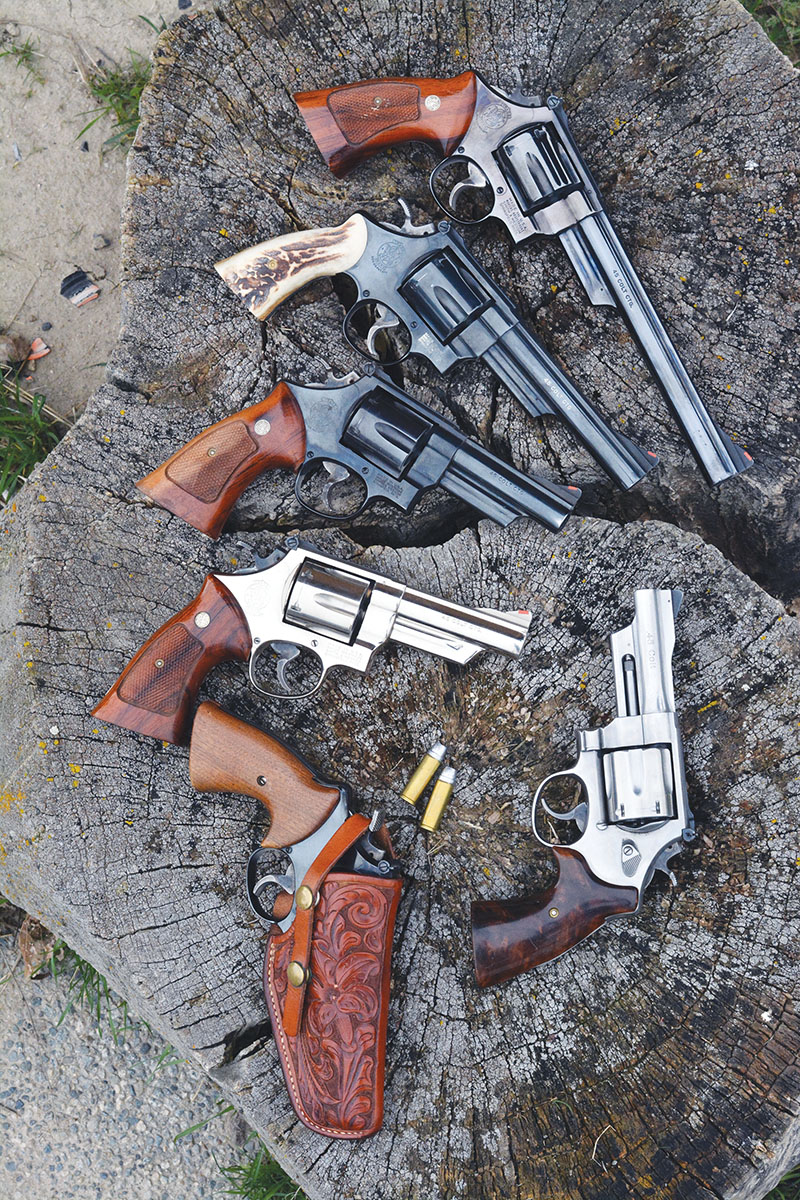
The Smith & Wesson Model 25-5 and 625-6 chambered in 45 Colt have been offered in different barrel lengths and configurations.
The
Smith & Wesson N-frame Models 25 and 625 (stainless) chambered in 45 Colt are highly useful and versatile big bore sixguns that are held in high regard. However, the Model 25 in particular had a rocky road that temporarily tarnished its reputation for accuracy. Today, we will shed a little light on guns, accuracy both bad and good, suitable handloads and the general performance of the 45 Colt.
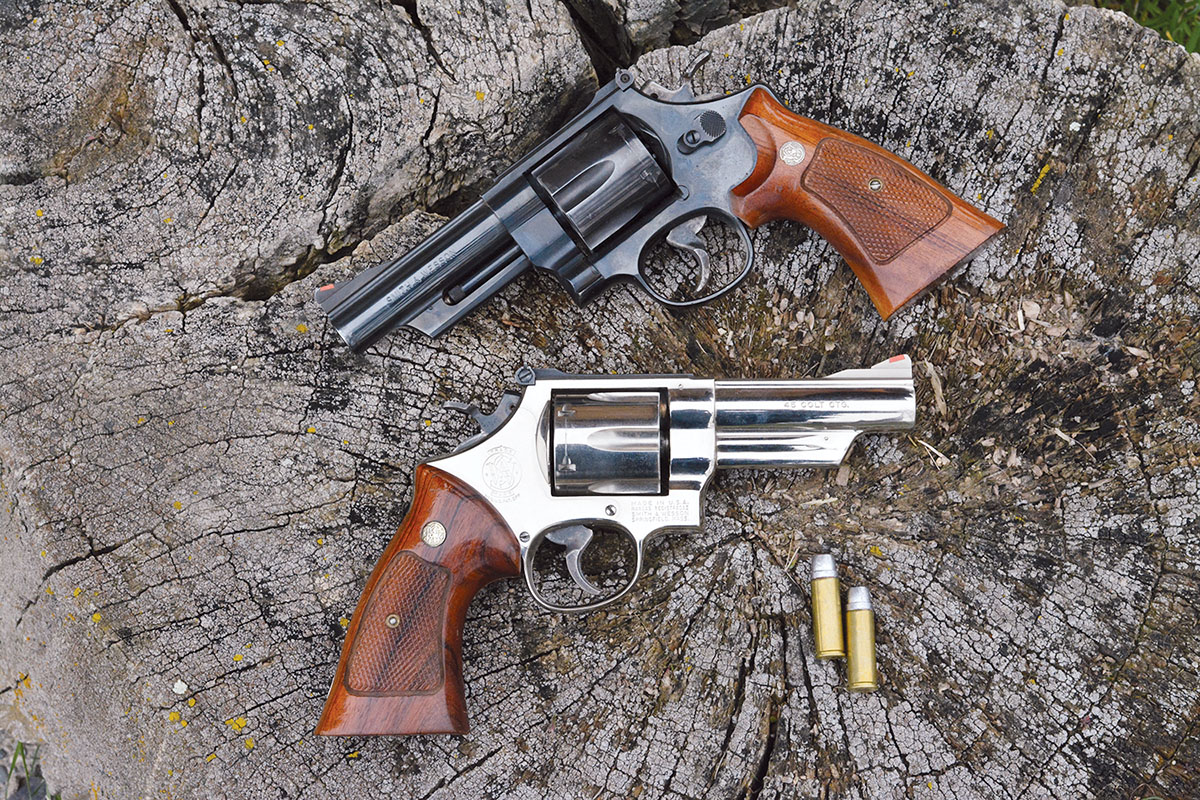
The Smith & Wesson Model 25-5 chambered in 45 Colt was offered in both blue and nickel finishes.
![]() Let’s go back to the beginning, when the first Smith & Wesson N-frame was introduced in 1907/1908 (produced through 1917). They were known as the Hand Ejector First Model, New Century, or more commonly known today as the Triple Lock due to its third lock in the crane area that served to prevent the gun from loosening prematurely. The primary caliber was 44 Special, but it was also chambered in 38-40, 44-40, 44 Russian, 455 and the grand old 45 Colt. However, the 45 Colt was an extremely scarce chambering and is rarely encountered, so are probably best relinquished to collectors. Regardless of the caliber, all Triple Locks featured a so-called “short cylinder” that measured around 1.575 to 1.585 inches (not including ratchet). The Hand Ejector Second Model (produced 1915-1940) and Hand Ejector Third Model (produced 1926-1941) were each primarily produced in 44 Special, but a very few were made in 45 Colt and still featured the same short cylinder as the Triple Lock. In the post-World War II era, the Model 45 Hand Ejector Model 1950 Military (fixed sights) and 1950 Target were primarily chambered in 45 ACP, but were also chambered in 45 Colt, which again are scarce. Regardless, they too featured the short cylinder.
Let’s go back to the beginning, when the first Smith & Wesson N-frame was introduced in 1907/1908 (produced through 1917). They were known as the Hand Ejector First Model, New Century, or more commonly known today as the Triple Lock due to its third lock in the crane area that served to prevent the gun from loosening prematurely. The primary caliber was 44 Special, but it was also chambered in 38-40, 44-40, 44 Russian, 455 and the grand old 45 Colt. However, the 45 Colt was an extremely scarce chambering and is rarely encountered, so are probably best relinquished to collectors. Regardless of the caliber, all Triple Locks featured a so-called “short cylinder” that measured around 1.575 to 1.585 inches (not including ratchet). The Hand Ejector Second Model (produced 1915-1940) and Hand Ejector Third Model (produced 1926-1941) were each primarily produced in 44 Special, but a very few were made in 45 Colt and still featured the same short cylinder as the Triple Lock. In the post-World War II era, the Model 45 Hand Ejector Model 1950 Military (fixed sights) and 1950 Target were primarily chambered in 45 ACP, but were also chambered in 45 Colt, which again are scarce. Regardless, they too featured the short cylinder. Fast forward to 1977 when Smith & Wesson was celebrating their 125th Anniversary and produced the Model 25-3 chambered in 45 Colt, but it too featured the short cylinder that would not allow classic bullets, such as the Lyman/Keith cast bullet 454424, to be seated to the crimp groove and still chamber, as the bullet would protrude out the front of the chamber!
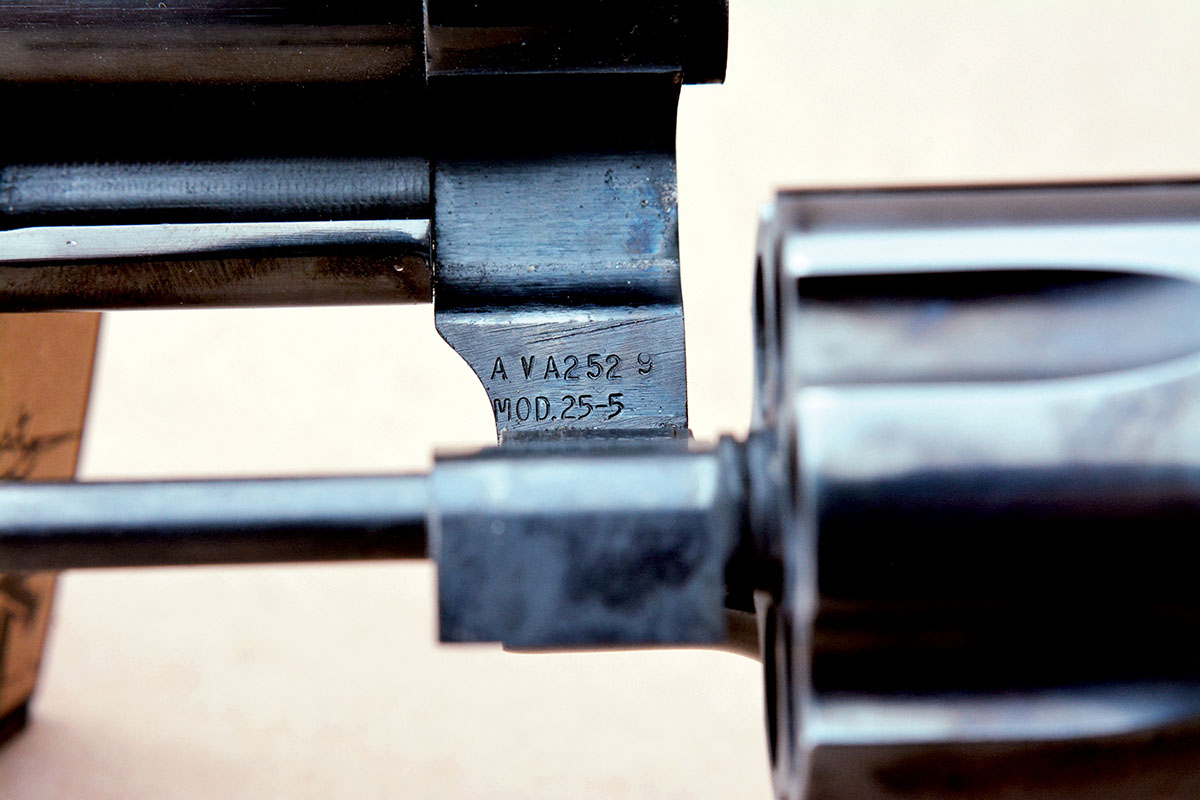
The Model 25-5 chambered in 45 Colt is a desirable sixgun.
All of the above Smith & Wesson revolvers chambered in 45 Colt have another problem; they featured throats that measured at least .456 inch, but most (and I have measured many) ran .458 inch and sometimes larger. A savvy handloader could tailor loads and get them to shoot just okay, but even the best efforts were not going to win any pistol matches. Generally speaking, accuracy was poor.
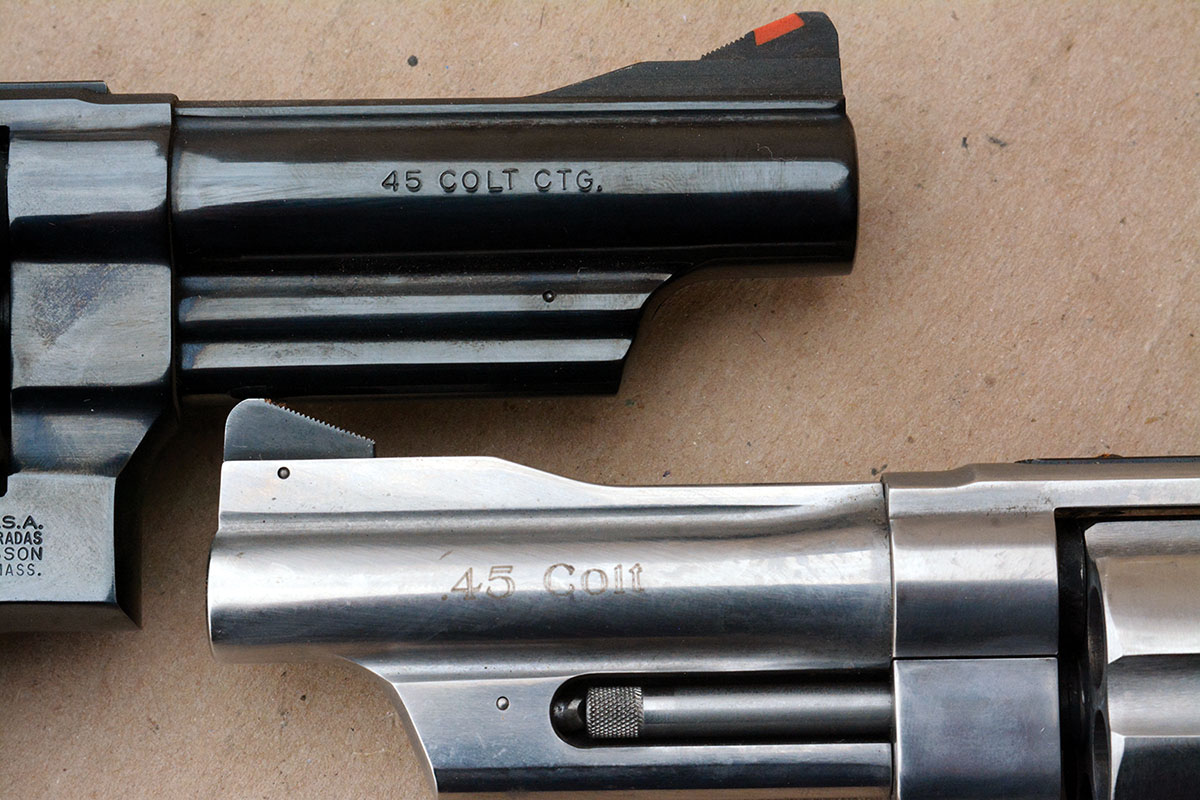
The 45 Colt is an excellent cartridge for Smith & Wesson’s big N-frame sixgun.
Smith and Wesson had a significant response from customers wanting a standard (non-commemorative) N-frame chambered in 45 Colt – they introduced the Model 25-5 in 4, 6 and 83⁄8-inch barrels with blue or nickel finishes in 1978. This was the first Smith & Wesson 45 Colt to feature the long cylinder (just slightly shorter than the Model 29 44 Magnum cylinder, but it did not feature countersunk chambers). It would accommodate handloads that exceed the industry standard cartridge length of 1.600 inches (more on that in a moment).
During the 1970s, obtaining a new Smith & Wesson N-frame revolver was a year-long waiting game, and some dealers asked double the retail price. I had a friend that was a dealer/distributor that pulled some strings and I soon had one of the first Model 25-5 45 Colts with blue finish and 4-inch barrel. I immediately began shooting my proven handloads that were very accurate in my old pre-World War II custom Colt SAA, but I could not hit a bull in the…um, I couldn’t hit the side of the barn with the new Smith & Wesson. Additional loads were tried with the same results.
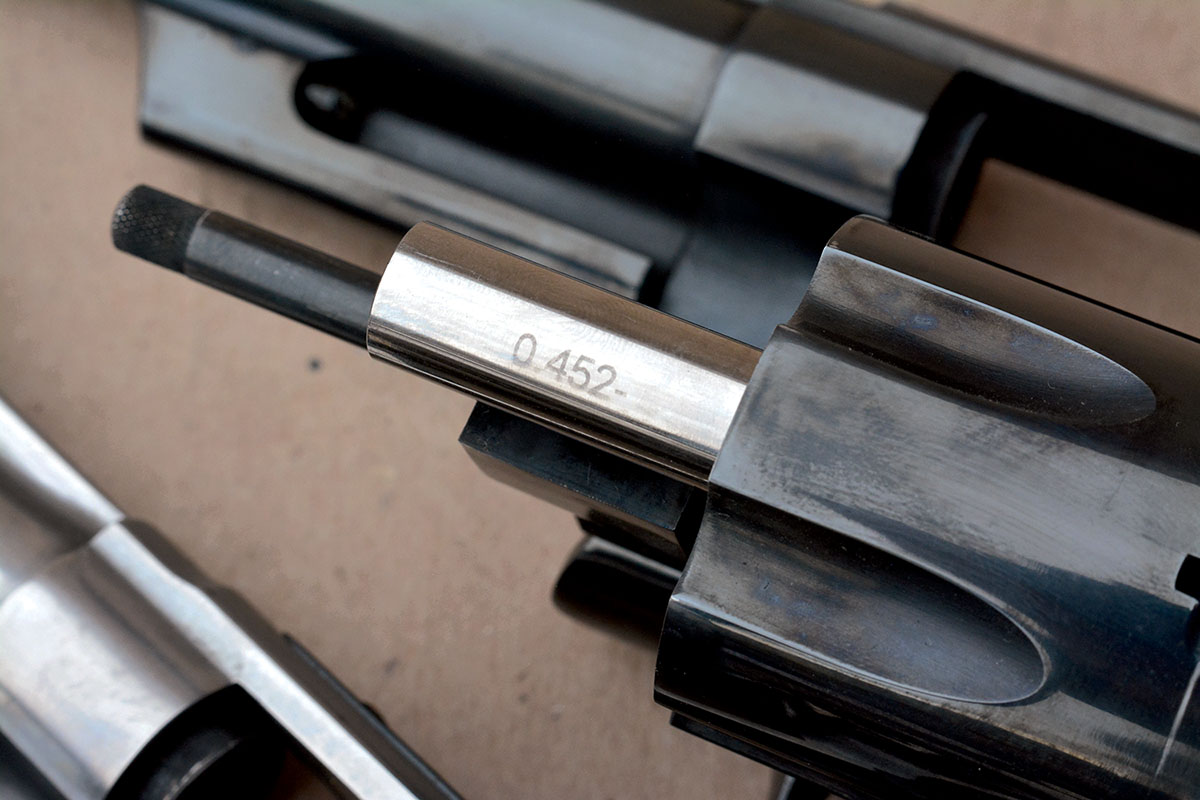
During the early 1980s, Smith & Wesson tightened up the chamber throats to .452 inch, which served to substantially improve accuracy.
My shiny new sixgun was returned to Smith & Wesson, and a year later to the day, it was returned, but the accuracy was still poor, and I soon sold it. A couple of years later, I purchased another one, but it too was inaccurate and was quickly traded off. I stuck to my proven Smith & Wesson Model 1950 Target 44 Special and a Model 29 44 Magnum, both of which were tack drivers with any reasonable load.
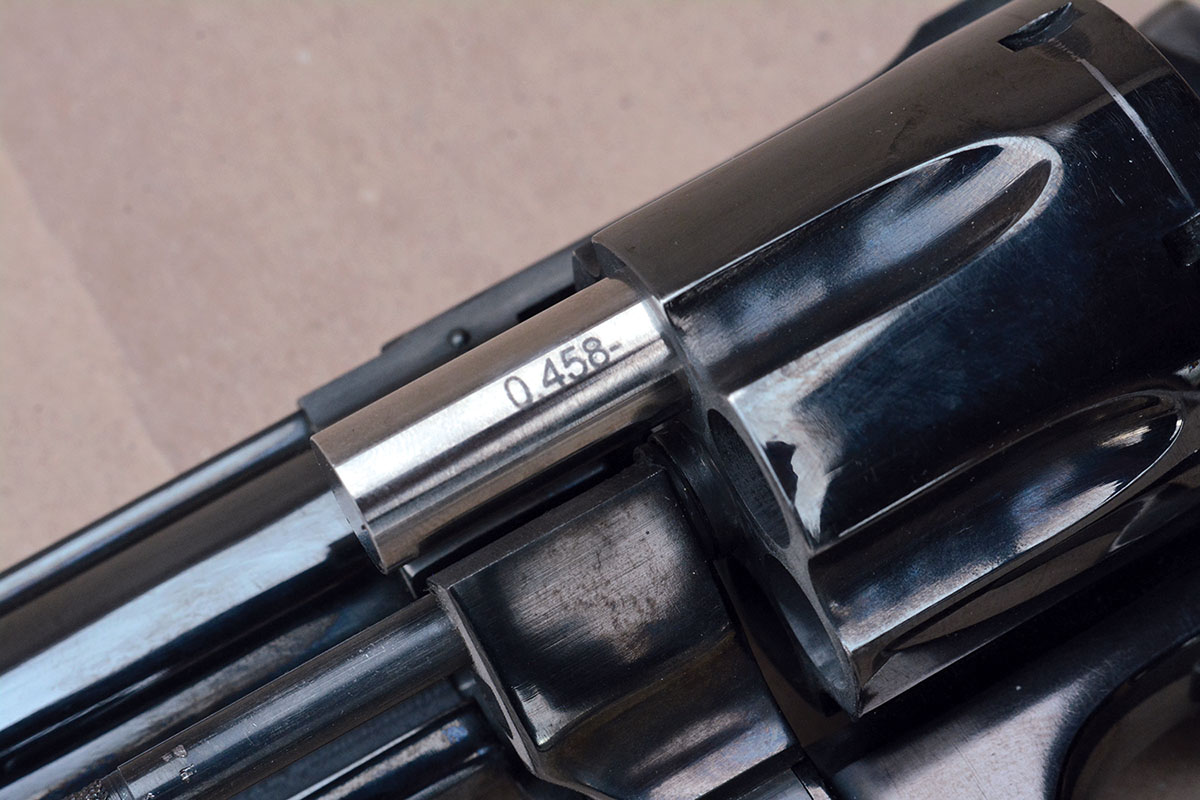
Smith & Wesson first began offering the 25-5 sixguns with long cylinders and chambered in 45 Colt in 1978, but for the first three years, most featured grossly oversized .458 inch throats that produced poor accuracy.
The accuracy mystery of these sixguns bothered me, as I really wanted a modern N-frame 45 Colt that would shoot well. The barrels of several guns were slugged, and specifications were fine. I talked to every savvy sixgunner I knew. I called Smith & Wesson, but there were no definitive answers. Within a couple of years, I became acquainted with John Taffin, and he more or less had the same experience with these frustrating Smith & Wesson guns and sold his. We discussed the matter with a largely unknown gunsmith, John Linebaugh, but he had no experience with the Model 25-5s at that time. To make a long story short, it was finally figured out that the throats were huge and measured between .458 inch and even as large as .460 inch. The throats were the accuracy-robbing culprits. It is interesting that no gun writers from that era ever mentioned this problem.
Smith & Wesson had enough complaints regarding accuracy that they changed the throats to measure a perfect .452 inch, and bingo, these sixguns became fine shooters. They even replaced cylinders for customers willing to return their 25-5 to the factory. This is mentioned as many early guns were returned and have the improved throat size. With that said, by around 1982 (and maybe earlier), production guns came standard with the improved chambers.
There are too many variations of the Model 25 to discuss, but suffice to say that since around 1982, they have all been properly chambered and are great shooters. To save confusion, Model 25s with an odd dash number (such as 5, 7, 9, 11 and 13) are chambered in 45 Colt, while even dash numbers (such as 2, 4, 6, 8, 10 and 12) are chambered in 45 ACP.
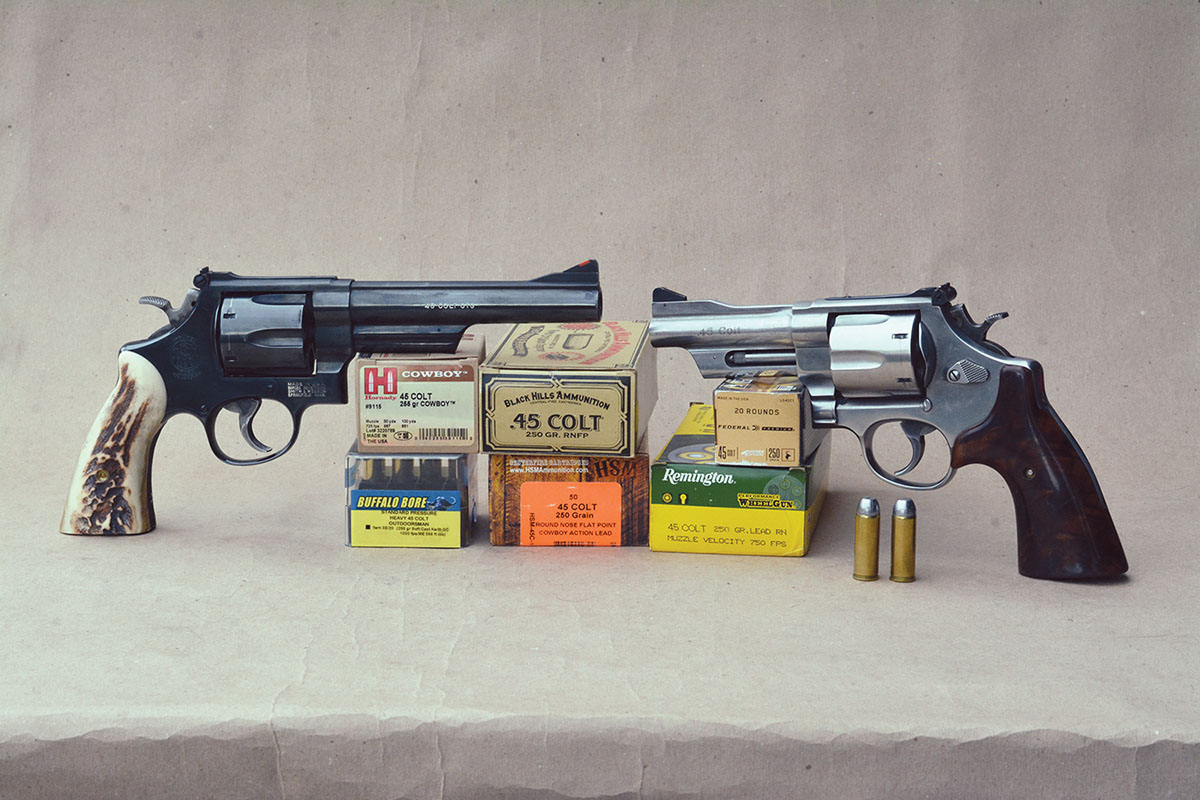
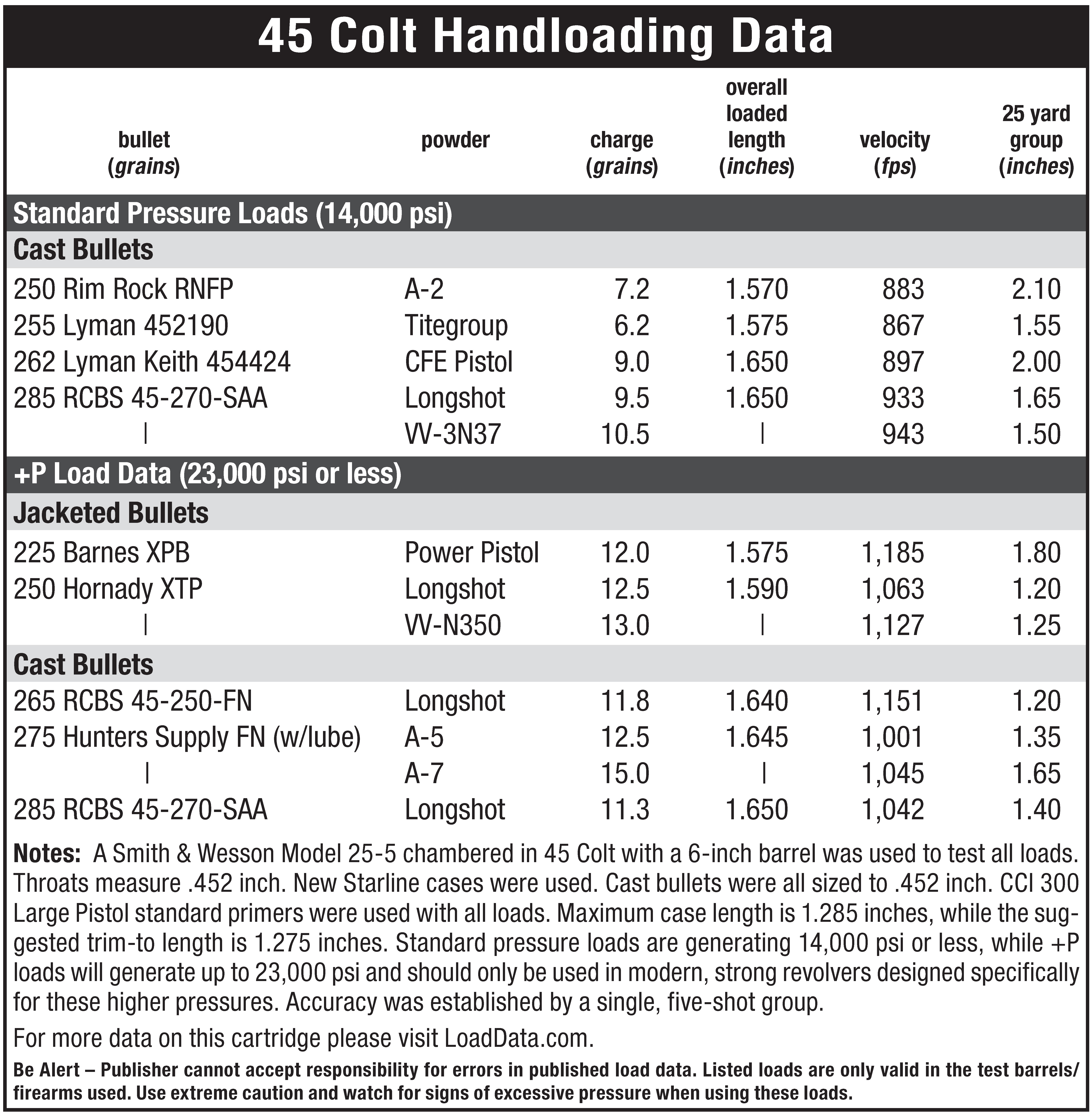
Due to the many old black-powder-era guns chambered in 45 Colt, factory loads are often loaded to low pressures. Handloading can substantially improve performance.
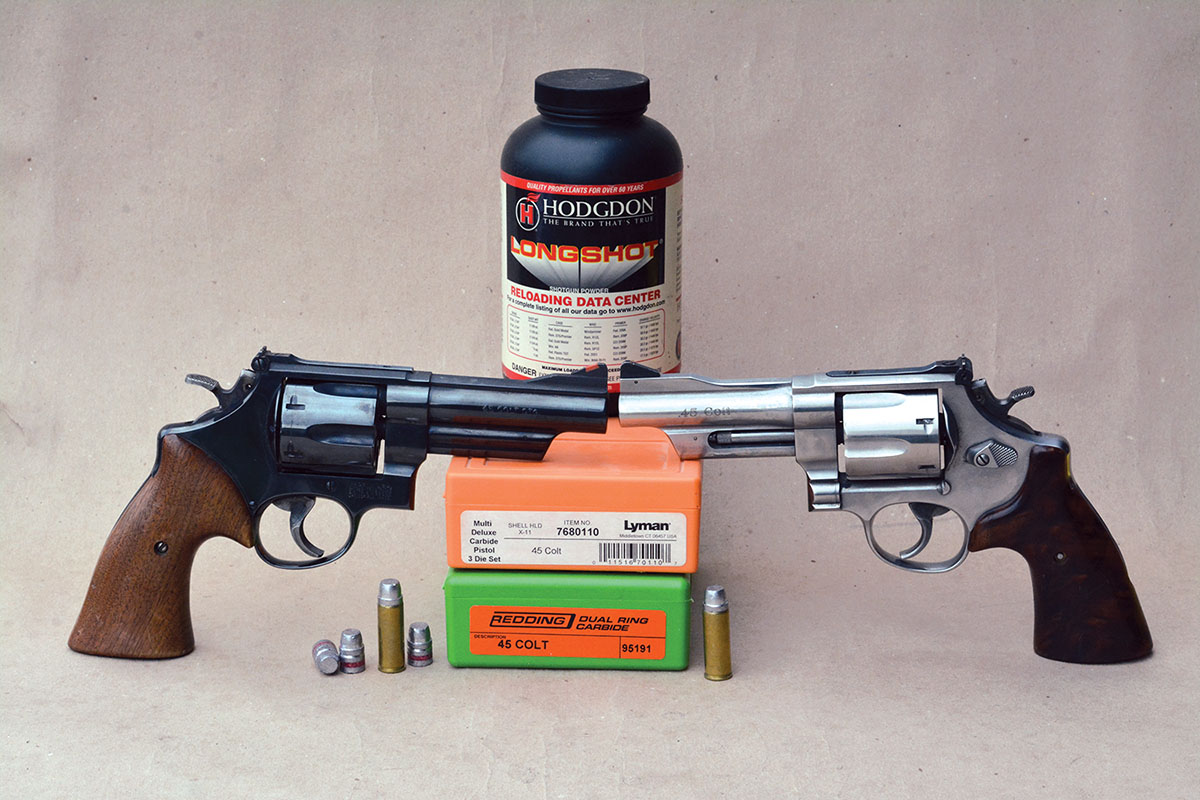
The Smith & Wesson Models 25-5 and 625-6 in 45 Colt can enjoy substantially improved performance through handloading.
This brings us to the Model 625 (aka Model of 1988/Model of 1989), which is a stainless-steel version that has been produced in several additional configurations. I am especially fond of the 625-6 Mountain Gun that was first offered in 1996. It features the light-tapered 4-inch barrel, standard-width smooth trigger and hammer, and shares the same Endurance Package features that were incorporated on the Models 29 and 629 44 Magnums beginning in 1988 and finalized in 1990. Some of the engineering changes included longer bolt stop notches on the cylinder, a new heat-treated yoke retention system, a radius stud package and overall tighter tolerances. Oddly, the 625 frame is notched for the clever internal bolt block that prevents the cylinder from unlocking during recoil, but S&W chose not to include that part on 45 Colt models. Regardless, this model features fully machined lockwork parts, a cut-rifled barrel and .4515-inch throats. My pair of Mountain Guns are incredibly accurate and have been used to take several head of big game along with many pests and varmints. They are the pinnacle of quality, endurance and accuracy of the Smith & Wesson N-frame 45 Colt sixguns. Around 2000, the EDM rifling appeared, along with the silly key lock, MIM parts, frame-mounted firing pin and the overall quality soon declined.
Just over a year ago, Smith & Wesson began offering the 629 Mountain Gun in 44 Magnum. Sample guns were void of the EDM rifling and lock. Based on demand, it is speculated that the 625 45 Colt will soon be offered. I have not tested this new series of Mountain Guns, but am told that Smith & Wesson has worked hard to improve quality.
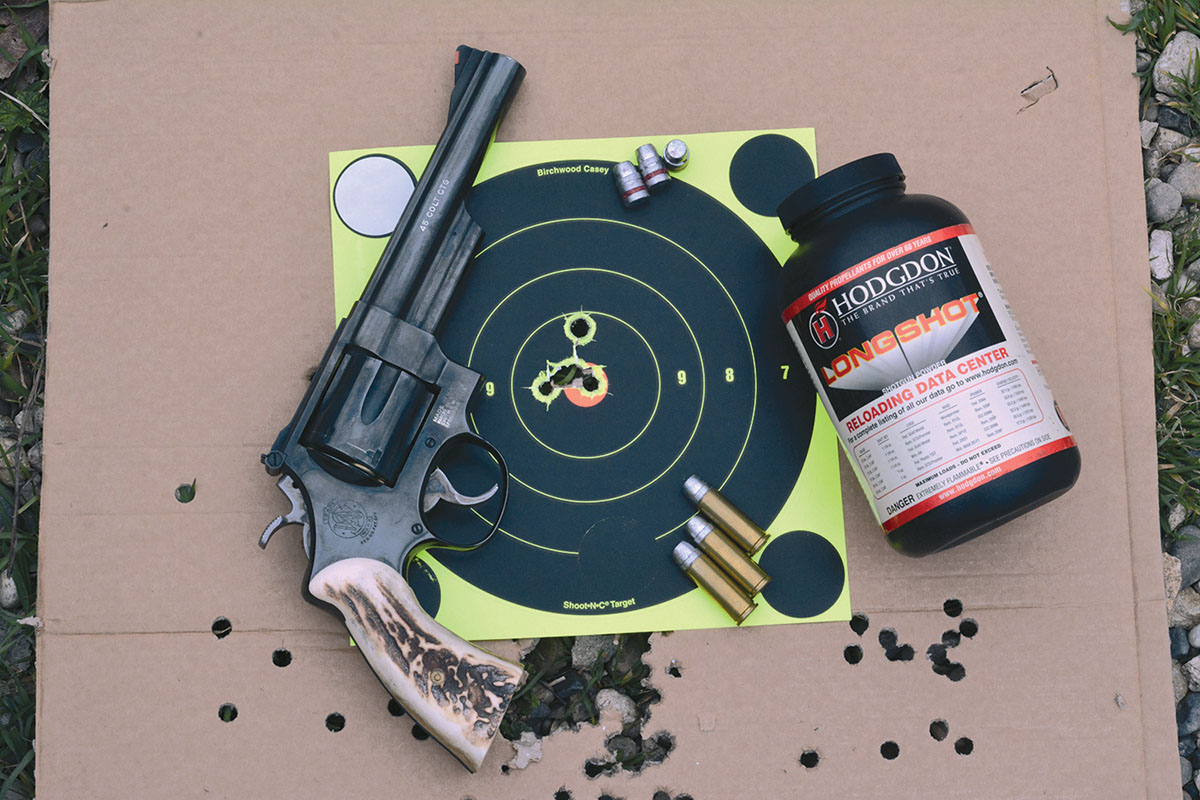
Brian has obtained impressive accuracy from his Model 25-5 45 Colt sixguns, but especially with handloads.
The 45 Colt is a truly grand cartridge that is powerful, yet pleasant to shoot due to its modest muzzle report and slow recoil. Even the rather mild factory loads that traditionally push a 250 (Remington) or 255-grain (Winchester) lead roundnose with flatpoint bullet at 860 feet per second (fps) are effective and more powerful than the 45 ACP. Handloaders can choose better bullets and increase velocity to obtain reliable, deep wound channels and produce better shock on game or other applications.
Due to the many old black-powder-era Colt SAA revolvers (produced from 1873-1900) still in circulation, maximum average pressure for the 45 Colt, per the SAAMI (Sporting Arms and Ammunition Manufacturers’ Institute), is established at 14,000 pouns per square inch (psi). However, due to its larger cylinder, thicker chamber walls and modern steels, the Smith & Wesson Model 25/625 can easily handle handloads that produce greater pressure. There has been much published data for “Ruger Blackhawk 45 Colt” loads and pressures that run up to 32,000 CUP; however, this data is excessive for the Smith & Wesson revolvers and should never be used. While these guns will take greater pressures than outlined here today, I prefer to limit loads to 23,000 psi, which is the same as the 45 ACP +P. Incidentally, Smith & Wesson recommends using +P 45 ACP loads in Model 25 revolvers chambered for that caliber. However, due to the 45 Colt’s much larger case, when loaded to that pressure level, it offers substantially greater performance. When loaded to this pressure level, the gun will enjoy a long life, which is important to most shooters.
The longer cylinder of the Model 25-5 and all subsequent versions allows cartridges to be loaded with an overall length up to 1.720 inches. This accommodates the use of heavier bullets that seat out of the case to increase powder capacity and lower pressures. When 250 to 300-grain cast bullets are pushed to around 1,050 fps, these are potent loads that are capable of taking deer, black bear and even elk with ease and will fully penetrate on broadside shots, but are nonetheless very manageable by most shooters, and the muzzle report is substantially less when compared to magnum cartridges. This is a truly great sixgun and cartridge combination.