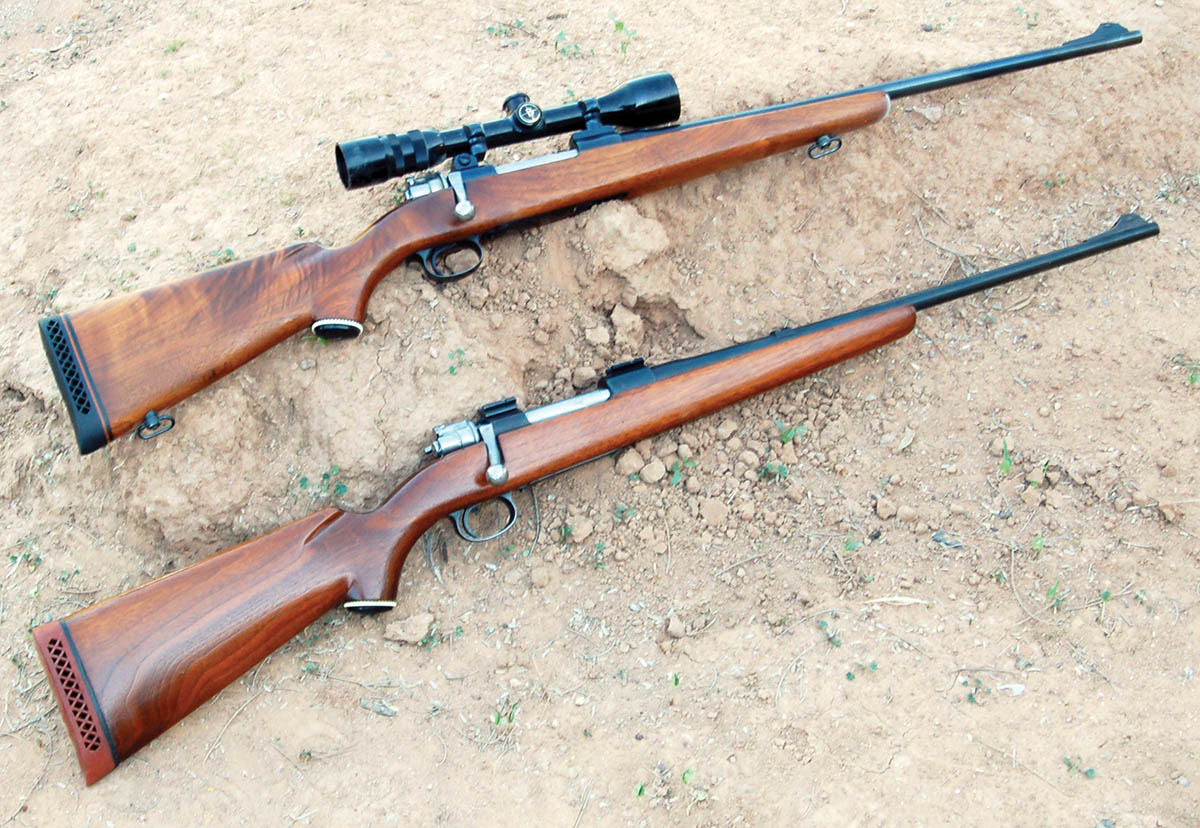
J. C. Higgins (Sears, Roebuck) Model 50s on post-World War II FN Mauser actions using modern steel and no case hardening.
Humans have been tinkering with weapon making ever since the first person tied a pointed rock to a long stick. He no longer had to get close enough to his meat source to bash it with a club, which on many occasions didn’t turn out well.
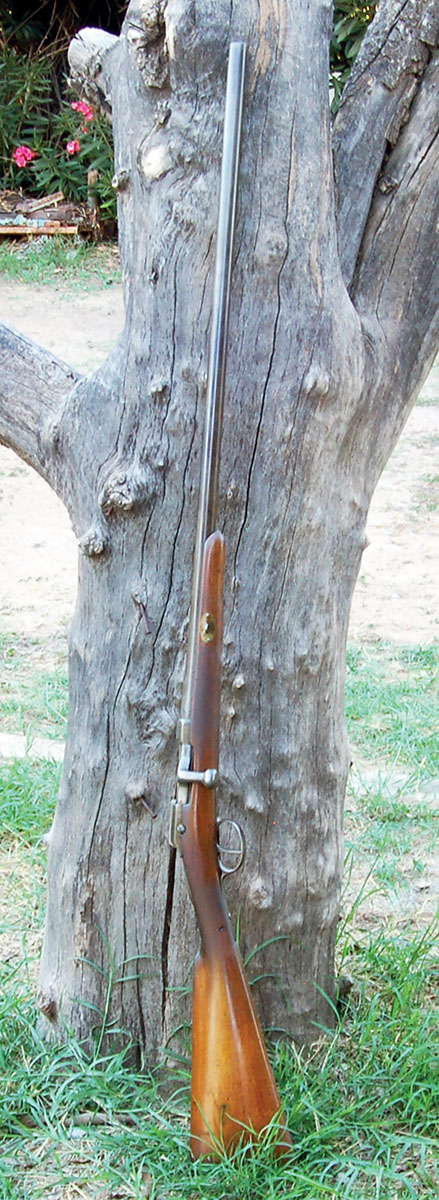
A home-made shotgun (except for the barrel), made around 1900 by an Iowa farmer, shows America’s fascination with making firearms.
In modern times, kings and their armies used these amateur designs to defend or expand the realm. The allure of a machine that could launch a projectile and hit a distant object was overwhelming to many individuals. A good example is the photo of the bolt-action shotgun, which (as the story goes) was made about 1900 by an Iowa farmer so he could shoot rabbits. There is not a machine tool mark on the thing, only file marks, except for the barrel that was salvaged from another gun. How the receiver was made is a mystery. Yes, I have fired it with black powder and killed a couple of rabbits. It worked fine.
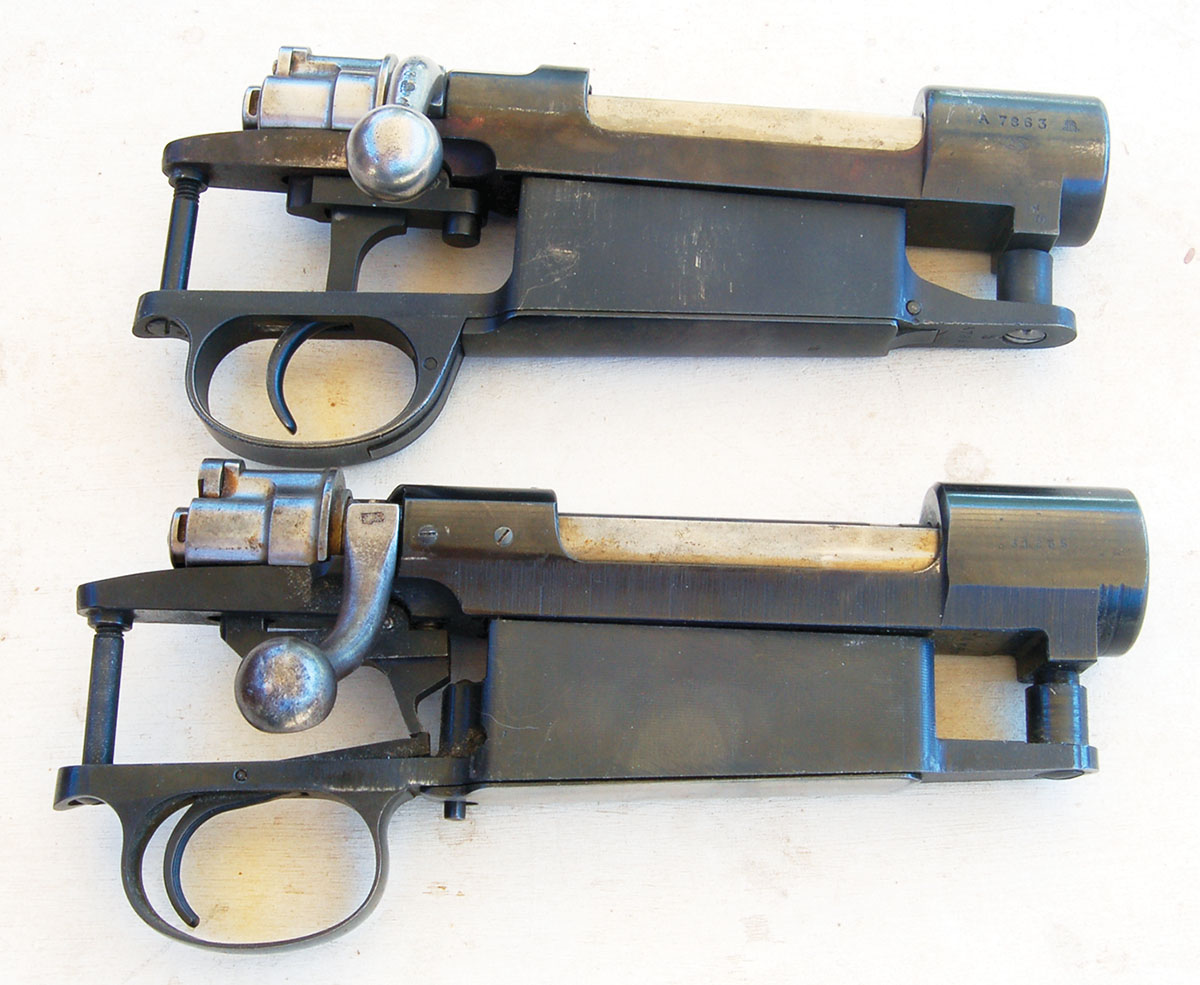
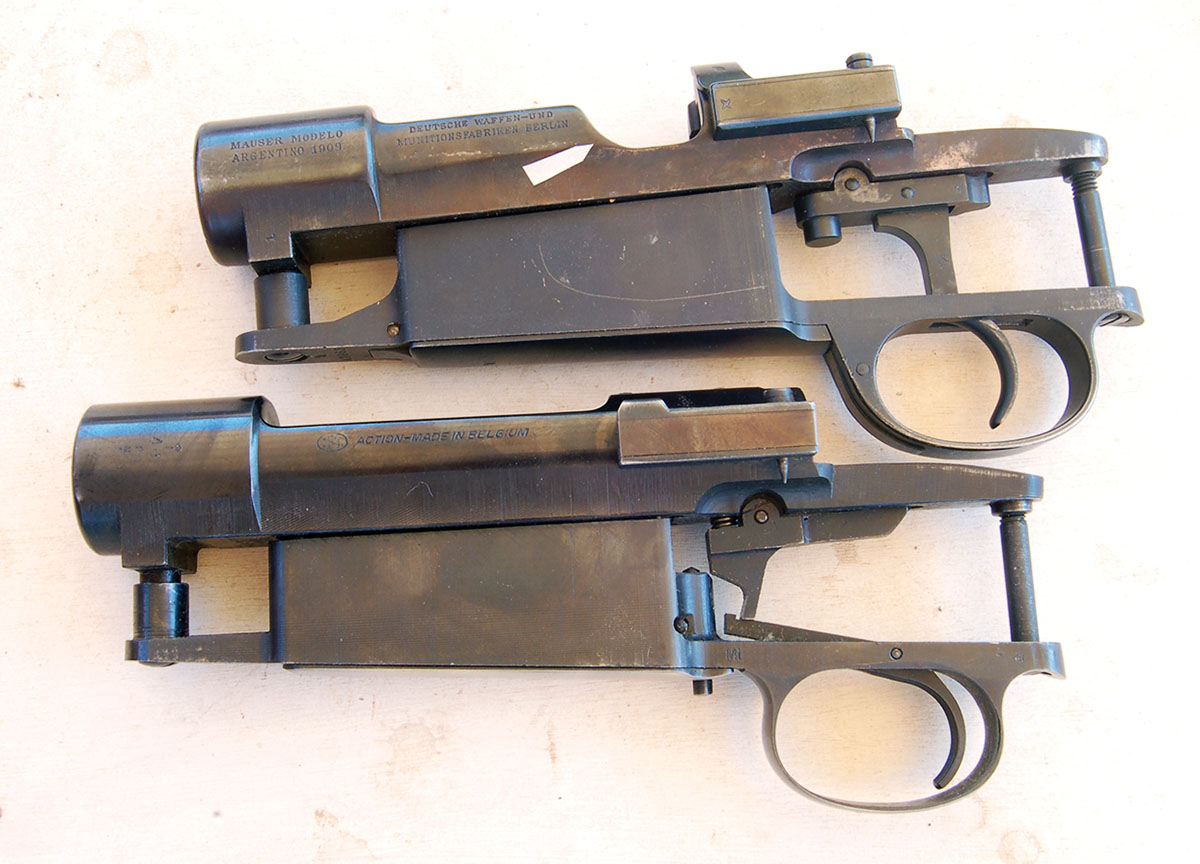
A Military M98 (top) and an FN commercial (bottom). Note the single-stage trigger on the FN action.
The point here is that gunfolks are drawn to making usable guns from salvaged parts and those they make themselves. It is just fun to make something unique and functional from basically nothing. The guns are never needed. They are just made for the satisfaction of it.
The heyday of amateur gun building occurred from about 1950 to 1980, with the import of countless obsolete bolt-action and single-shot military rifles. These were disassembled, but retained only the action, which was then drilled, filed and reshaped, then barreled and chambered for a wildcat cartridge. Riflefolk would finish one project, then start another. Great fun!
Home shop gun building is not as popular today because of large price increases of parts and operations that most hobbyists· can’t do themselves, such as barrel fitting. Availability of downright cheap “entry-level” bolt rifles in all the hot new cartridges hasn’t helped the situation either.
The presence of a thumb cut (arrow) means it is a military action (top). The commercial action (bottom) has none.
Nevertheless, many riflefolk, who have come into the field in the last twenty years, eventually want to build a classic Mauser-action hunting rifle. Unlike their grandfathers, they cannot buy a surplus M98 military rifle for twenty bucks or so! Today, the price is in the hundreds. Even if price is not a concern, another question regarding action safety has come up among new shooters.
Shooters today are more technologically oriented and ask if hundred-year-old Mauser actions are safe with hot new rounds. Good question. Proof loads for Mauser M98 military rifles chambered in 7.92x57mm range from 50,000 to over 80,000 pounds per square inch (psi), depending upon the reference. Richard D. Law, in his Backbone of the Wehrmacht: The German K98k Rifle,
1934-45, says M98 proof loads developed 500 kilograms per square centimeter. My conversion formula gives this as 64,000 psi. This would be adequate for service ammunition developing 50,000 to 55,000 psi or a bit more, but what about today’s new cartridges that show maximum average pressure (MAP) numbers of 65,000 psi or more?
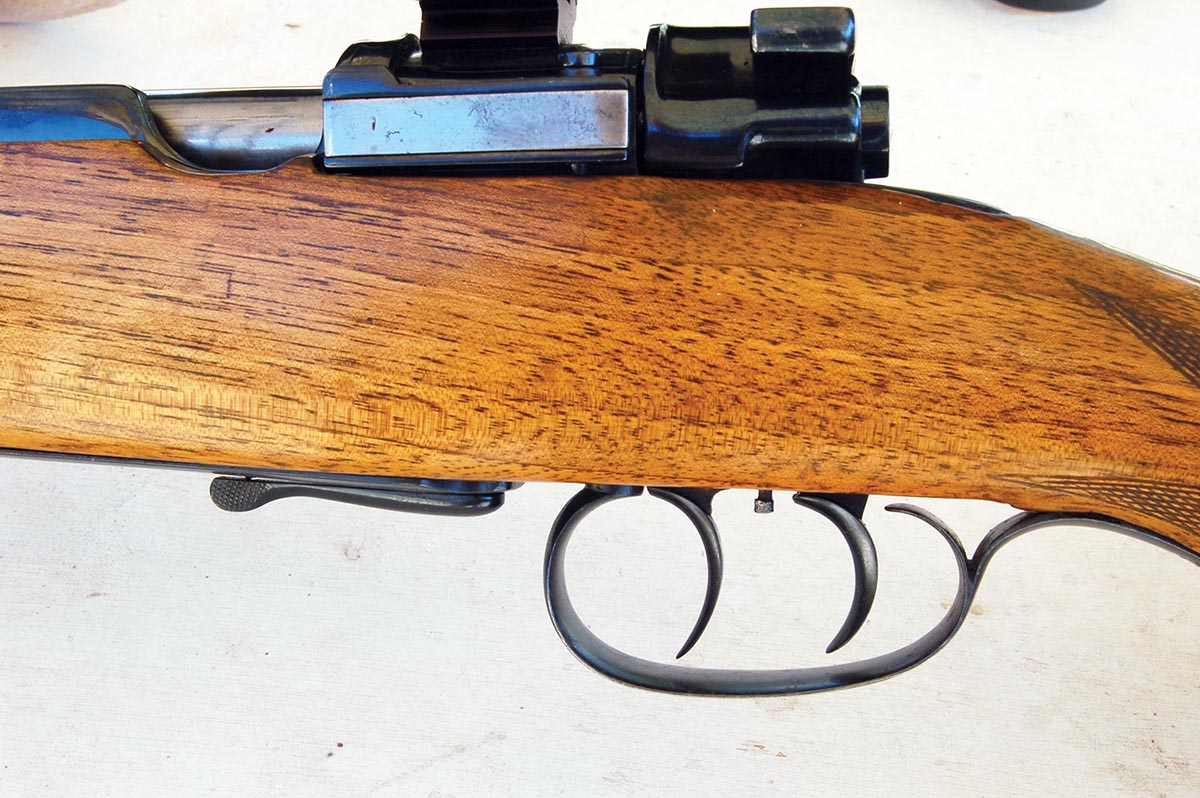
Double-set triggers and lever floorplate release with all markings removed were common gunsmith additions to military actions. Note the thumb cut in the side rail.
Obviously, an old Mauser military action is not going to disappear in an orange flash if a round is fired that produces slightly more pressure than the proof cartridge. Given the cavalier attitude of many handloaders and gunsmiths in the early post-World War II period, such loads were not rare. However, fifty years ago, gunsmiths who did rebarreling, riflefolk and gun magazines started discussing something they called “locking lug setback,” which created dangerous headspace in the case-hardened Military Mauser actions. The cause was said to be pounding due to hand-
loads that were too hot. I have seen a few such rifles over the years. All chambered the 308 Winchester or belted magnum rounds, and all had fired only maximum hunting handloads for years. None of the rifle’s owners noticed the increasing headspace until partial head separations began occurring.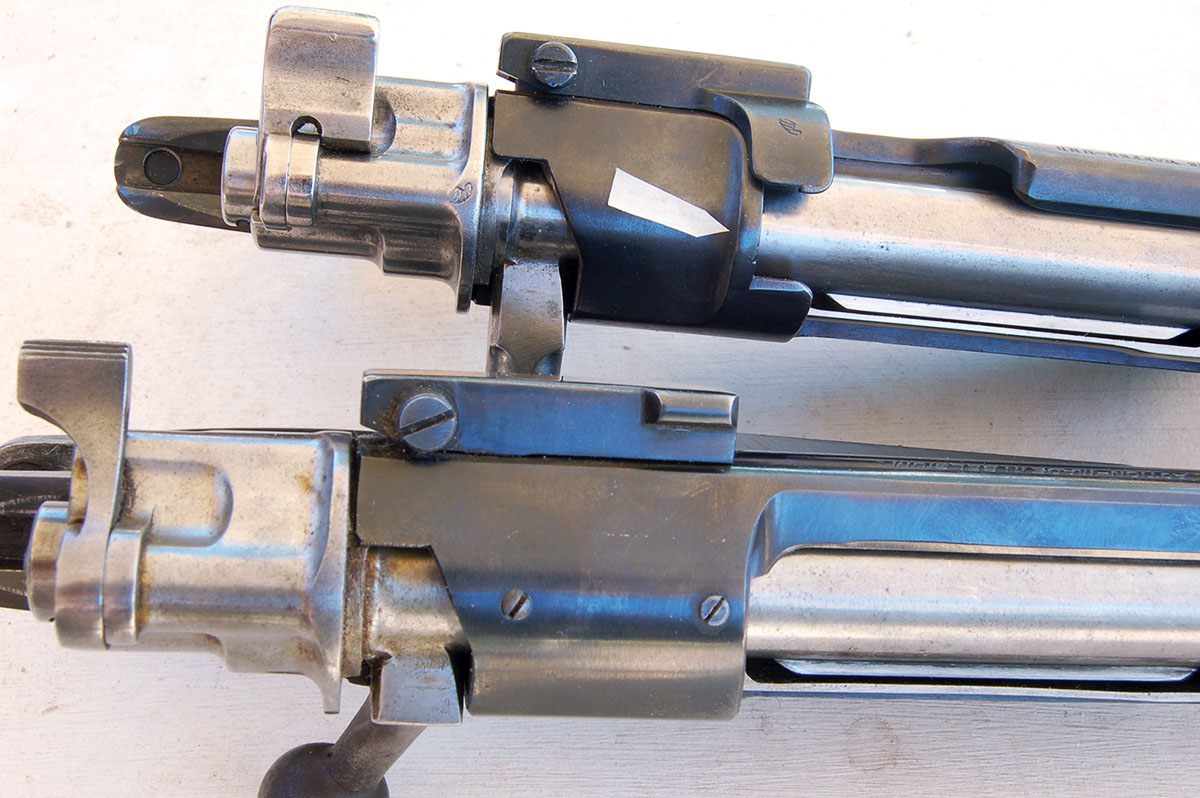
Another indication of a military action is a charger cut (arrow). A commercial action deletes it.
Given the foregoing, it would not seem to be a good idea to build a rifle
for a cartridge developing much over 50,000 psi breech pressure on a surplus M98 action if it is going to be shot a lot. This includes the 308 Winchester belted magnums, and certainly the new rounds that run pressures to 65,000 psi or more.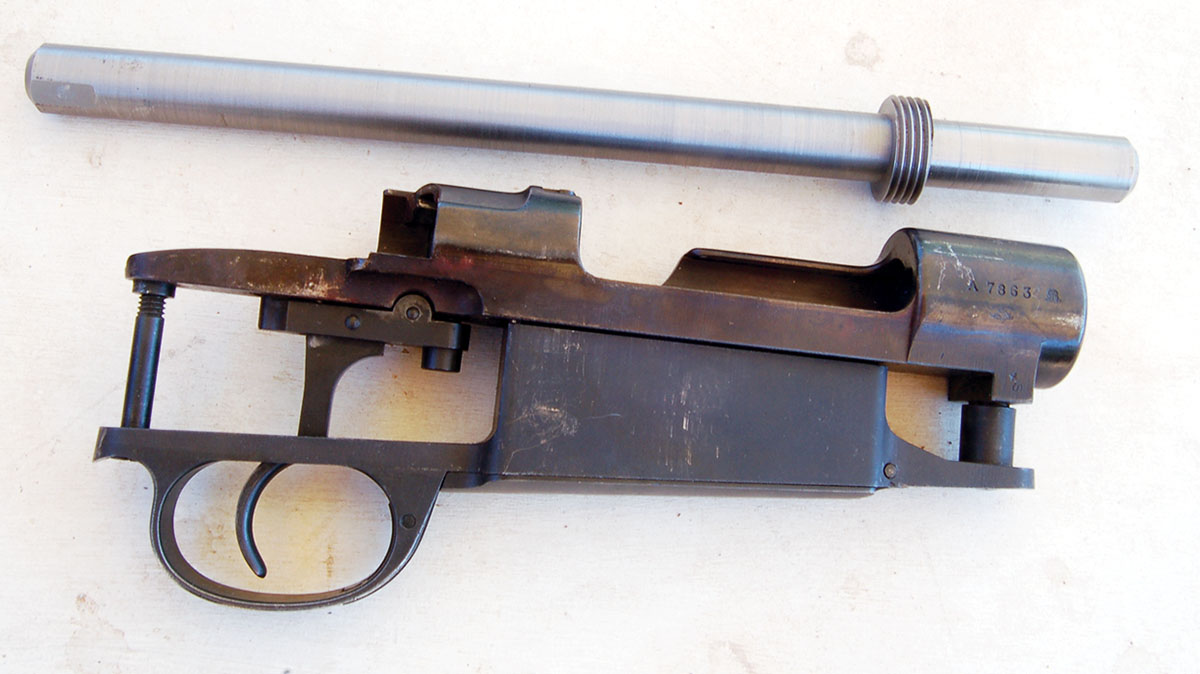
The mandrel screws into action, allowing mounting in the lathe. A tool post grinder then trues the receiver ring but it can also grind off the crest and stamping on the left receiver wall.
If a classic hunting rifle on a Mauser M98 action is wanted in one of these high-pressure cartridges, there is an option: a post-World War II commercial M98 action. The first of these was Fabrique Nationale d’Armes de Guerre (FN) in Liege, Belgium. In 1947, it ran a full-page ad picturing an M98 military action without thumb or chamber cuts, a swept back low bolt handle, a single
stage trigger, and stating, “11 F. N. Mauser actions are properly and uniformly hardened.” No doubt they were because barreled actions were offered in 270 Winchester, a 65,000 psi cartridge that was loaded hotter by most handloaders at the time. A photo shows the left receiver marking of what is believed to be one of these actions. Unfortunately, the classic bolt sleeve was replaced by a streamlined thing with tab safety behind the bolt handle about 1957. Yuck!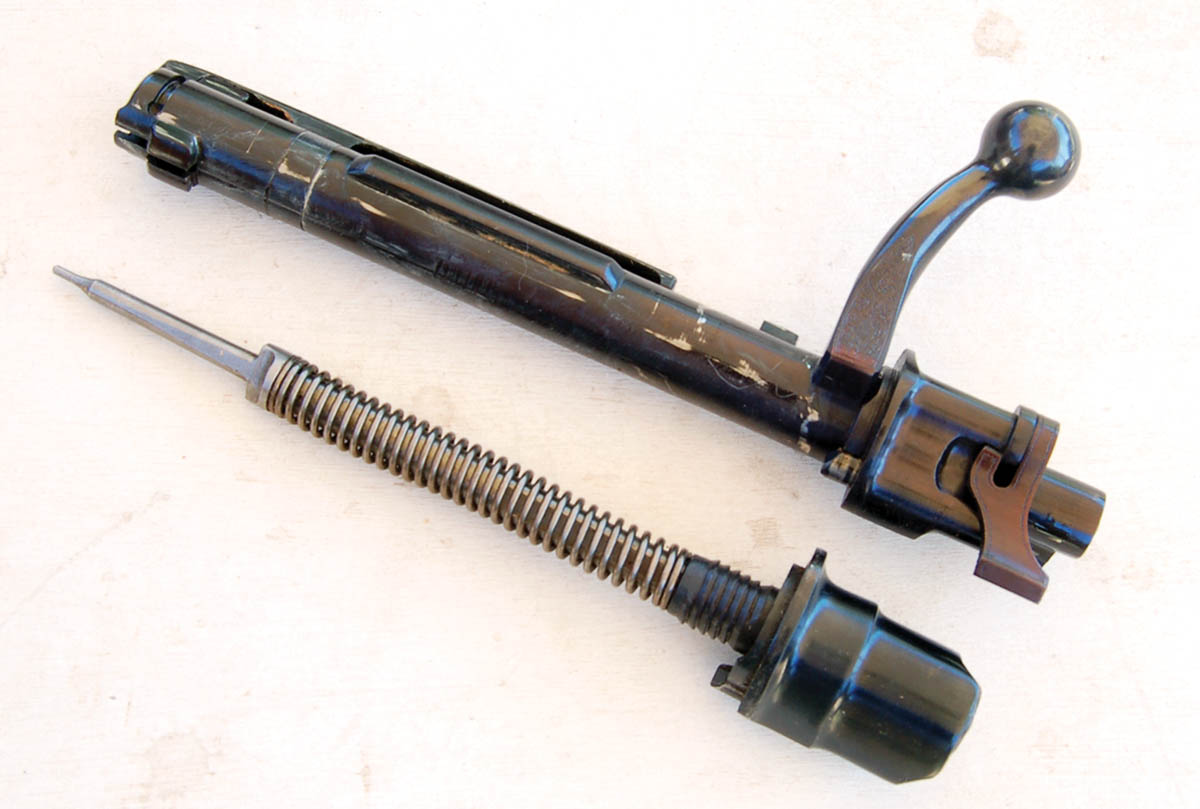
The modern bolt sleeve of the Mark X action (bottom) was replaced by the military unit (top). It looks better.
The 1947 FN action was used on the J.C. Higgins Model 50 sold by Sears, Roebuck & Co. from about 1952 to 1957. Chambered in 30-06 and 270 Winchester, it is a perfect rifle to remodel into a classic M98 sporter in these two cartridges – or just use the action, rebarrel and reshape the stock. The rifles seem to be quite common and relatively in
expensive, probably because of the J.C. Higgins name. 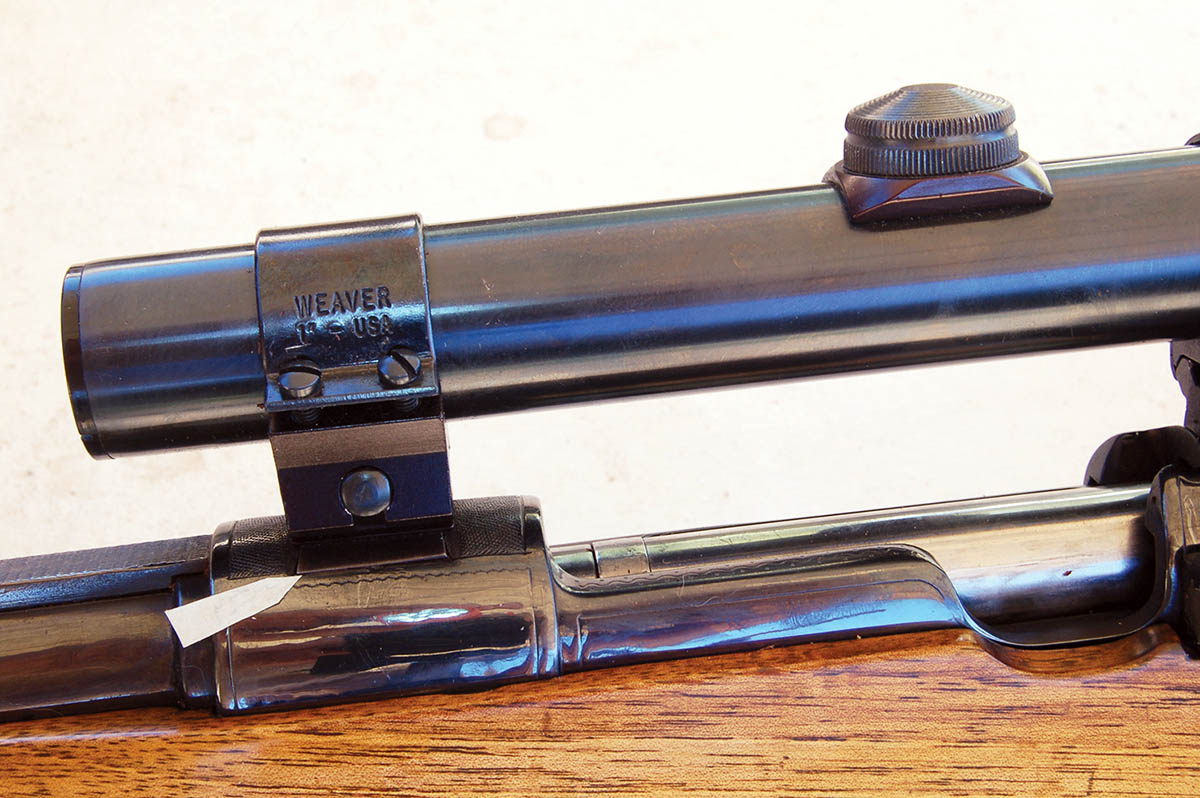
Filler for the claw-mount base can just be seen peeking out from under the Weaver base (arrow). All markings were removed from military action. Note the thumb cut.
About 1955, “commercial” Mauser M98 actions began appearing with no markings except for the word, “Spain.” They had thumb and charger cuts. A few years later, these actions (with no thumb and charger cuts) showed up marked “Golden State Arms Corp.” Similar actions were
offered by others. Spanish-made M98 military actions had acquired a reputation for being soft, and it carried over to these actions. They didn’t sell well but are still seen at gun shows.The large mail-order firm Herters,Inc., in Waseca, Minnesota, imported a M98 action called the “J9.” The bolt sleeve was streamlined, with a safety tab behind the bolt handle. The receiver was stamped “MADE IN YUGOSLAVIA.” Herters catalog states the actions are “the finest and most expensive ordnance steel made and are proof tested. That was probably true as barreled actions were available in 7mm Remington and 300 Winchester Magnums. Having said that, several actions that I have seen were real projects. The polishing was bad, triggers too heavy, safeties almost impossible to engage, and on and on.
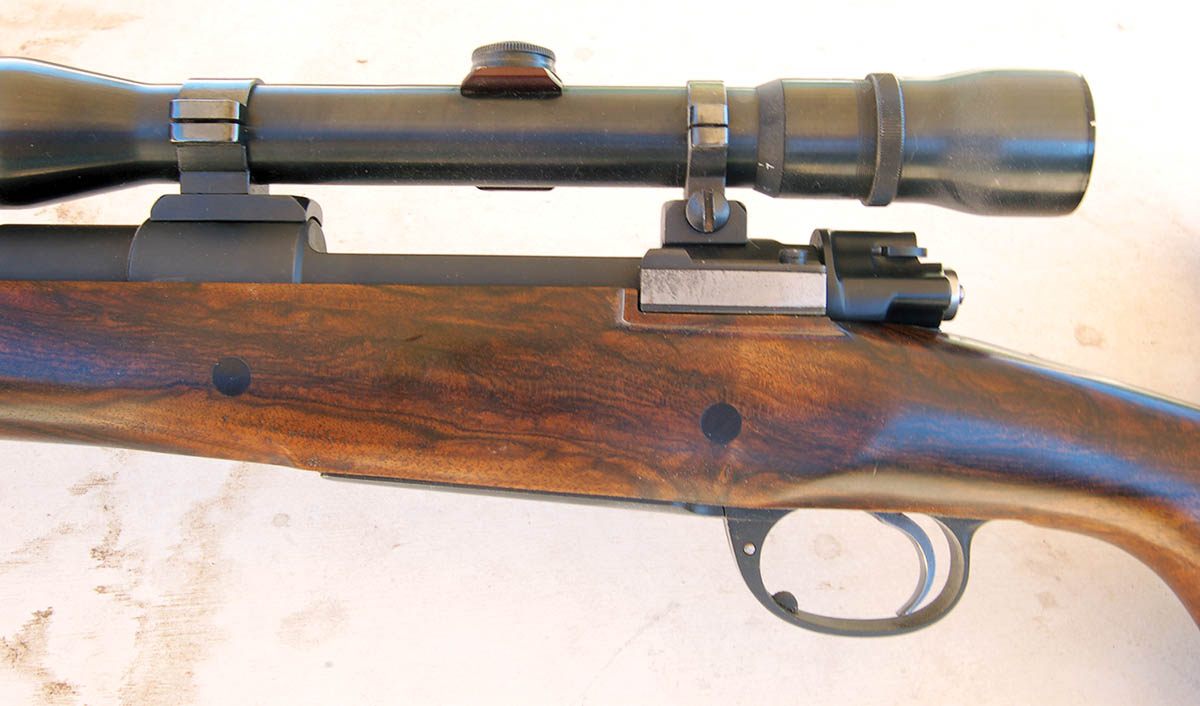
A high-dollar custom Mauser on a commercial action? No thumb cut, but careful examination shows it was welded up, along with the charger cut. Custom work costs several times that of a new Mark X action.
Perhaps the best of the commercial M98s was the Interarms Mark-X (Mark Ten). It was made in Yugo
slavia by Zavodi Crvena Zastava. The bolt sleeve is streamlined with a safety slide behind the bolt handle. That’s okay because the striker/bolt sleeve assembly can be replaced with military parts, giving the classic Mauser appearance. The trigger is then replaced by a Timney unit. All other custom alterations commonly done to military M98s already exist on this action. Best of all, references state the action came with a proof-tested certificate indicating a proof pressure of 70,000 psi. This means modern steel was used, and case hardening was not necessary. I know this is true because receivers and bolt handles are easily engraved using standard high-speed engravers.Finally, be alert for M98s being sold as modern commercial actions, but with no markings. Some gunsmiths make a mandrel to screw into military actions, then mount it between centers in a lathe and use a tool post grinder to true up the receiver ring for scope mounting. It is also possible to grind off the crest and markings on the left sidewall, creating a “commercial” action. Some of these actions even have a double-set, metal trigger bottom. Sorry, but if the action has a thumb cut it is military and should be treated as such.
The silliest example of this is the well over two-thousand-dollar porter shown in the photo having no markings, and no thumb or charger cuts. It was sold as a custom commercial action. Unfortunately, close inspection showed both cuts had been welded up. A good job, yet the cost of the action work could have bought three Mark X actions. The cartridge? A wildcat, blown-out 7mm magnum.
There are many standard pressure rounds for military M98s that will take any deer, elk or antelope that ever lived. It’s not necessary to stress the old actions.