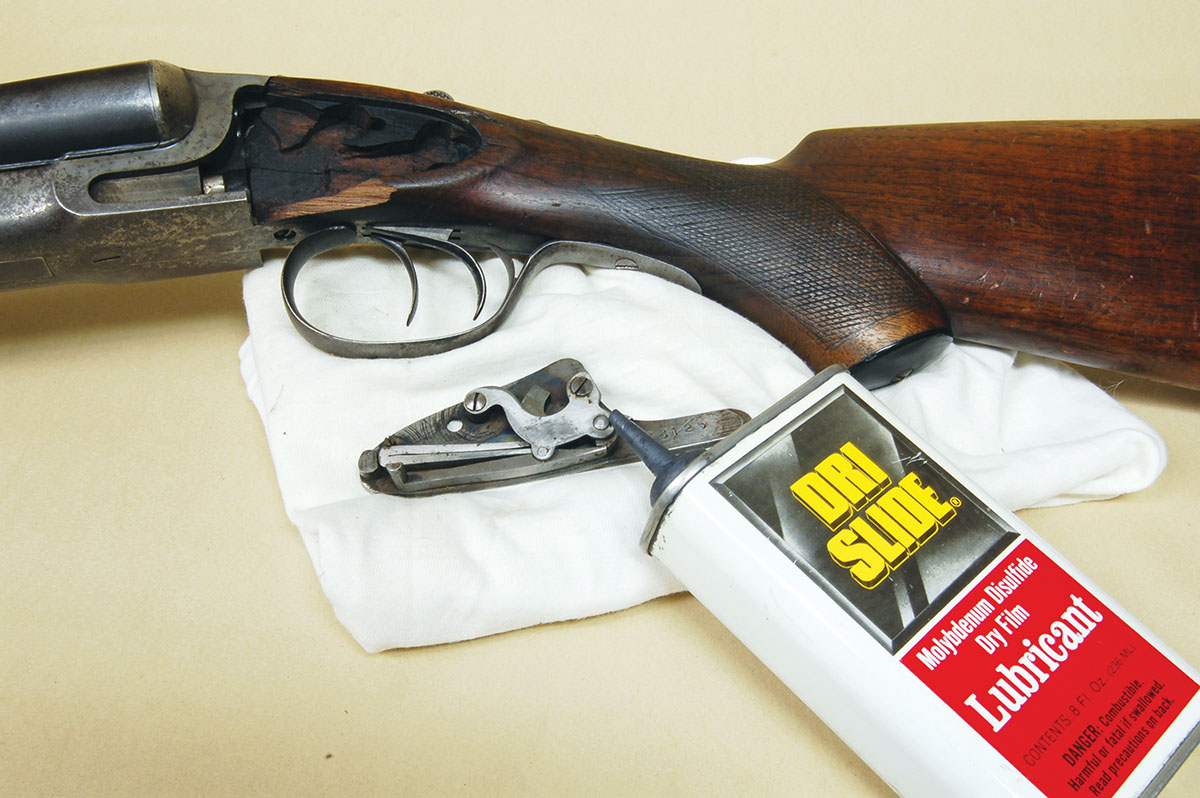
DRI SLIDE is a perfect lube for old sidelocks, which should not be totally disassembled for entertainment.
The years directly following World War II saw a large increase in both shooting sports and just informal plinking. Every weekend, the local gun club rifle and pistol ranges saw dozens of folks shooting all types of arms, including many big-bore hunting rifles. This seemed strange as my part of rural Illinois was noticeably lacking in elk, moose and grizzly bears. Here was my first encounter with what are now expensive “classics” but were then just old guns.
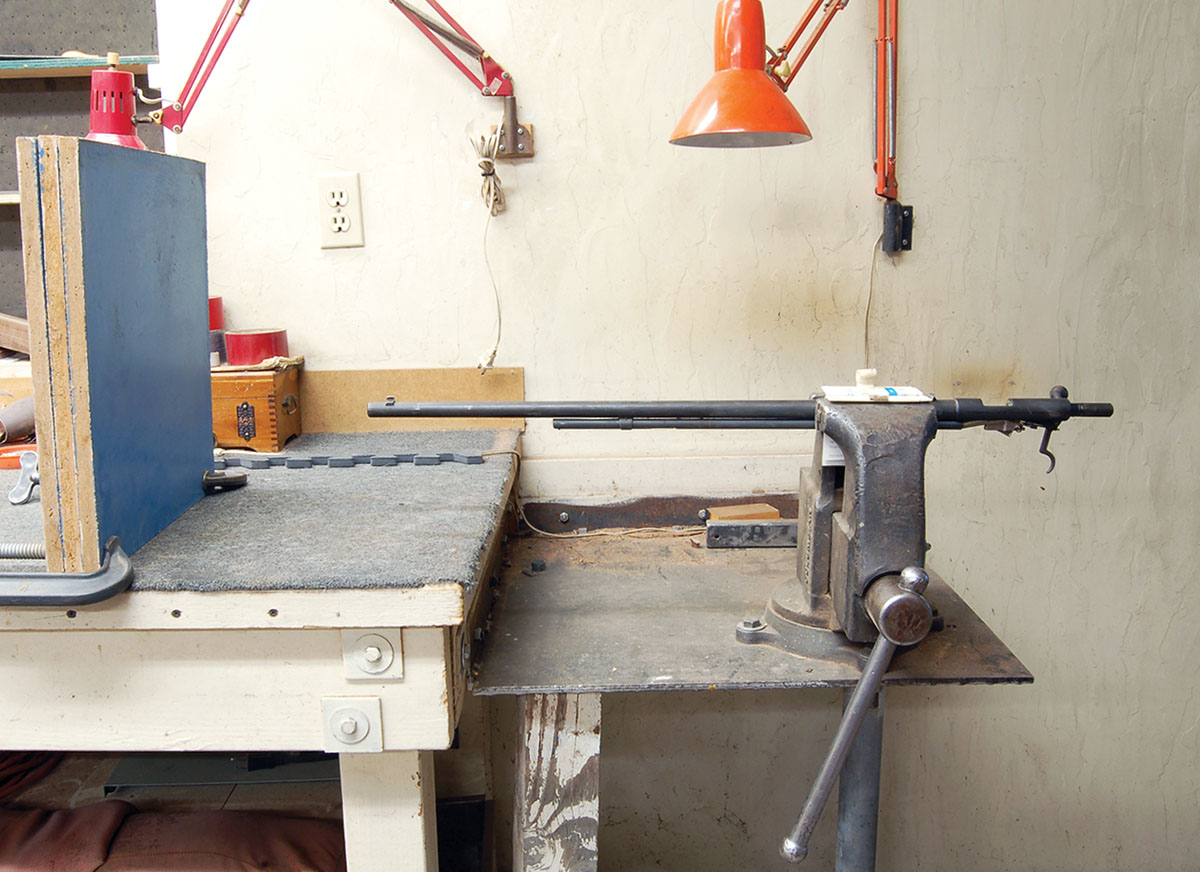
This is the setup described in the text for correcting feeding problems in 22RF tube magazines. The bullet stop on the left is mandatory because live ammunition must be used.
An interest in anything involving firearms resulted in a part-time job at a gun shop. The work involved doing whatever the owner didn’t want to do, like disassembly, cleaning and lubing customers’ guns or shop guns destined for the “used rack.” If rebluing was to be done, guns might not be reassembled for a few days. Better remember how to put them all back together again.
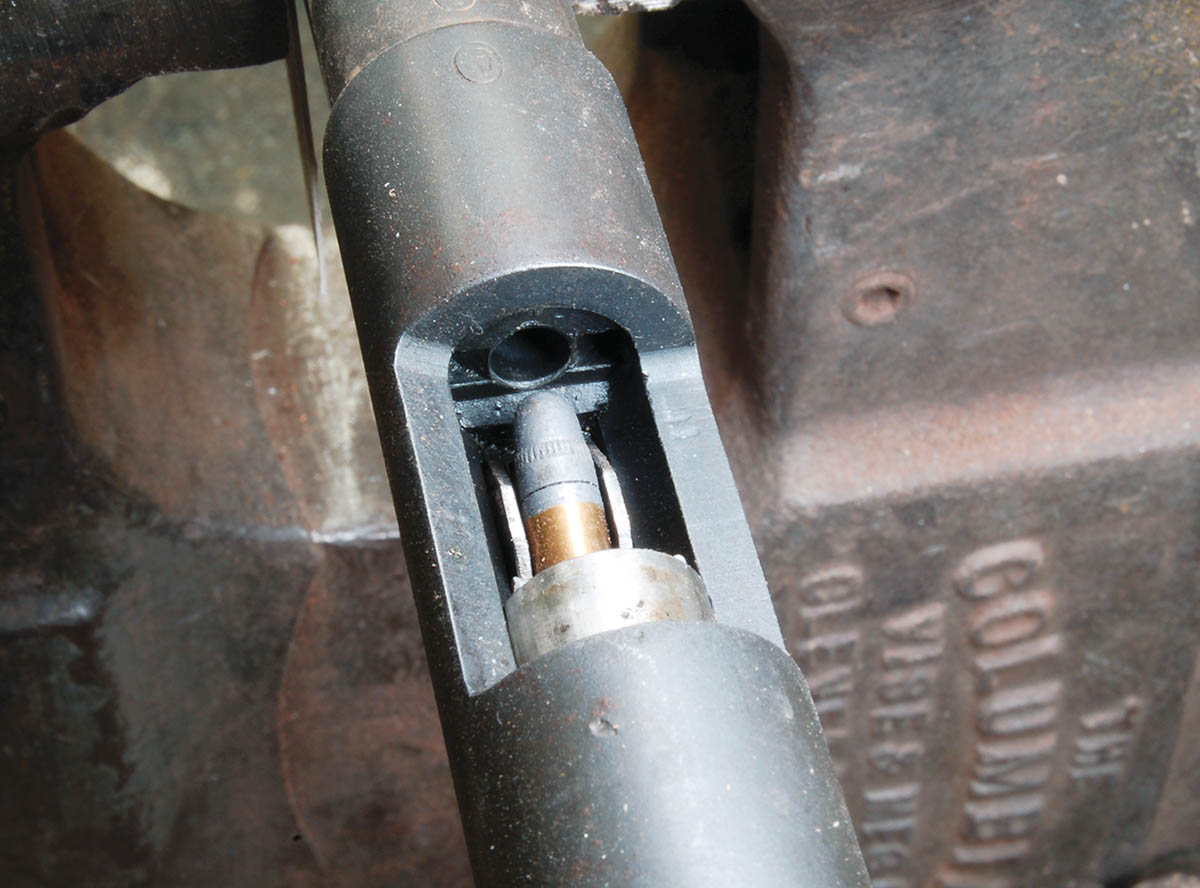
The cartridge is positioned low due to bent parts. This can be corrected.
Something noticed when disassembling all those guns was how many were running dry; no detectable lubrication at all. The worst offenders were 22 rimfires with tubular magazines or any old 22 that had been given to a kid to play with. We played at buffalo hunting and a couple of other things that can’t be mentioned in a national magazine without being cancelled on social media. As such, these rifles were cycled a thousand times a day and never lubed.
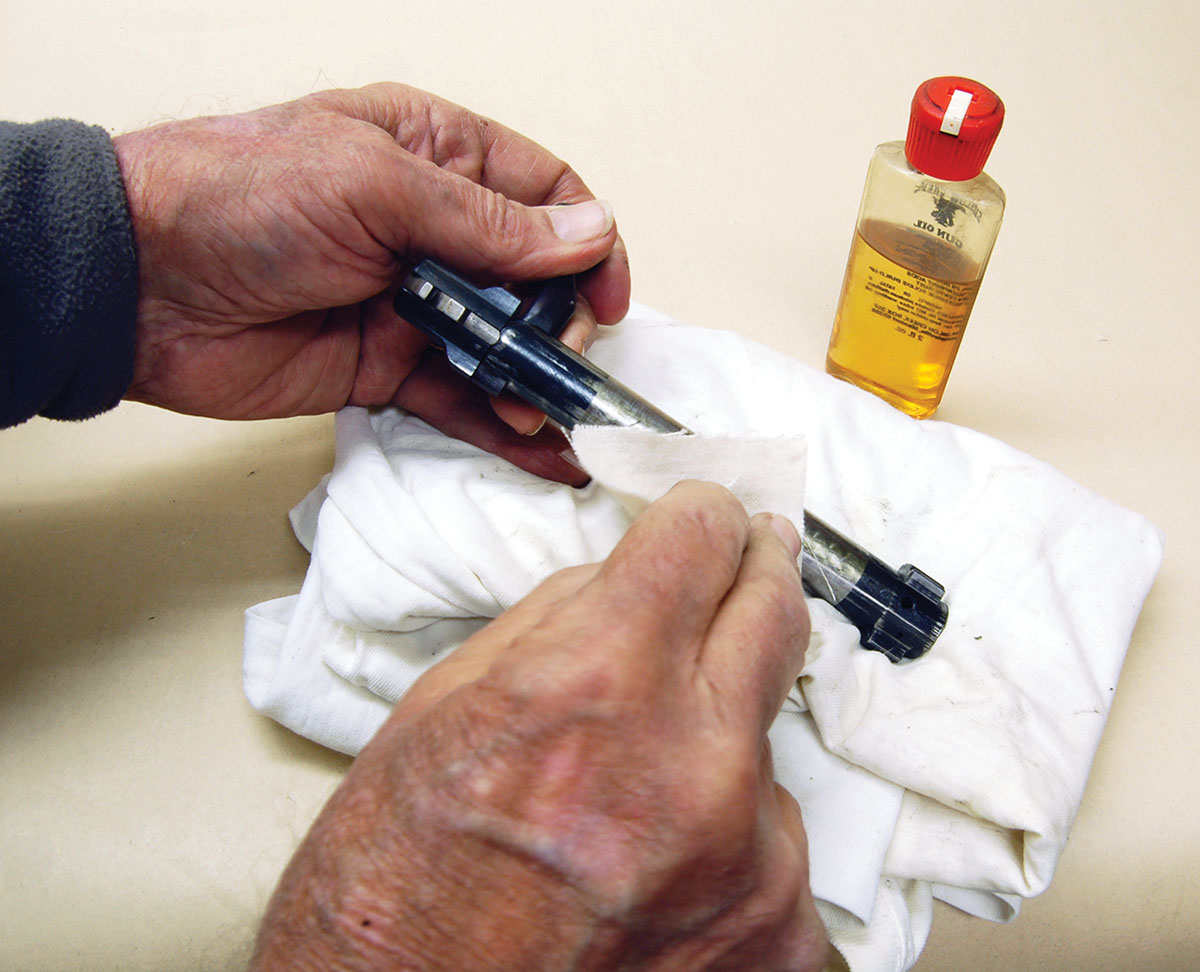
One job that gun oil can do is to very lightly lube bolt bodies.
Rifles like these would often come into the shop. Their owners had inherited them and wanted them to look new, like when their grandfathers bought them way back when. If the gun had a tubular magazine, there was no guarantee. Almost always, there was wear from no lubrication and bending of the sheet metal parts from prying out jammed cartridges with a pocketknife. In many cases, however, old bolt guns and some semiautomatics can be put back in
service by use of the setup shown in the photos.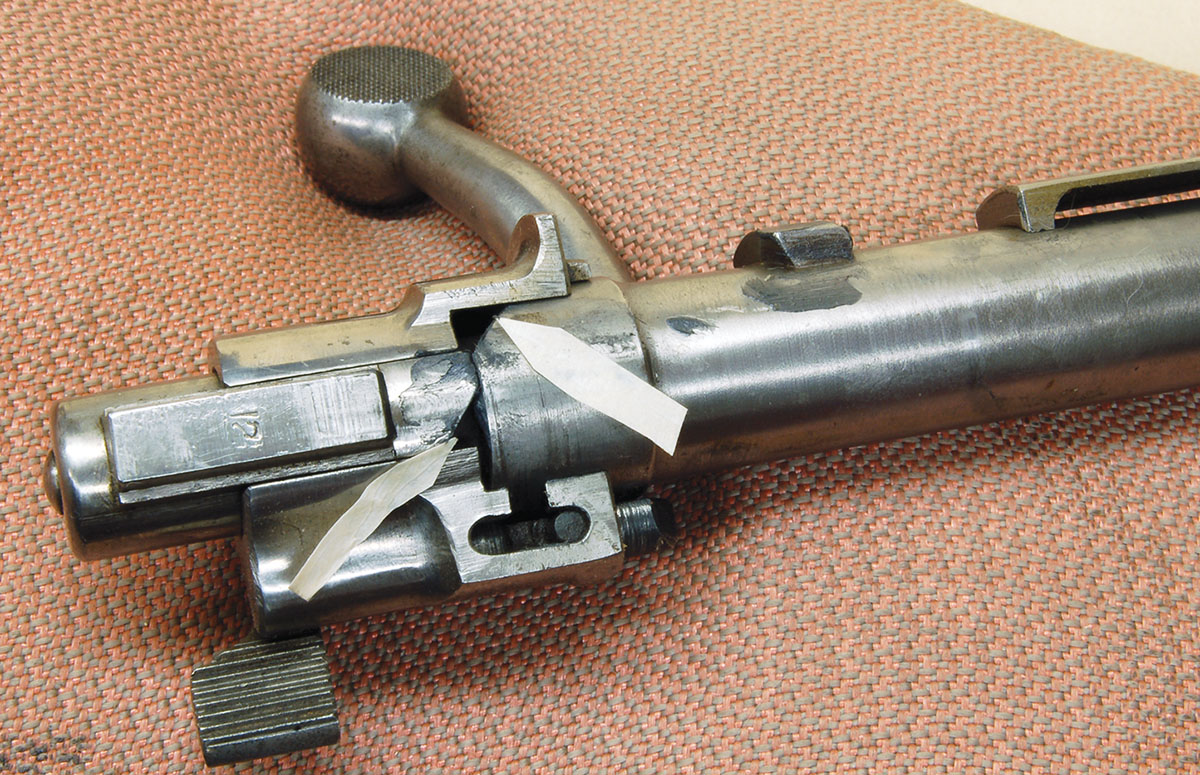
Cocking cams of bolt guns (arrows) must be greased. The oil runs off – doing little good.
To use this idea, first remove the stock and be certain the sear engagement and pull weight are safe. Next, clamp the barrel solidly in a bench vise between hardwood jaw inserts, an inch or so forward of the receiver. The barreled action must be upright with the barrel parallel to the bench top, as shown in the photo below. The large object in front of the muzzle is a bullet stop, which is absolutely mandatory because factory cartridges are the only way to identify and correct feeding problems. With the stock off, the trigger hangs out in space and could be bumped when feeding cartridges through the action and firing a round. Any such bullet must be stopped immediately.
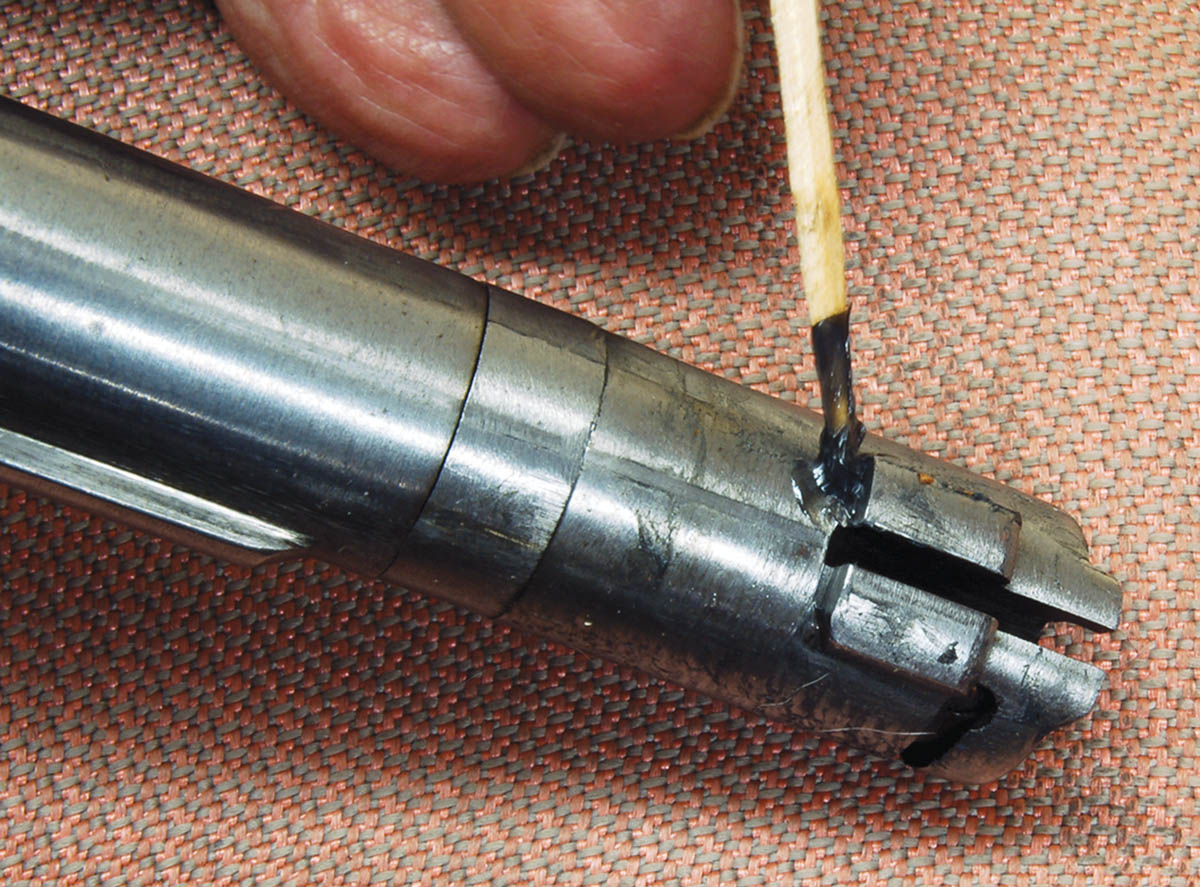
A small hump on the breechblock or the hammer (arrow) pushes the hammer back far enough to cock. Lightly grease the underside of the breechblock.
The bullet stop shown is made of square pieces of scrap oriented strand board (OSB) roof sheeting, glued and screwed together to make a 2.5-inch-thick block.
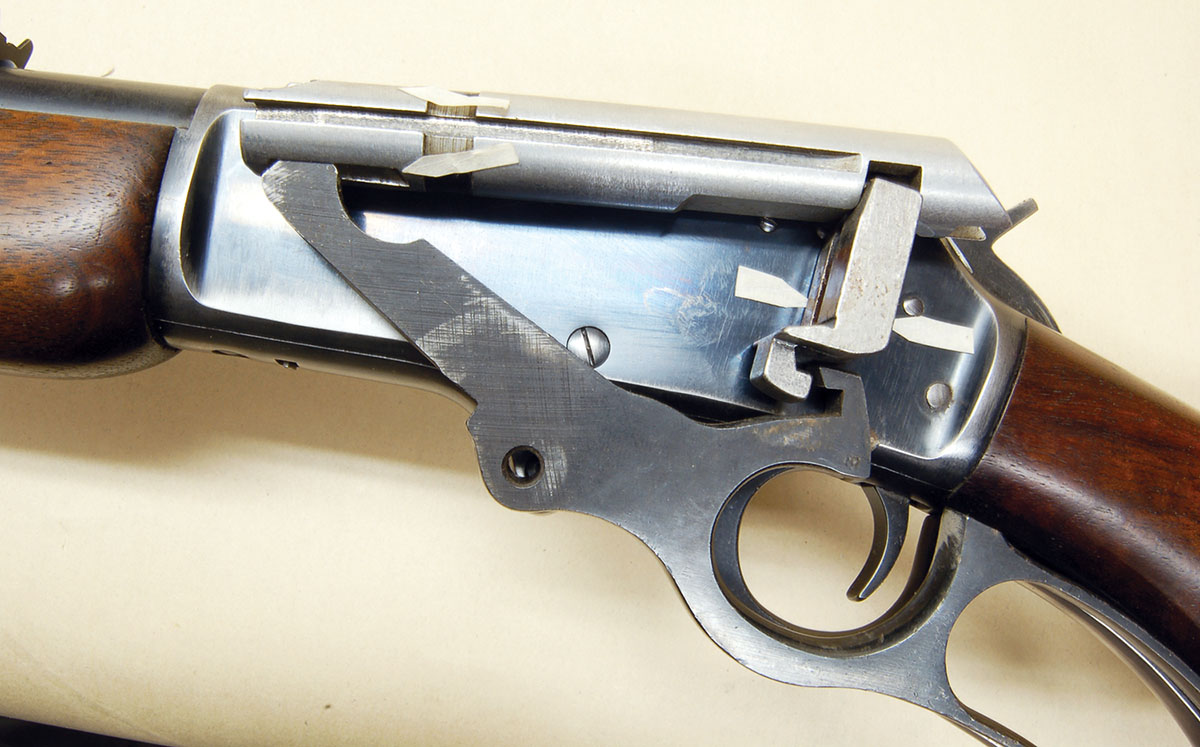
Since the Marlin M336 is easy to disassemble, the points shown by arrows should be lightly greased.
Two C-clamps on the bottom hold it vertically. After
completion, a couple of high-velocity rounds were fired into it (this was at least 25 years ago) at a range of one foot. Penetration was 1.5 inches. 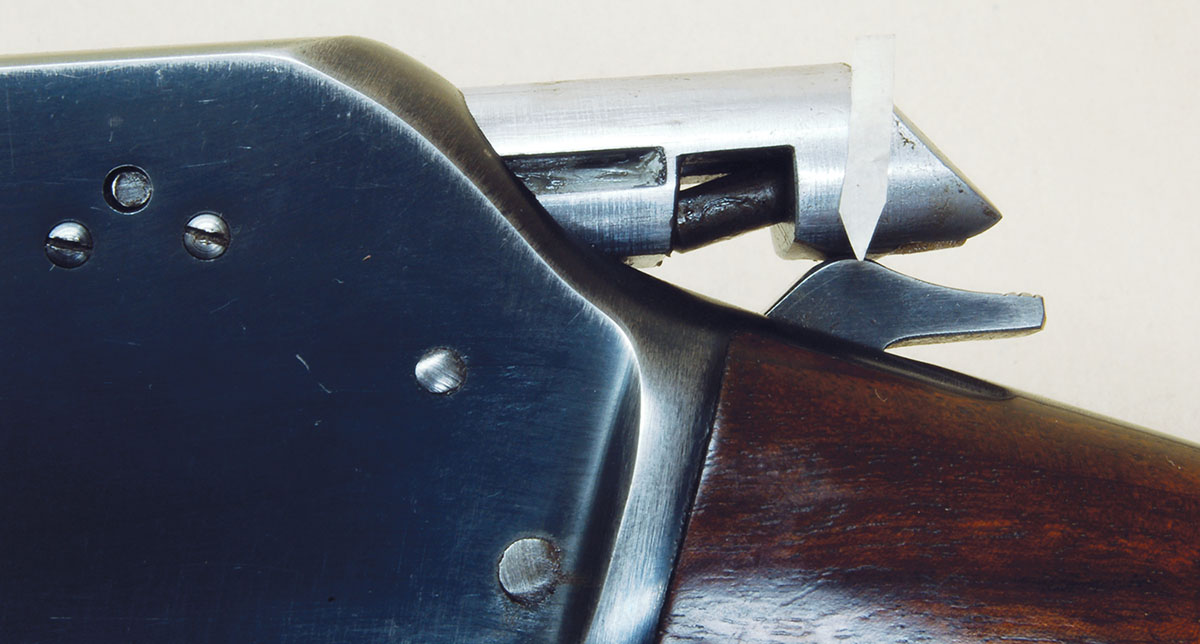
A small hump on the breechblock or the hammer (arrow) pushes the hammer back far enough to cock. Lightly grease the underside of the breechblock.
A few rounds are now loaded into the magazine, but the chamber is left empty. Place the bullet stop in front of the muzzle. The bolt handle is slowly raised, supposedly allowing a cartridge to pop out of the magazine onto the lifter. Further bolt movement should raise the round and push it into the chamber. When the bolt handle moves down and closes, immediately raise it to prevent bumping the trigger and firing the rifle. Of course, this won’t happen on the first try because the round won’t feed. Correcting this fault was the object of the exercise in the first place.
The tip of the lever arm of any lever action suffers the most wear. A small amount of grease will eliminate this.
Since the entire feed mechanism is out in the open, where it can be clearly seen, any errant movement of the cartridge is easily seen. Because of the rigidity of this setup, bending feed parts is easy, so don’t overdo it. Minor wear of parts can often be allowed for by very slight additional adjustment (bending). Now back to lubrication.
Looking down into a typical tube magazine rimfire feed mechanism. All those parts have to work together. Prevent wear at all costs.
Some folks think that guns wear out after a certain amount of shooting, then they are traded or simply thrown away. This especially applies to rimfires. Don’t believe it! Case in point, my grandpa bought a new Winchester M72 22 rimfire with a tubular magazine in 1954. I learned rifle shooting with that M72. Most Saturdays during my grade school years, he and I would walk behind the barn to shoot the rifle into a big pile of dirt. Targets were paper, tin cans and iron tip-overs. Grandpa always brought a 500-round brick of ammunition, which was pretty much gone in a few hours. Grandpa also shot by himself a couple times a week if possible. He just liked to shoot a rifle.
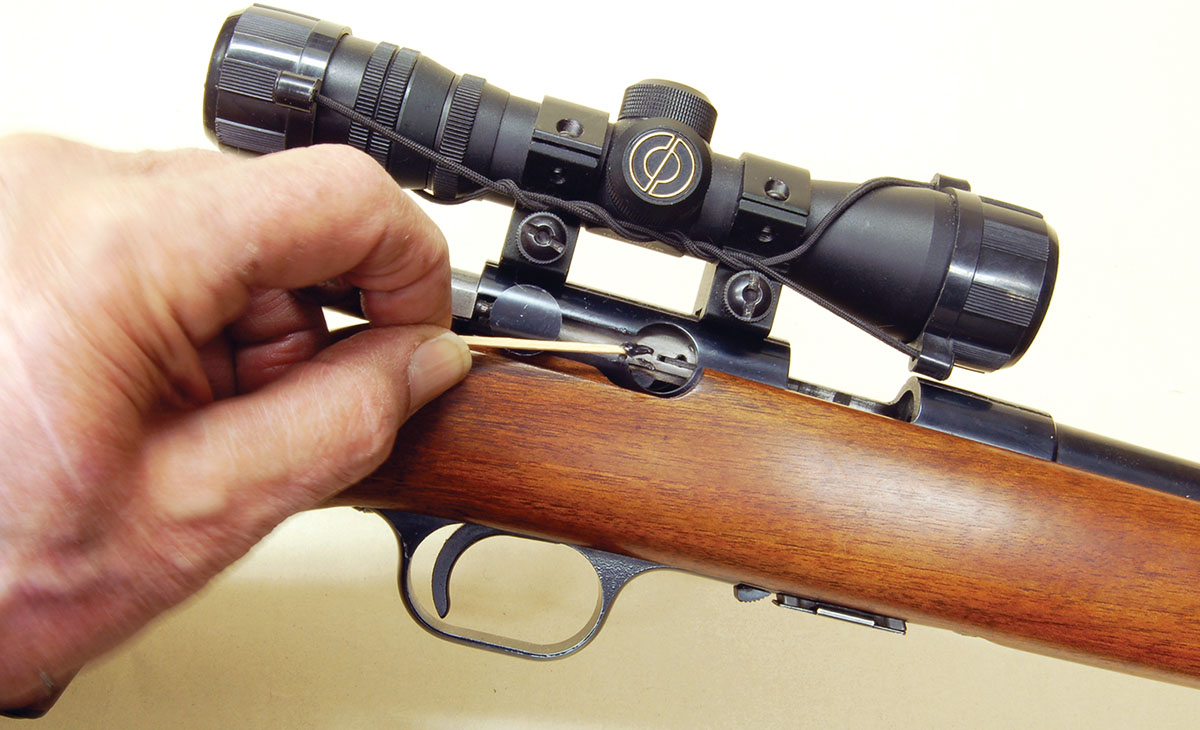
A very small dab of grease on the locking surfaces of the Browning T-Bolt is needed because they rub hard when opening and closing.
A few years before he died, Grandpa
(still shooting the M72) told me he figured he had fired between 130 and 140 thousand rounds through that rifle. Certainly, the gun was worn out. Hardly. It lives in my gun safe today. Trigger pull is the same, a little over four pounds. Cartridges feed without missing a beat. There seems to be no wear, perhaps due to Grandpa’s cleaning method, which I observed many times after Saturday’s shooting. 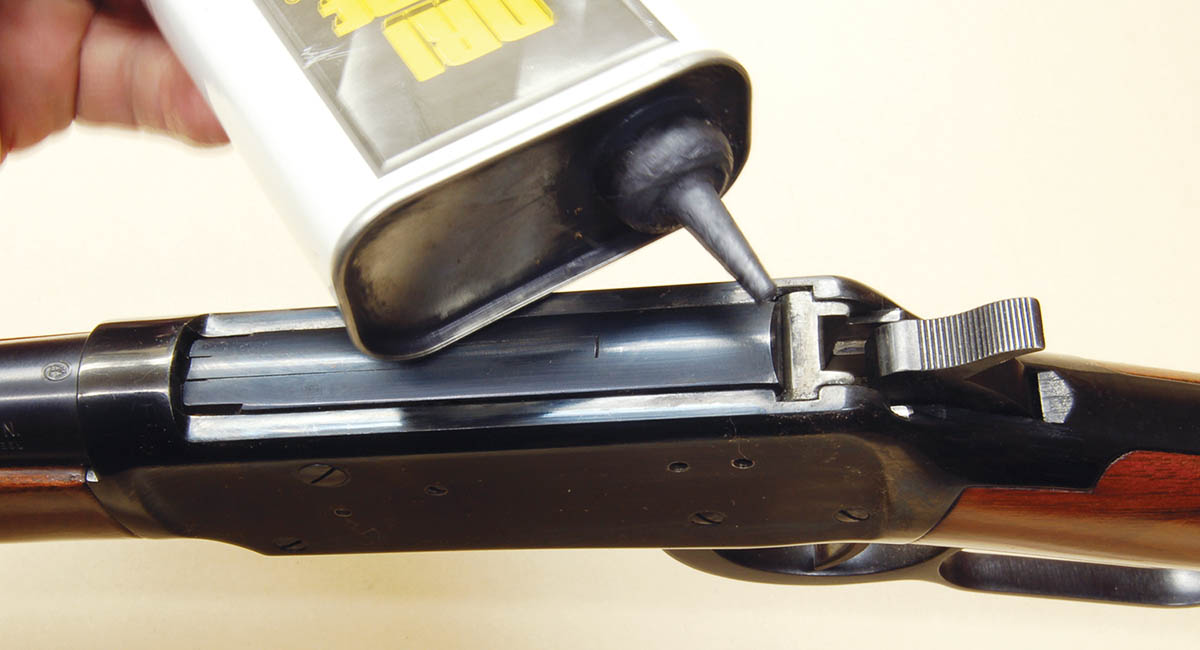
DRI SLIDE is also excellent for actions that are open on top and relatively hard to disassemble.
Two patches soaked with Hoppe’s No. 9 (of course) were run down the bore. Next, a wooden toothpick put a very small dab of farm machinery grease, which Grandpa called “tractor grease,” on the sear and its contact point in the bolt body. Iron was then removed from the stock and wear points of the cartridge feeding parts lubed the same way. No exotic chemicals or compounds from strange foreign lands. Just American Hoppe’s No. 9 and tractor grease.
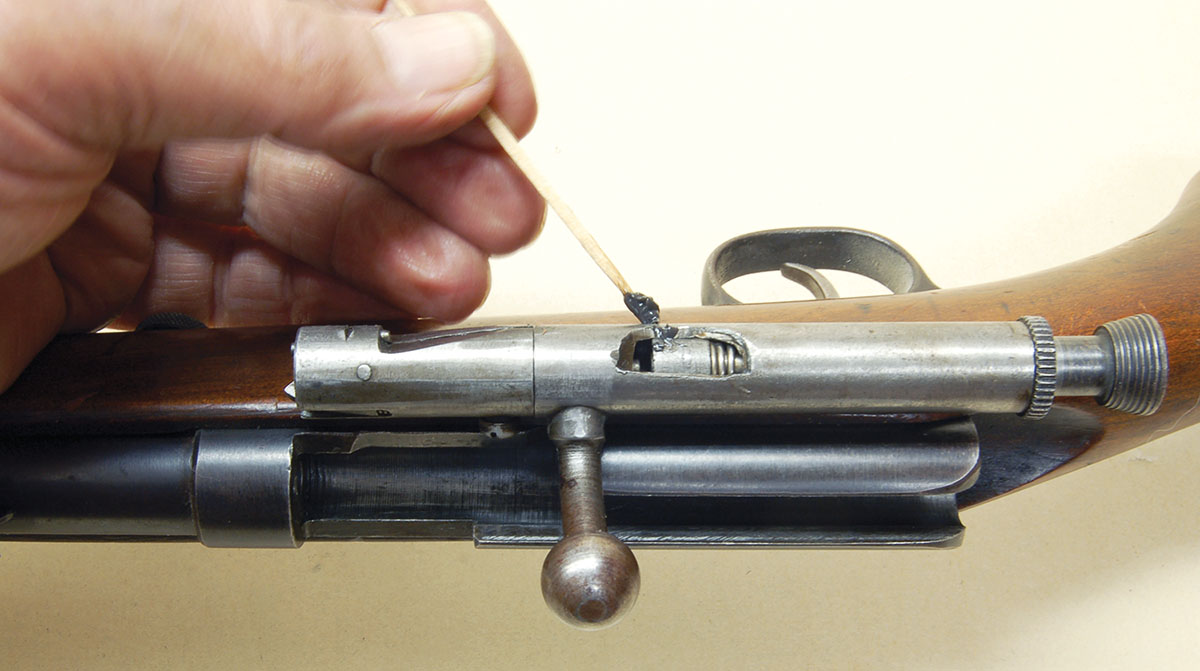
The trigger directly contacts the firing pin of most inexpensive 22 rimfires. This point must be greased to prevent wear.
Of course, centerfire rifles need lube, too, but in the right places. One of these that is always ignored is the rear of the locking lugs. It is not
noticeable when the chamber is empty. If the bolt has to chamber a marginally resized handload, it is very noticeable. Lever actions or pumps with rotating bolt heads, like the Winchester M88 or Remington M760, suffer most. A very small amount of grease put on with a toothpick will suffice for a long time. While “tractor grease” is still okay, I now use Moly-D chassis grease. A 14-ounce tube will last at least five thousand years for gun work. It is also superior for lubricating the tie rod ends of the pickup. 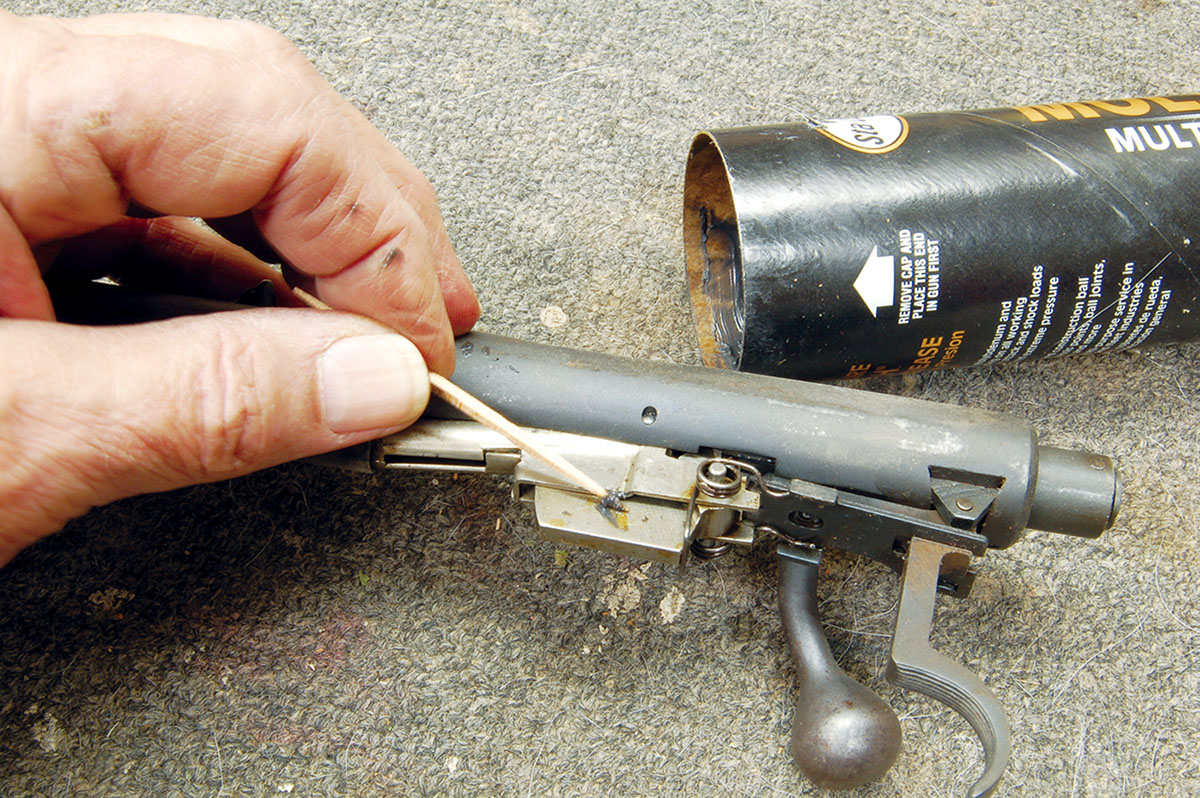
Lubing Grandpa’s Winchester M72 just like he did, using a toothpick and “tractor grease” (machinery grease).
Another overlooked item is the “bump” on the top of the hammer of all exposed hammer repeaters. The breechblock rides over this, pushing the hammer down far enough for
the sear to engage its hammer notch. A lot of friction takes place here, and when enough wear takes place, the sear barely engages. Firing when the breechblock slams closed then happens, or perhaps when the trigger is barely touched. This is not good if wearing gloves.
While it is impossible to keep grease on the top of the hammer, it’s easy to grease its wear point on the bottom of the breechblock. At least it would seem wise to slowly open the action of old lever guns and listen for the metallic “click” as the sear drops into place. No “click,” further inquiry is necessary.
Lastly, lubrication of actions that are not readily disassembled, such as some lever actions, automatics and the locks of sidelock guns. This is where a product called DRI SLIDE really shines. It is molybdenum disulfide (a dry powder) suspended in a volatile vehicle (a liquid that evaporates, leaving the lube in place). It will penetrate the tightest-fitting parts, providing superior lubrication compared to thin oil. Just one drop on the side rails of Winchester breechblocks, semiautomatics, or the various parts of a sidelock when removed from the action is needed. Lay the gun on the bench horizontally overnight to allow the liquid to evaporate. One coating of DRI SLIDE is good for years of normal use, provided the gun doesn’t fall into a lake.
It is sometimes said that we don’t own our guns, we are just caring for them until passed on to the next shooter, hunter or collector to enjoy. Taking good care of them, even the seemingly most insignificant, is part of the bargain.