

Rifle & Handgun September-October 2026
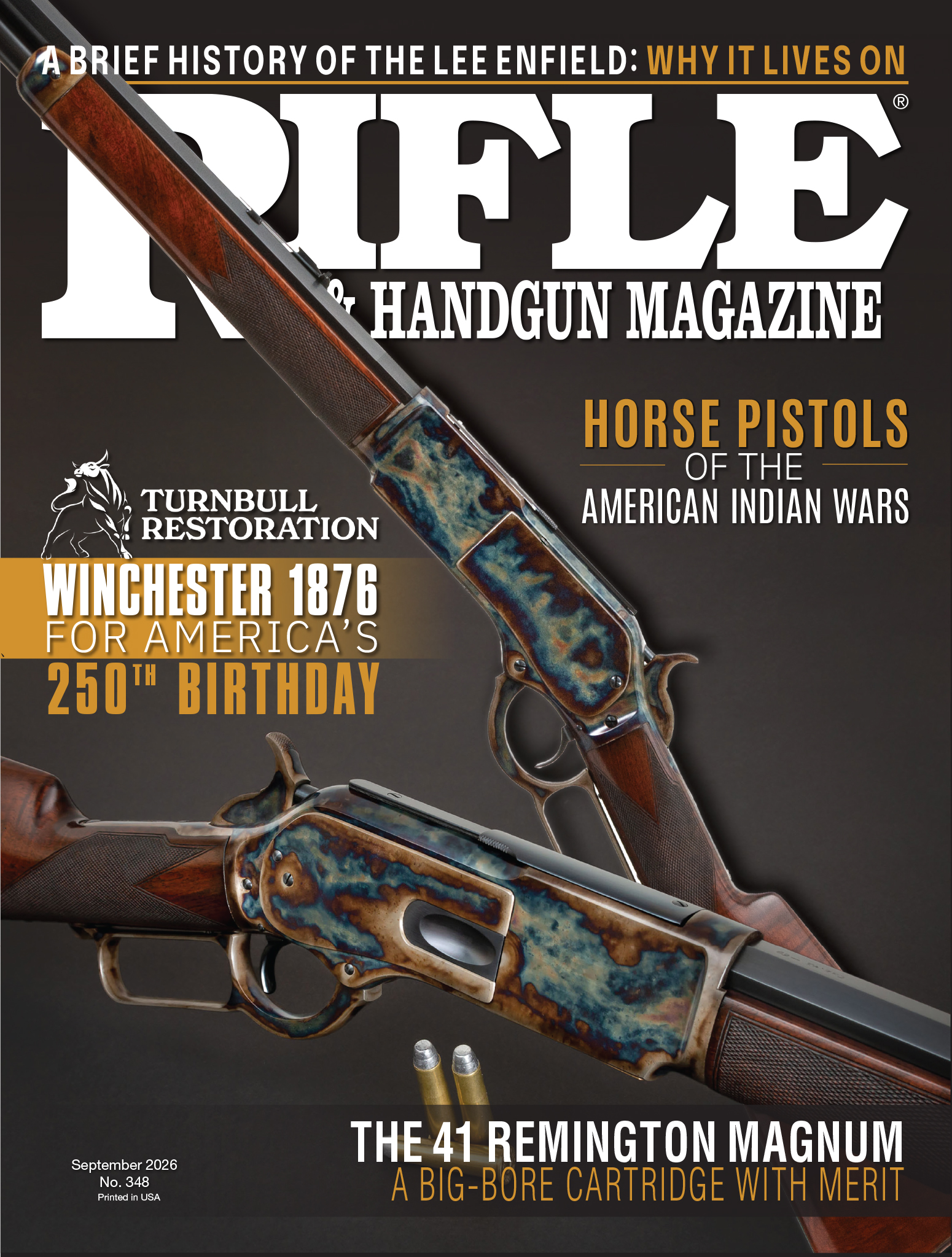
On the Cover: An original Winchester 1876 chambered in 45-60 manufactured in 1882, fully restored by Turnbull Restoration Co., just in time for America’s 250th birthday. The rifle features Turnbull’s signature deep color casehardening, recut checkering, fresh bluing and so much more. Photo courtesy of Turnbull Restoration.
Volume 58, Number 5 | ISSN:
Article Bites
Mostly Long Guns
Skinner Sights and Charter Arms Target Pathfinder
column by: Brian Pearce
The Winchester Model 1895 with its box magazine was a rather unique lever-action rifle that was chambered for modern, high-intensity cartridges with spitzer profile bullets, such as the 30-40 Krag, 30-03, 30-06 Springfield and several other cartridges. However, with the economic factors of the Great Depression, followed by World War II, it was discontinued by 1940. Nonetheless, it remains in demand by collectors, modern shooters and hunters. As a result, Miroku (Japan) began offering reproductions in 1984 that were imported by Browning Arms, with subsequent guns imported by USRAC with the Winchester trademark. These are great shooting rifles that are accurate, made from modern high-tensile steel and can be obtained at reasonable shooters’ prices. ...Read More >
Fouling Shots
Cloning the Stevens Single-Shot Pistol
column by: Art Merrill
Among gun shows, the one held maybe twice each year in Cottonwood, Arizona, is my favorite. It isn’t large compared to gun shows in Phoenix or Tucson or even the one hosted at the ice-skating rink built for a failed hockey team business venture in my town, and now owned by a car dealership, and that’s one of its appeals. ...Read More >
Light Gunsmithing
Marlin Model 1893
column by: Gil Sengel
The shooting sports are changing. Because of concealed carry, many folks who would never have touched a gun are finding shooting is fun, especially at some sort of reactive target. If you want to see enthusiasm, stand two moms, who first fired a handgun only a few weeks ago, in front of one of the articulated dueling-tree targets and watch the brass fly. ...Read More >
A Rifleman’s Optics
Burris Optics FastFire 4 Multi-Reticle Reflex Sight
column by: Patrick Meitin
I’m decidedly old school when it comes to handguns, preferring iron sights to do all my shooting. It’s a familiar and reliable system that I learned the ins and outs of long ago on the trapline and carrying a backup while an outfitter running bear and cougar hounds. Despite that, slide-mounted optics have become all the rage in the handgun world. I have seen Doug Koenig credited with popularizing the approach in competitive shooting, which has also crept into defensive classes. ...Read More >
Sixguns, Slugs and Such
New Mould Versatility
column by: Jeff “Tank” Hoover
For a bullet caster, nothing’s more exciting than getting a new bullet mould. To think otherwise would be boring. New moulds provide the potential for unleashing endless possibilities for different cartridges in various guns of that caliber. Plus, cast bullets can be sized down, within reason, and with a little imagination, along with some innovative thinking, the same bullets can be used for slightly smaller calibers. ...Read More >
Custom Corner
Turnbull Restoration Co. Winchester 1876
column by: Jeremiah Polacek
The Winchester 1876, affectionately known as the Centennial Model, is essentially a scaled-up version of the Winchester 1873 that we all know and love. The dual toggle-link mechanism of the repeating rifle was designed by Benjamin Tyler Henry, of the New Haven Arms Co. famous for the Henry repeating rifle. ...Read More >
Walnut Hill
Lovely, Lovely Leather
column by: Terry Wieland
There was a time, alas, no longer within living memory, when walking around town with a gun on your hip was nothing out of the ordinary. ...Read More >
The Lee-Enfield Lives On
The Great Lady of Bisley
feature by: Terry Wieland
George MacDonald Fraser, novelist and editor of The Flashman Papers, was an infantryman during the Second World War, serving with the Border Regiment in Burma. ...Read More >
Horse Pistols of the Indian Wars
Shooting Over Their Saddles
feature by: Gary Lewis
Riding on the coattails of the success of the Walker Colt of 1847, Sam Colt’s manufacturing machine began to gain steam, and a new large-frame pistol called the Colt Dragoon was introduced in 1848. With a shorter barrel (71⁄2 inches instead of 9 inches) and a shorter cylinder, it weighed 4 pounds 2 ounces, a bit less than the Walker at 41⁄2 pounds, and still too big for a man to wear comfortably on a belt. Colt was making pistols for men to carry, like the 28- to 31-caliber Colt Pocket Pistol, but the Dragoons were designed to be carried on the saddle. The Dragoons had been to the Mexican War, and now they were going West. ...Read More >
Primary Weapons Systems MK114 MOD 2-M
A Softer, Gentler AR-15 in 6mm ARC
feature by: Patrick Meitin
Boise, Idaho, headquartered Primary Weapons Systems, Inc. (PWS) entered the firearms arena by producing muzzle devices, a.k.a. compensators. The company’s unique design offers low maintenance across a wide variety of semiautomatic firearms platforms. With that low-maintenance mindset, PWS then ventured into designing the company’s long-stroke AR piston system. PWS remained true to AR-15 form and function, but introduced an operating system that requires less maintenance following high-volume shooting or adverse conditions, particularly with a suppressor installed. PWS has evolved as a highly respected manufacturer of tactical and sporting rifles and accessories. ...Read More >
41 Magnum
A Big-Bore Sixgun Cartridge with Great Merit
feature by: Brian Pearce
In 1998, I received a new Smith & Wesson Model 657 Mountain Gun chambered in .41 Magnum. Within 24 hours, the gun had been sighted in at 50 yards using my handloads and was accompanying me on a 10-day hunting trip to Texas. The first guide was a bit skeptical when I told him I planned to take a few head of deer with it, as this was a trophy hunt and a culling hunt intended to reduce whitetail numbers on the well-managed ranch. This assured there would be enough forage to carry the deer through winter. Unlike the two previous deer, each taken with a single shot at 15 and around 35 yards, the guide was present when the 3rd deer was taken at around 90 yards. The angle was difficult, but I had a good forearm rest, and the deer was standing perfectly still. The sixgun recoiled, and the buck dropped in its tracks as the bullet broke bone and perforated the vitals. The guide was elated and admitted that he was more than skeptical about how the handgun cartridge would perform. However, over the next few days, more game was taken, including Catalina ibex, javelina, turkey, hogs, etc., each with a single shot. ...Read More >
Weatherby’s Mark XXII Semiautomatic Rifle
A Blast from the Past Comes in an Unusual Way
feature by: Stan Trzoniec
Amazing how life can treat you sometimes. Perusing a local gun show recently, I stopped at one dealer who, on a shelf above most of his wares, was a mint-lookingWeatherby Mark XXII 4x 50mm scope. It looked as though it had not been associated with a rifle during its lifetime. ...Read More >
A Better Bolt Lock for the Ruger 10/22
TANDEMKROSS Upgrade Improves Ergonomics and Bolt Operation
feature by: Art Merrill
Bill Ruger designed, or promulgated the design, of now-iconic American firearms, many with novel features that improve performance, simplify operation and reduce manufacturing costs. I don’t presume to challenge his engineering mind, and at risk of picking a nit, in spite of all its positive features, the Ruger 10/22’s bolt lock is among the least ergonomic of any semiautomatic rimfire rifle I’ve ever encountered (the one on Winchester’s late Model 77 is a “Worst-Of” runner-up). Virtually every new shooter or shooter new to the 10/22 that I’ve trained or observed inevitably is perplexed by the bolt lock’s near invisibility and non-intuitive rocking-motion operation. Even experienced 10/22 owners will occasionally fumble with the 10/22’s bolt lock. ...Read More >