

Walnut Hill
Lovely, Lovely Leather
column By: Terry Wieland | September, 26
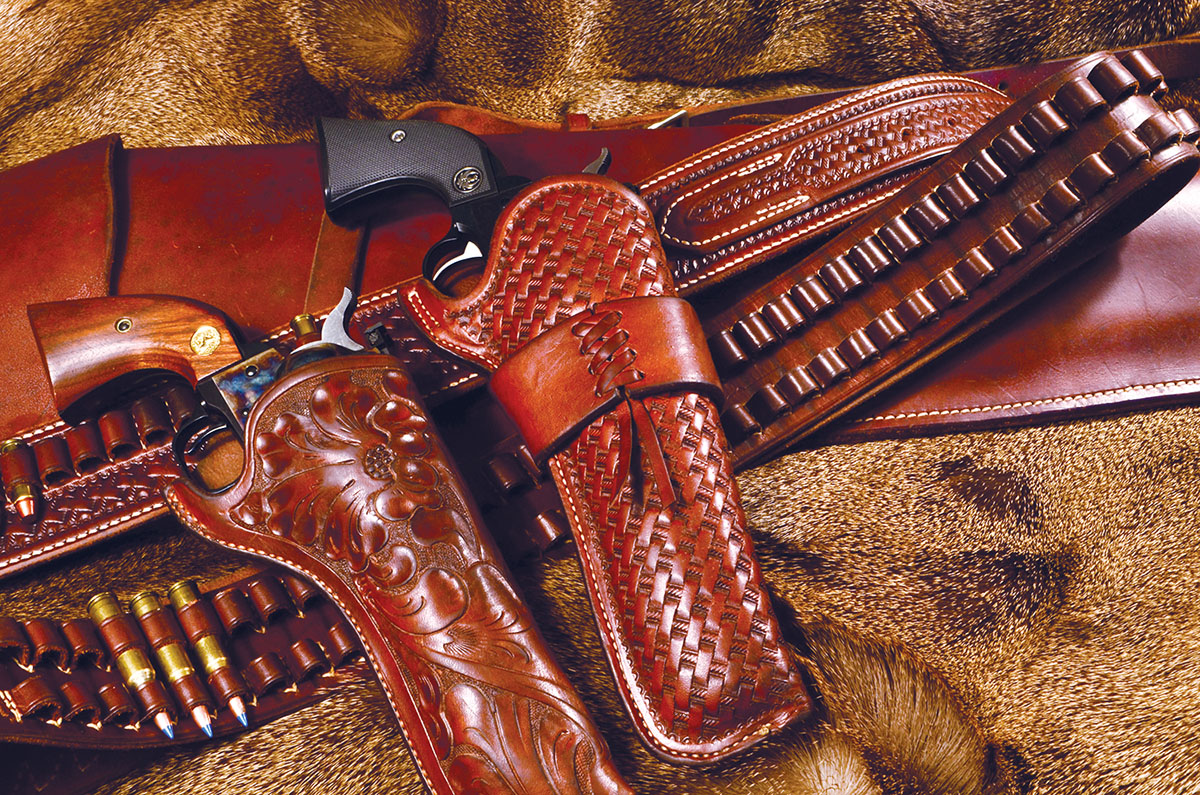
There was a time, alas, no longer within living memory, when walking around town with a gun on your hip was nothing out of the ordinary.
To quote Chris (Yul Brynner), from The Magnificent Seven, when the Mexican villagers seeking help pointed out that everyone in town was wearing a gun, he replied, “Sure, same as they wear pants. It’s expected. But good men…?”
The custom eventually died out almost everywhere, through a combination of legislation, social approbrium and a general feeling of not being in danger on Main Street. It hung on the longest, and in some places to this day, west of the Mississippi. Like pants, in many a small town in Missouri or Wyoming, it’s expected.
Initially, the guns carried this way were big, heavy revolvers, although later it was not uncommon to see the distinctive square butt of a 1911. The guys I’ve talked to insist that only a hefty piece of ordnance is capable of dealing with anything from a rattlesnake to a coyote, never mind the two-legged sort of hombre one is (purportedly) guarding against, and it’s hard to carry a Peacemaker concealed.
If I have to reduce this to a general rule, out west, a handgun is regarded as a tool as much as a weapon, and one you need to have immediately handy for when you need it. When there’s time to spare, you grab a rifle; at least, I do. This does not mean the handgun has no more value than a screwdriver, or is treated as such. There is no shortage of Westerners who carry a treasured pistol with custom grips, snuggled in a beautiful piece of crafted leather. Just because it’s a tool doesn’t mean it has to look like one.
A magazine cover from the 1960s sticks in my memory. It was Guns and Hunting, and it paired a Smith & Wesson double-action 357 Magnum with a rifle of some sort. The Smith was in a lovely George Lawrence holster, and you could almost smell the oiled leather. It was a standard design from the era that more or less cradled the gun rather loosely but held it in place with a leather strap behind the hammer. I assume it was designed by Lawrence, later copied by Hunter, and improved with Hunter’s “Snap-On” feature. Today, you can find all kinds of those holsters. They were intended to accommodate a range of guns, and some would handle either a revolver or a semiautomatic, albeit with a bit more wiggle room than we would tolerate today.
My father brought a Browning Model 1922 back from Europe in 1945, and when we acquired an old hunting camp on a lake up north, he bought a Hunter holster for it. Sure, the gun rattled around a bit, but the strap kept it secure. It was close enough, which, in those less purist and specialized days, was close enough.
Since then, I’ve probably bought a half dozen holsters of that configuration, either Lawrence or Hunter, and found that when I want to carry a gun on a belt and don’t have the exact holster for it, one of those will usually accommodate it.
Although Hunter holsters were widely distributed, and it was the brand you could find in most gun shops, Lawrence was higher quality, both in leather and workmanship. Although 60 years on, when either one comes my way, if it’s been looked after and not bounced around in the bed of a pickup, it looks, feels and often smells great as well. (There is nothing like the smell of oil-tanned leather, hence the number of aftershaves that try to mimic it.)
I have never tried to explore all the ins and outs of this, but the leather we can buy today is nothing like the leather from the 1960s, and 1960’s leather was but an imitation of the stuff they made gun cases from in London in 1900. I’m told this has to do with both expense, no surprise, and environmental regulations, no surprise there, either. You can still buy comparable leather, supposedly, but it will cost you.
Oil-tanned leather in a holster is both thicker and more pliable than most of what we find today. Now, the approach is to get thinner leather, mould it to the shape of the actual gun it will carry and then glaze it in some way to make it stiff. This means it’s good for that gun and that gun only.
This is not to say that Lawrence holsters were just leather pouches into which you could stuff anything. They were given letter and number designations to show what make and model they were intended for. For example, I have a later crossdraw, stamped “30 F SA 51⁄2.” This is more exact than most and all but names the Colt Single Action Army with a 51⁄2-inch barrel. It fits snugly, but has just enough leeway that I can carry a Ruger Blackhawk .44 Special in it.
Lawrence had a code system for holsters, with later modifications of a particular model added to its earlier designation, hence 603 and 603A. Stoeger, back when it was the nation’s all-around source for guns and goodies, naturally carried the full Lawrence line, and published a chart of the models and holster codes in its annual Shooter’s Bible. If you can find a copy from the 1950s, it should have one.
There are two distinct levels of leather from George Lawrence: The originals, from Portland, Oregon, and the later, post-1970s, after the company closed down and the name was sold. From examples I have seen, it was the old story of buy a respected brand, cut corners and costs, and cash in on the name while it lasts.
There are other big names in what is now known as “vintage leather,” including H.H. Heiser of Denver and Brauer Brothers of St. Louis. Being mainly interested in leather I can use, with guns, new, old and in between; I’ve never delved into most of them. Many of their products are specialized or ornate, like double buscadero holsters for fast-draw competitions, or riding the palomino in the annual rodeo parade. There is, as one might expect, the usual coterie of collectors with unbelievable arcane knowledge of these holsters, who would turn pale at the thought of someone actually stuffing a gun in one, hanging it from a belt and then carrying it all day.
Personally, I’d rather find a Hunter holster from the 1960s that has been kept pliable with mink oil, and which will fit any of the High Standard, original Browning
Challenger, or Colt Woodsman models that populate my office. I should add that Hunter is still in business, still in Colorado where it was founded in 1952, and still makes some of the old-style holsters I’ve been praising here. Naturally, old Hunter holsters are considerably less expensive than the collectible Lawrences, and I have seen decent ones go on eBay for 20 or 30 bucks, where a fine Lawrence might command several hundred.
At those prices, it makes sense to buy every Hunter you see on the assumption that, even if you don’t own a gun for it right now, someday you might. This approach has worked for me, although more than once it has led to me buying a gun just to fit a holster I already have.
For that matter, taking Hunter as the example and their “Snap-On” system, where you can attach your holster without removing your belt. Carrying a gun this way is a good reason to get rid of the sweat pants. Get something that demands a proper belt (jeans will do), and dress like an adult, complete with a holster.
As Chris told his new Mexican friends, it was expected. It should be again.