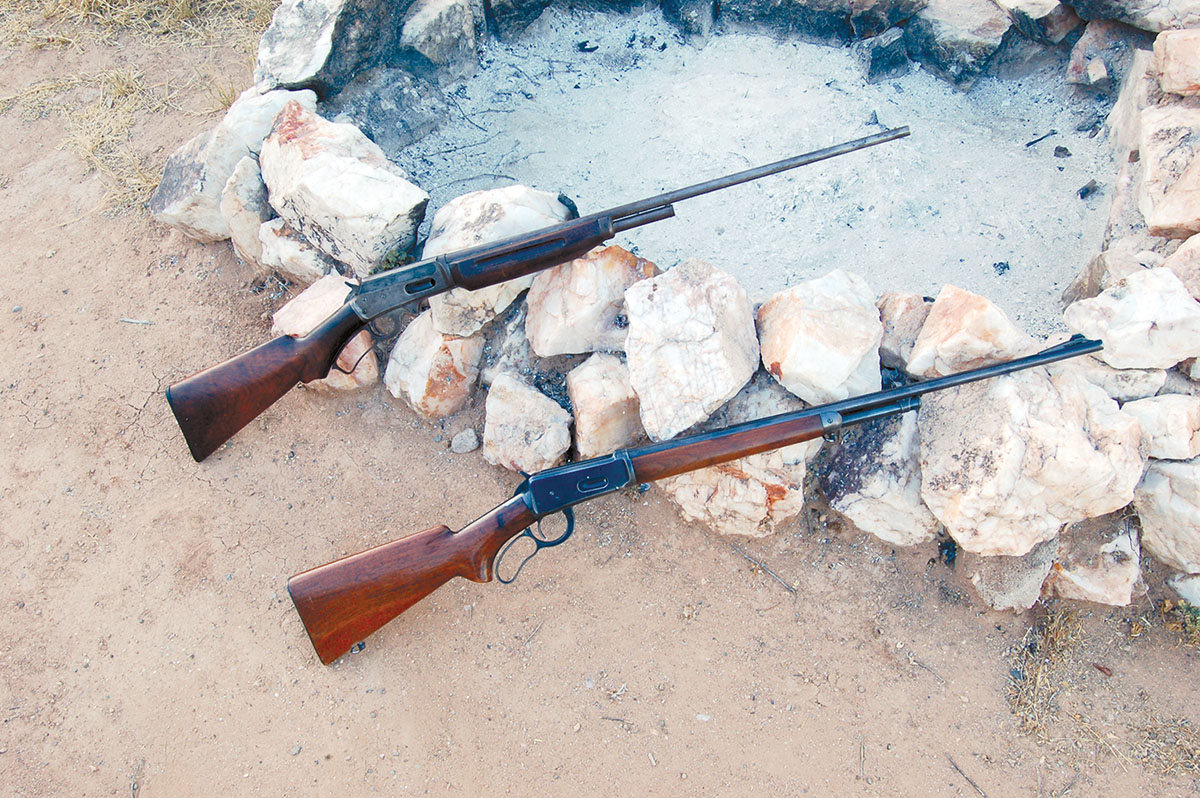
Marlin M93 (top) and its only serious competitor, the Winchester (bottom).
The shooting sports are changing. Because of concealed carry, many folks who would never have touched a gun are finding shooting is fun, especially at some sort of reactive target. If you want to see enthusiasm, stand two moms, who first fired a handgun only a few weeks ago, in front of one of the articulated
dueling-tree targets and watch the brass fly.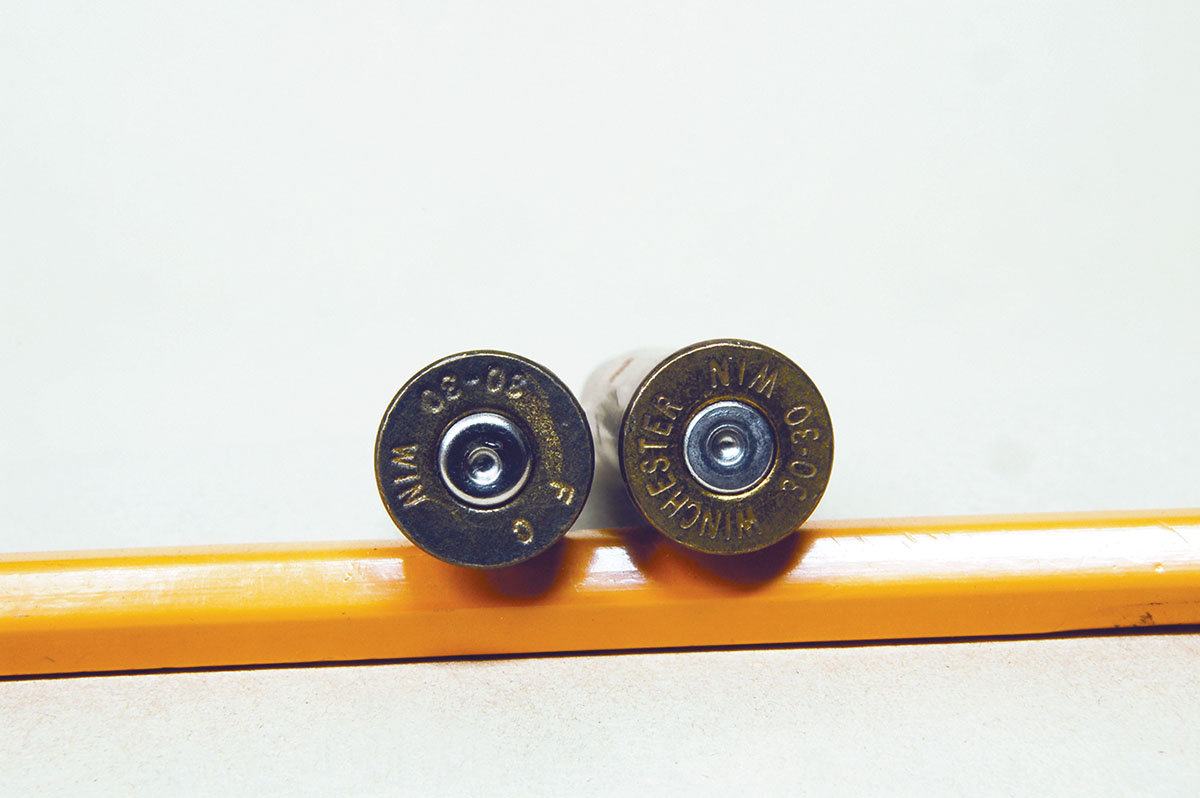
Leverguns chambered for rimmed cartridges always have generous headspace. The primer (left) protrudes .014 from the case, indicating that much headspace. The case (right) has been oiled and lubed giving us a flattened primer and false signs of pressure.
This desire to shoot at more than paper has resulted in leisurely contests just for fun. One club shoots steel gongs at various ranges using iron-sighted leverguns. Another has attached a log to the tops of posts. Steel crow (rook) silhouettes are set on the log. Shots are out to 150 yards using original British rook rifles with iron sights. Still another group sets out tip-over woodchuck silhouettes at ranges to 250 yards. Rifles must be pre-World War II chambered in 22 Hornet. There is also a contingent that shoots only original Winchester M54 and M70 Hornets. Sounds like fun!
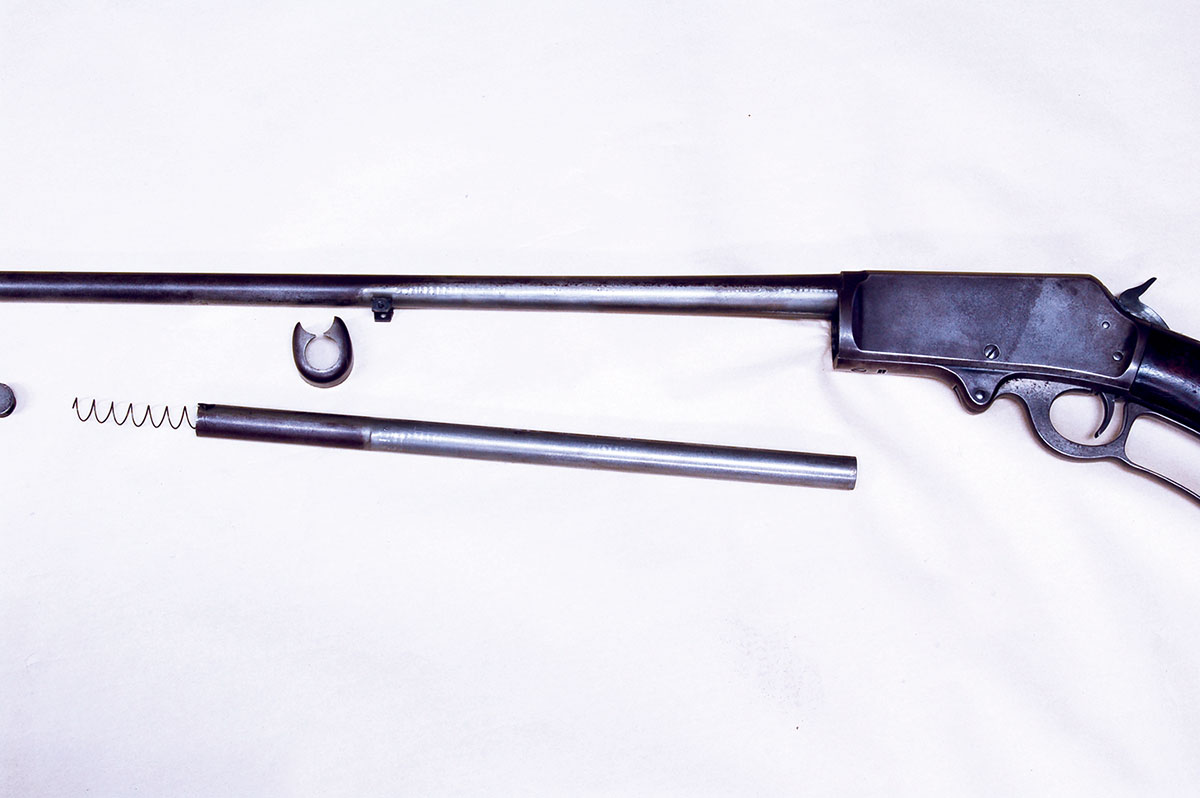
Always remove magazine tubes from old guns to check for rust. Spring should protrude about five inches. This one is weak, but still functions.
With this influx of new shooters, many old rifles are being purchased for shooting. These guns are coming out of collections at estate sales and auctions. World War II-era rifles probably haven’t been shot in sixty years; World War I-era in a hundred. New owners are rightly concerned about safety and what needs to be done before shooting them. We will try to answer these questions for leverguns in general and the once popular Marlin Model 1893 (after 1905, just Model 93). I have owned Marlins in 38-55 and 30-
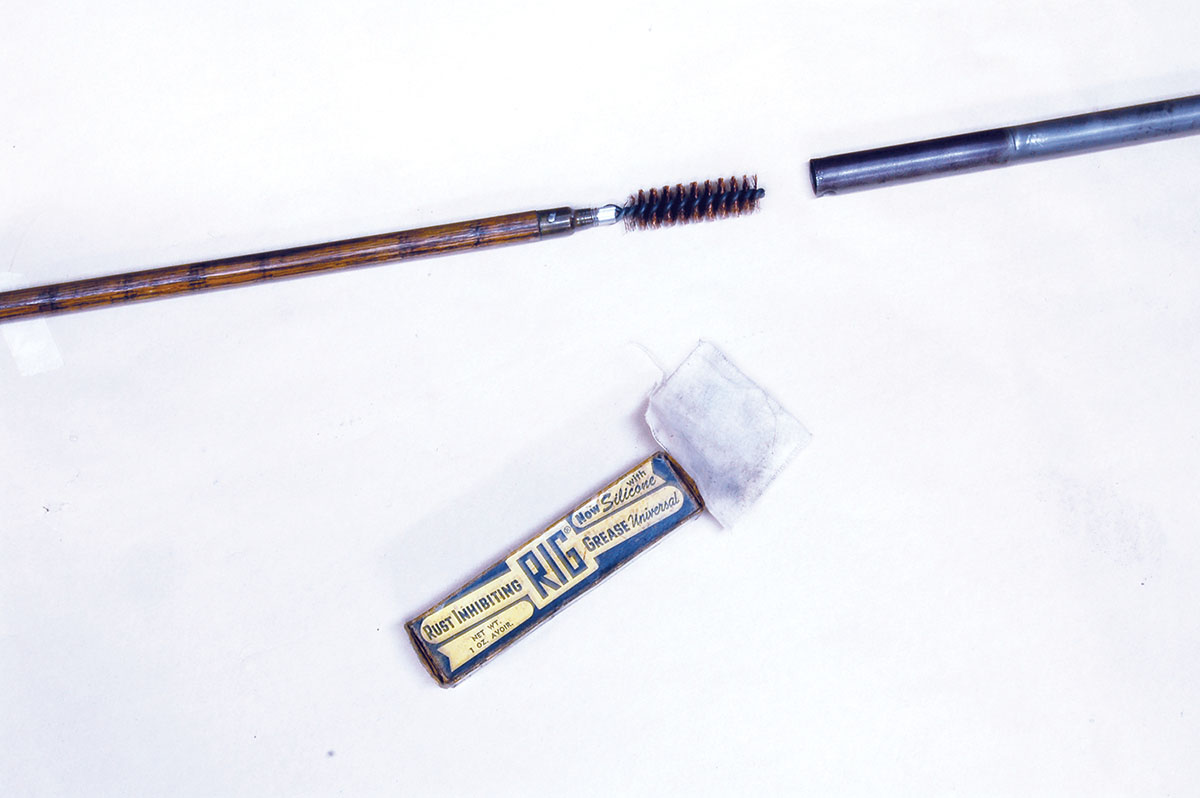
The best way to clean the inside of the magazine tube is with a shotgun bore brush. A bit of RIG on a rag finishes the job.
30 and consider them equal to Winchester M94s.
The place to begin with any pre-World War II gun is the metal it is made from. Soft metallic iron has been released from ore by heating since at least 1500 BC. Weapons from ancient Sparta, dated to 650 BC, were made from iron ore containing enough carbon (0.8 percent) to harden, thus making some of the first steel. Nobody, however, knew why the iron got so hard.
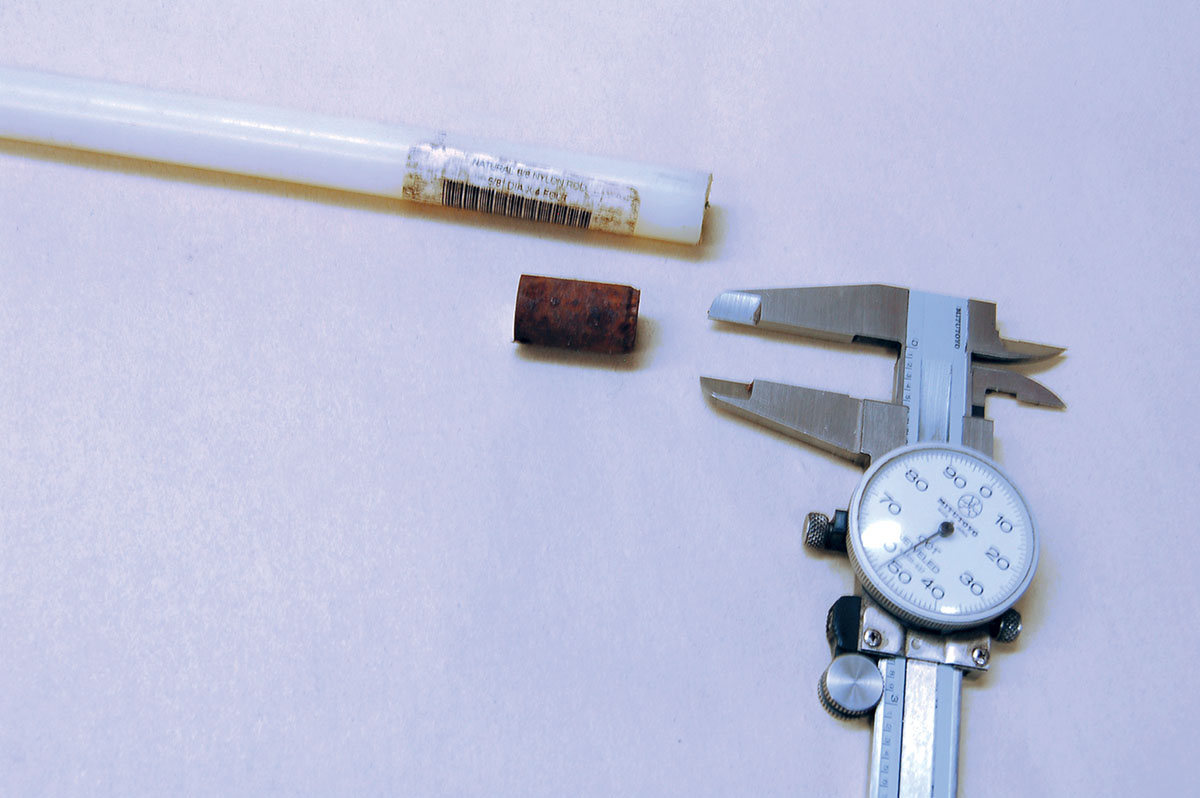
If the magazine follower is badly rusted, a new one can be made from a structural nylon rod. It won’t rust.
So, it is carbon that turns iron into steel. Razor quality steel contains about 1.25 percent carbon, spring steel 1.0 percent, ordnance steel 0.5 percent, down to boiler plate at 0.06 percent. Plain carbon steel has seldom been used in cartridge firearms. That we know of. Alloy steels are used. These are plain carbon steel having one to a dozen elements such as silicone, manganese or nickel added to give strength, wear resistance or machining properties not otherwise possible.
Of importance to us here is that the technical description of iron and
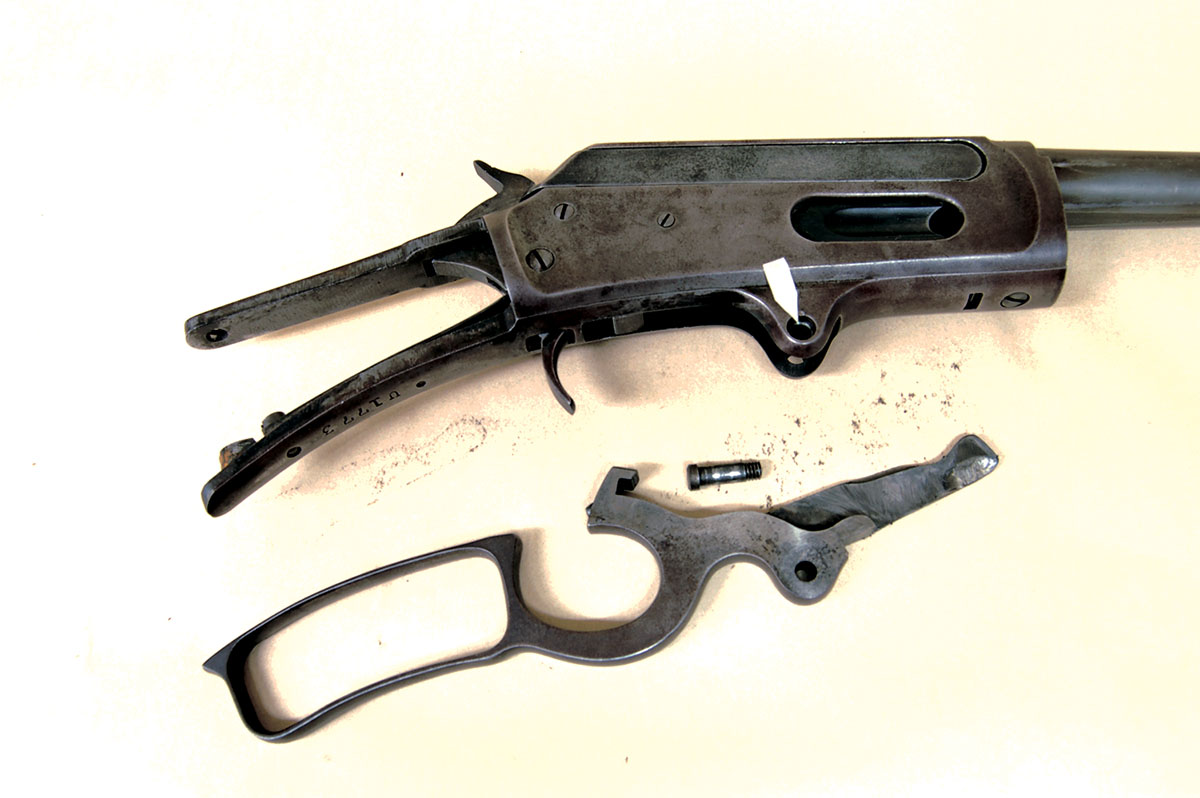
Remove the lever pivot screw from its recess (arrow), and the lever drops out of the bottom of the action.
steel alloys did not happen until about 1900; uniform composition from batch to batch until World War II. Unpreventable voids (gas bubbles) and inclusions (slag pockets) made proof testing mandatory. It is impossible to know for certain the composition or strength of the steel in most guns
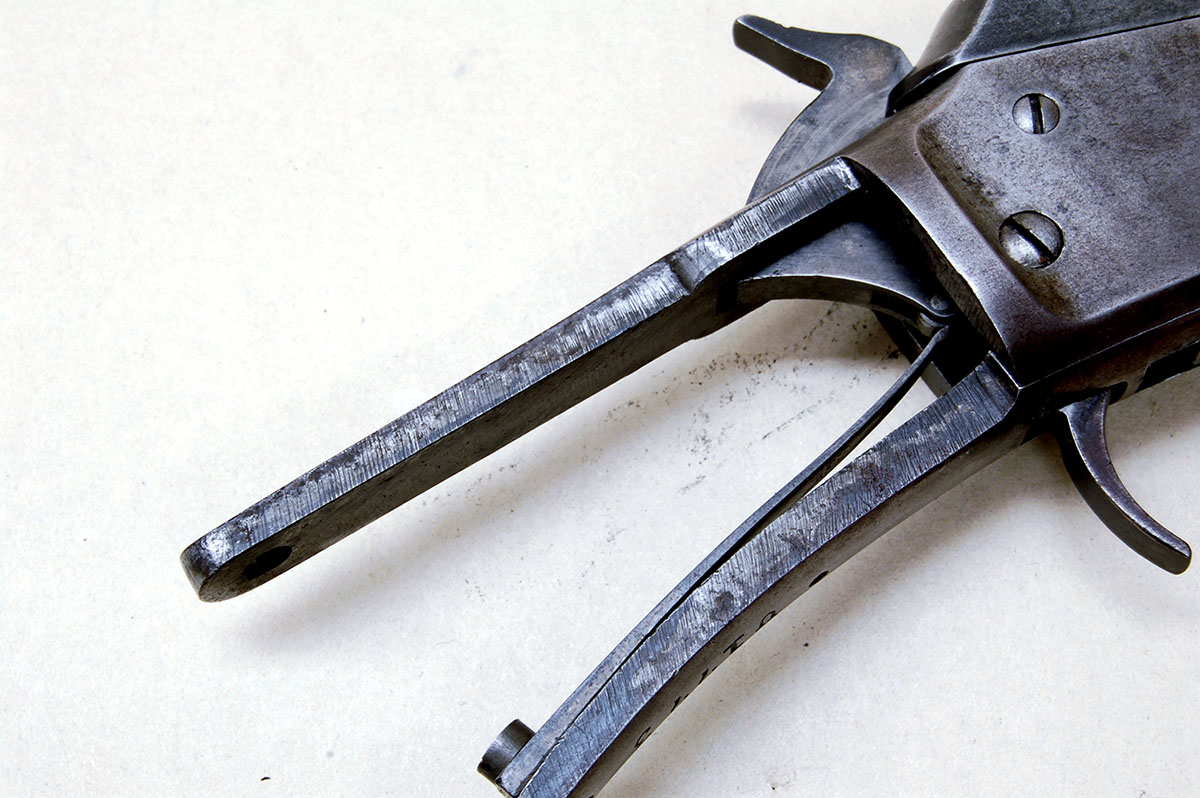
Mainspring is long and thin and can be weak. Hammer has a roller attached to make cocking smoother.
made prior to 1940 without employing modern destructive laboratory testing. The best we can do is use handloads that duplicate factory ballistics at the time the gun was made.
If the Marlin M93 in the photos looks odd (no open sights), perhaps it’s because it’s a shotgun. Brought out in 1929, the year the Great Depression began, it was probably intended to just sell more products of any kind. Called simply the Marlin .410, it differs from a Model 1893 rifle only in forearm shape, a 2.5-inch chambered .410 barrel, and a slightly lengthened loading port.
The Model 1893 is similar to the current Model 336 except for the old rifle’s
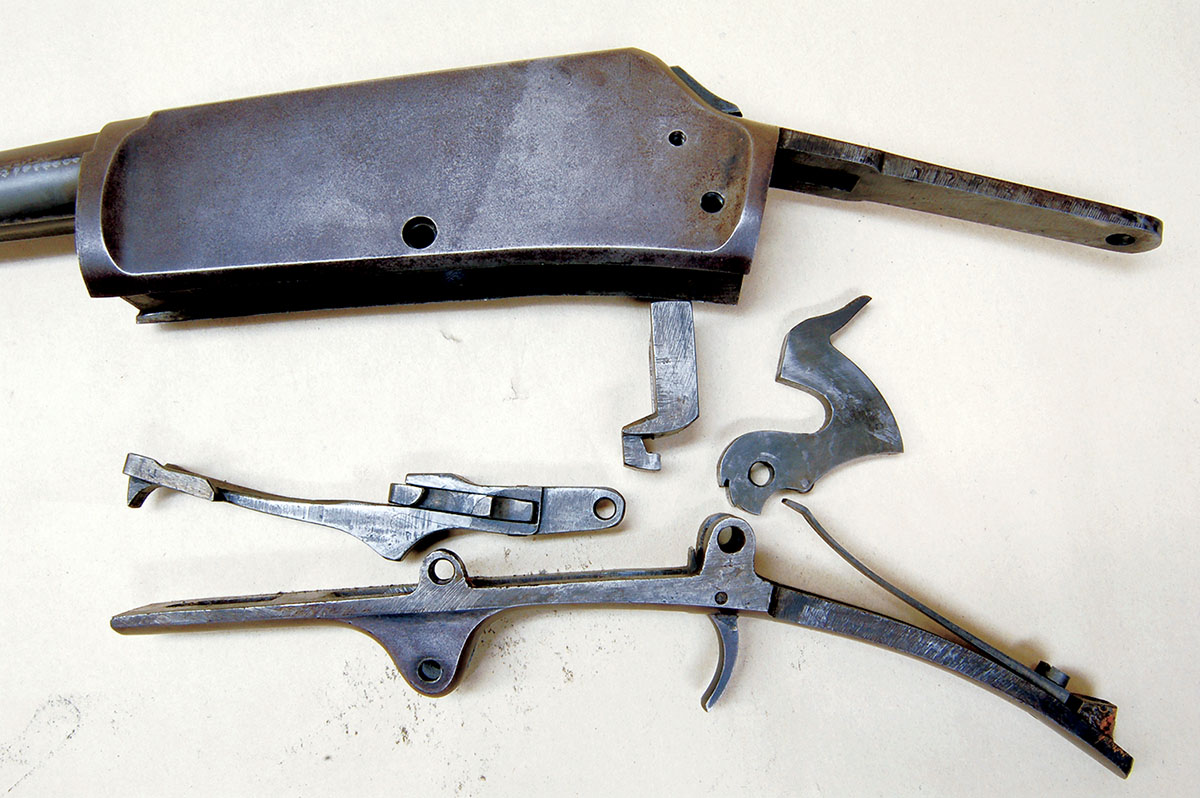
Remove the rest of the receiver screws (except the one behind the loading port), and the rest of the parts drop out. There are no small parts or springs, just big pieces of steel.
square breechblock. Receivers for the square block were expensive to machine, but when clean and lubed, the old actions are very smooth.
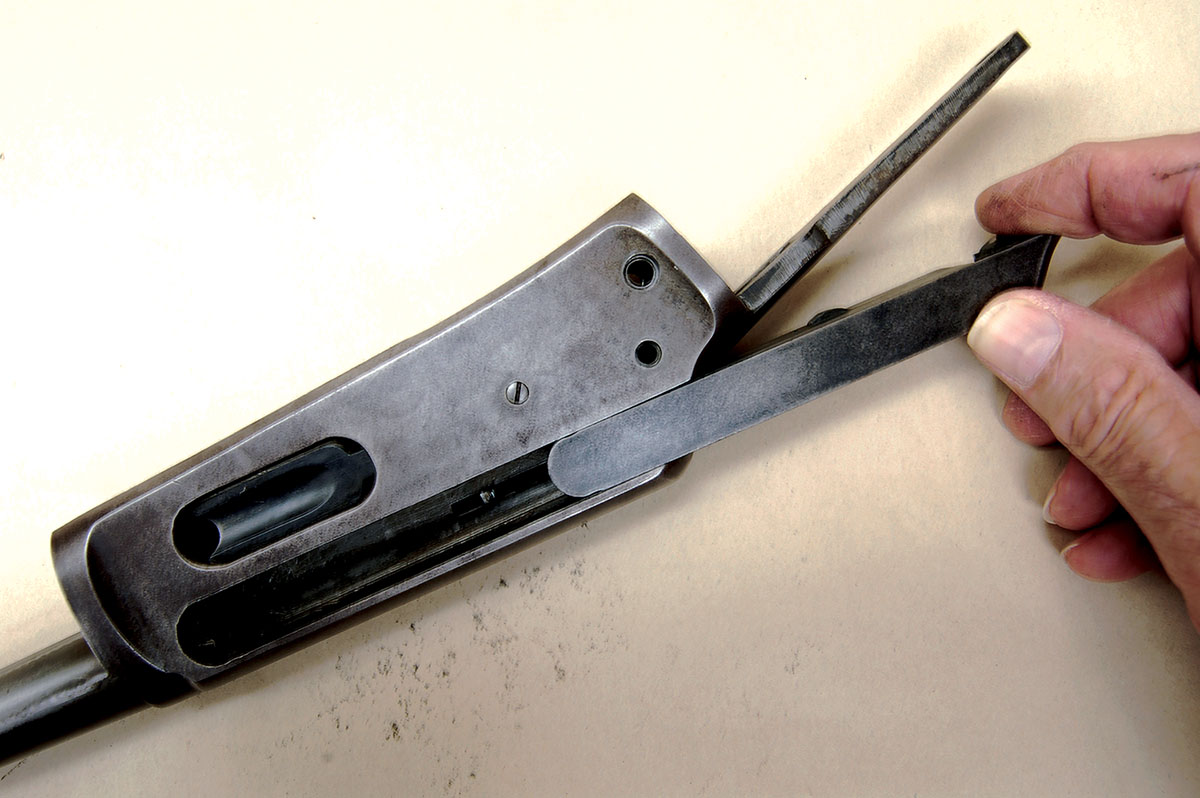
Once other parts are removed, the breechblock simply slides out of the receiver.
Disassembly and cleaning should be the first order of business before shooting. It also allows the discovery of “unfriendly” things previous owners may have done.
For the Marlin M1893, start with the magazine. Remove the two forearm cap screws, slide the cap forward, and lift the forearm/magazine tube assembly off the barrel. Magazine tube plug, plug screw and screw retainer can now be removed.
The inside of the magazine tube can now be examined for rust. Though uncommon, internal rusting likely occurs when warm guns are taken out into freezing weather. This causes moisture condensation inside the magazine tube. A few passes with a 28-gauge bronze brush soaked in WD-40, left overnight, will kill the rust. A couple passes with the same brush the next day,
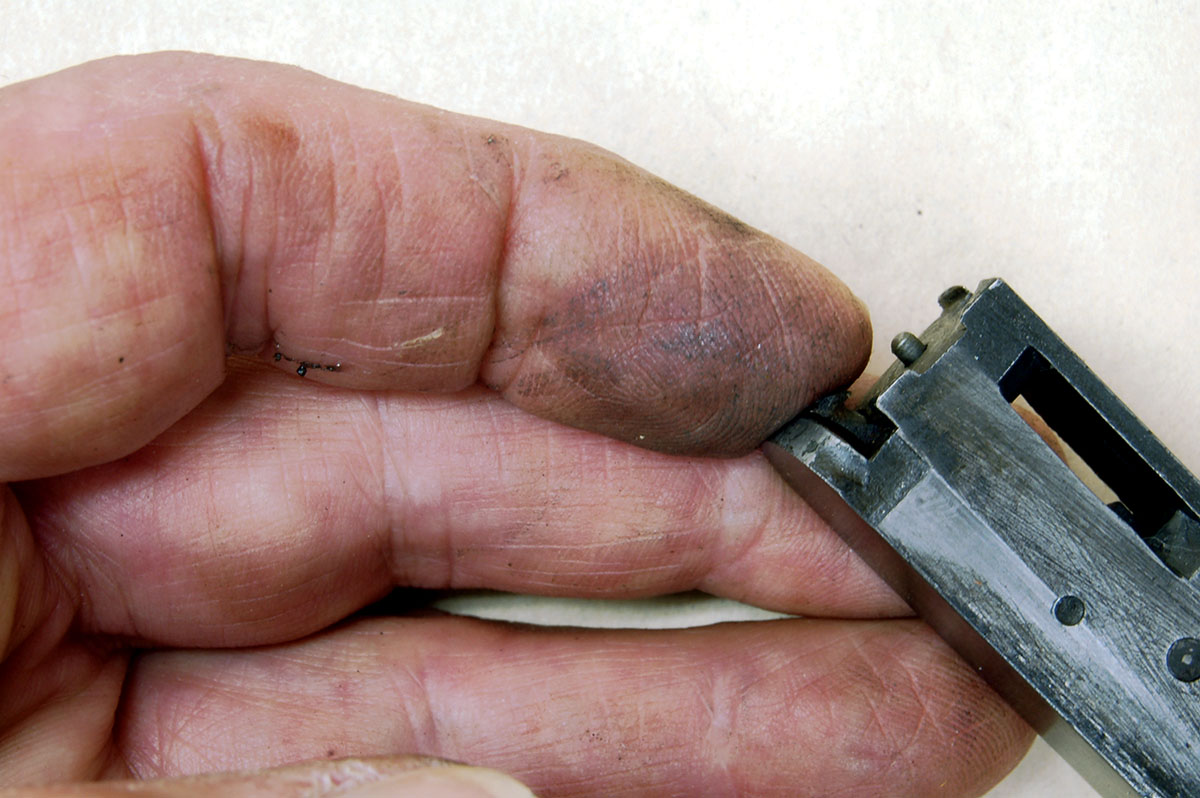
Check for firing-pin tip damage and hardened lube in its recess by pushing with a fingertip. If it moves freely, all is well.
followed by a dry patch, will remove loosened rust and any remaining liquid. A dab of RIG Universal Gun Grease on another patch
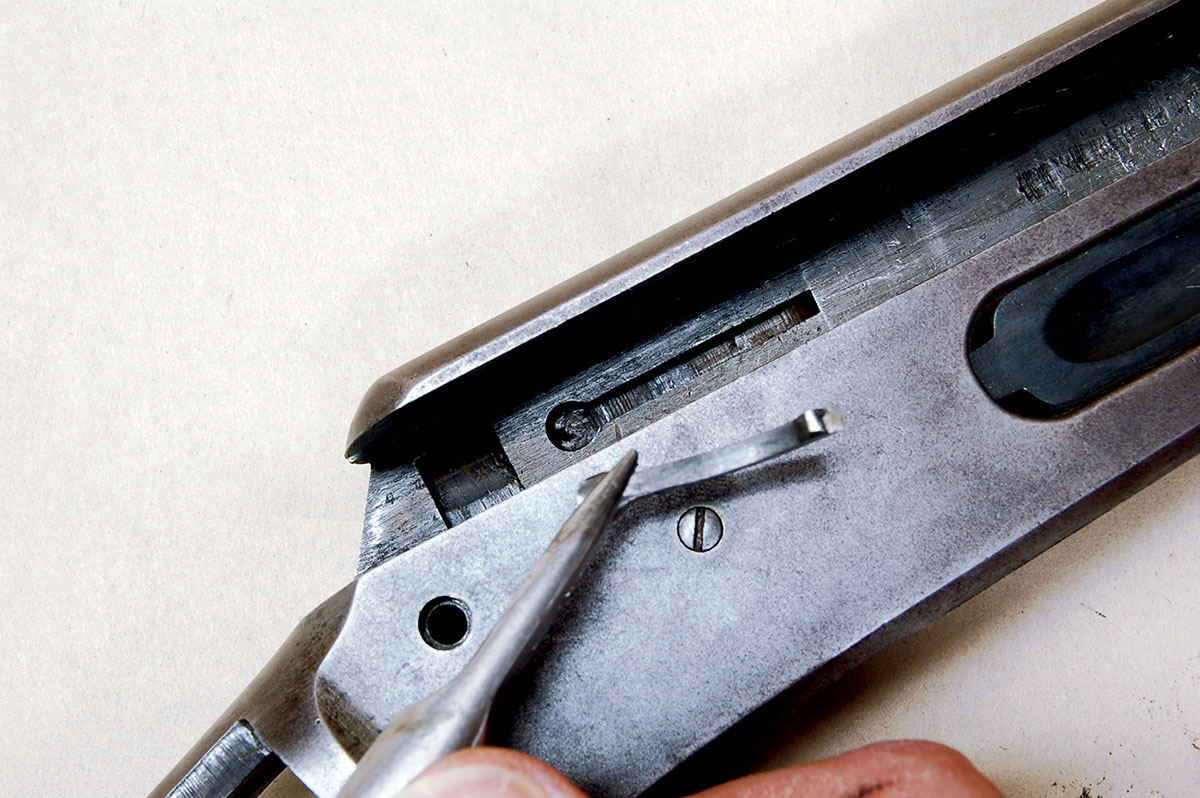
The ejector is unattached behind breechblock. Lift it out after the breechblock is removed.
finishes the job. Rusted followers are treated the same way, though in a few cases, new ones were made from structural nylon rod. They won’t rust, guaranteed.
Now remove the buttstock and loosen the mainspring screw a couple of turns to take all the pressure off the hammer. Next, remove the lever pivot screw (arrow in the below photo) and wiggle the lever down out of the receiver. Remove the rest of the screws in the action body except the one located an inch or so behind the loading port. It anchors the port cover. Threads are very fine, giving the chance of cross-threading during reassembly. It’s not worth it unless the port cover must be replaced.
Four of the six remaining receiver parts: receiver bottom plate, cartridge lifter, locking bolt and hammer may now be pulled out. The breechblock will slide out the rear of the receiver, but watch for the ejector as it is held in by the breechblock and will fall out when the block is removed. The ejector is a bit strange in that it has a thin piece of string steel crimped to its rear surface. All I have ever seen had this piece
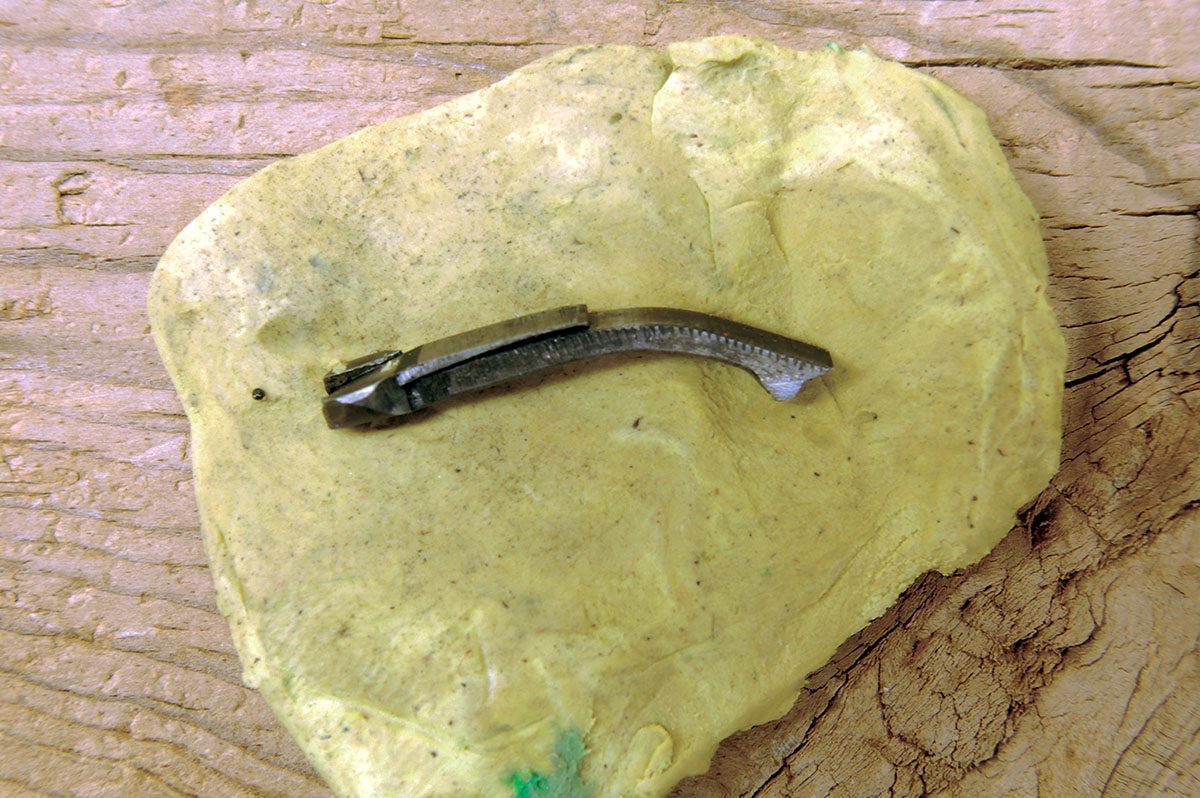
The ejector has a tiny flat spring crimped to its back. Whether it is nonfunctional or broken off seems to make no difference to ejection. Cases still eject flawlessly.
either flat against the rear of the ejector, like this M93, or broken off, as they were on the two M93s I owned years ago. All ejected empty cases perfectly. Guess it’s another example of “if it ain’t broke don’t fix it!” Parts are now cleaned, lubed and reassembled. Shooting will reveal any worn parts, especially a weak
magazine spring.Up until the last fifty years or so, it was not uncommon for rural folks to keep a fully loaded rifle close at hand. Years of magazine spring compression weakened it to the point that the last round may not feed out fast enough to prevent jamming when the lever is worked quickly. Fortunately, magazine springs are available from parts suppliers. The length of the spring is usually five inches longer than the magazine tube.
Then there is the dispute concerning Marlins marking M93 barrels “SPECIAL SMOKELESS STEEL” and some 32-40s and 38-55s as “FOR BLACK POWDER.” Since the company would never sell a rifle that was dangerous to fire with popular new smokeless propellant, the marking must have meant the barrel only. Even then, there was no danger. Marlin had simply discovered that their barrel steel did not hold up well to hot, erosive smokeless powder of the time and hard-jacketed bullets. They found something better, thus the smokeless marking. The older steel was used up, making identical M93s marked for black powder and priced about 18 percent below those using the newer steel. Hunters who saw nothing wrong with the black powder cartridges and their lead bullets didn’t mind.
Lastly, there is the headspace of any old levergun. Simply put, the headspace of leverguns firing rounds in the 30-30 class is largely unimportant. Rimmed cases headspace on the rim and brass is hard stuff. It can’t be compressed to force a case into the chamber like a 308 Winchester in a bolt gun. Thus, all old leverguns have generous headspace to allow easy chambering.
Firing one of these guns, if both the chamber and the cartridge are clean and dry, will result in the case adhering to the chamber walls and holding back the gas pressure. The primer, however, will be pushed out of its pocket and up against the breech face. If the chamber has been oiled or the case has sizing lube on it, the same thing happens, except the case may slide back in the chamber, forcing the slightly expanded primer back into the pocket. This flattens the primer face, giving the false appearance of very high pressure (see photo on page 12 for these examples). Don’t worry about it. Clean and lube the old guns, handload cartridges duplicating factory ballistics of the time, shoot a lot and have fun.