Mostly Long Guns
Skinner Sights and Charter Arms Target Pathfinder
column By: Brian Pearce | September, 26
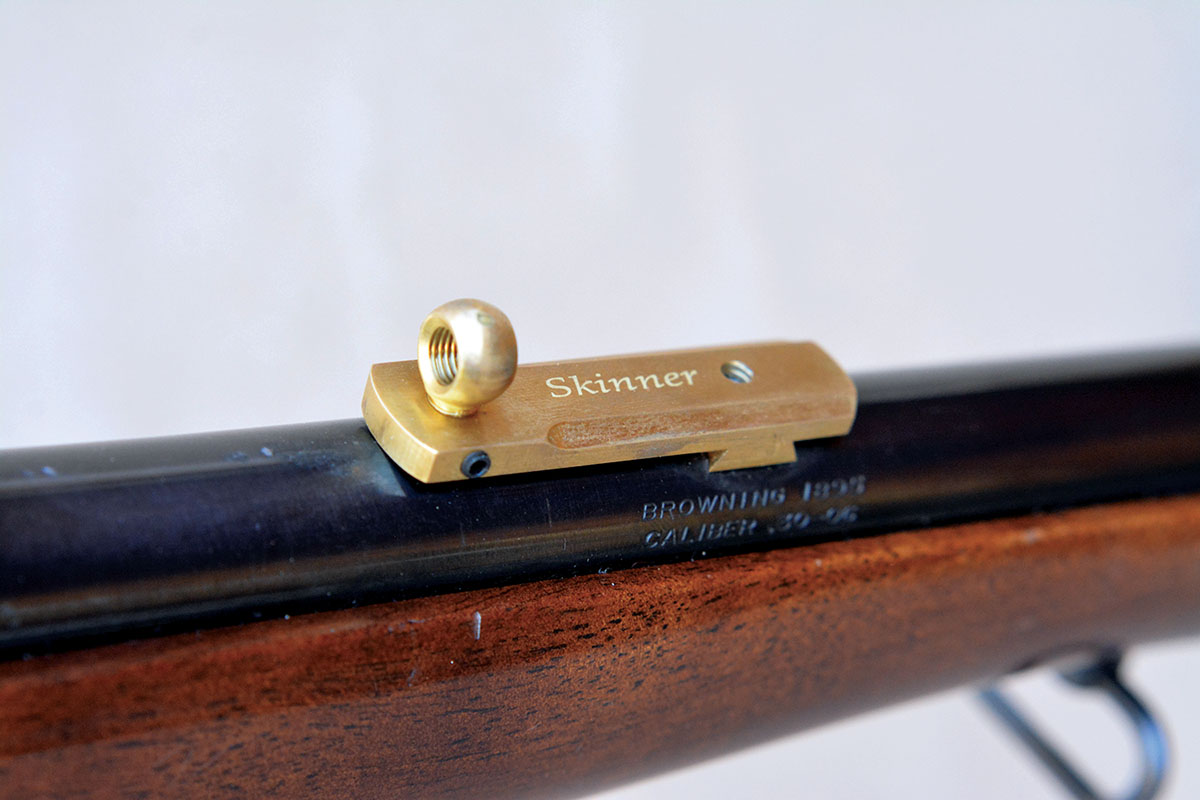
Skinner Sights Barrel Mount Peep Sight for Winchester 1895 Rifles
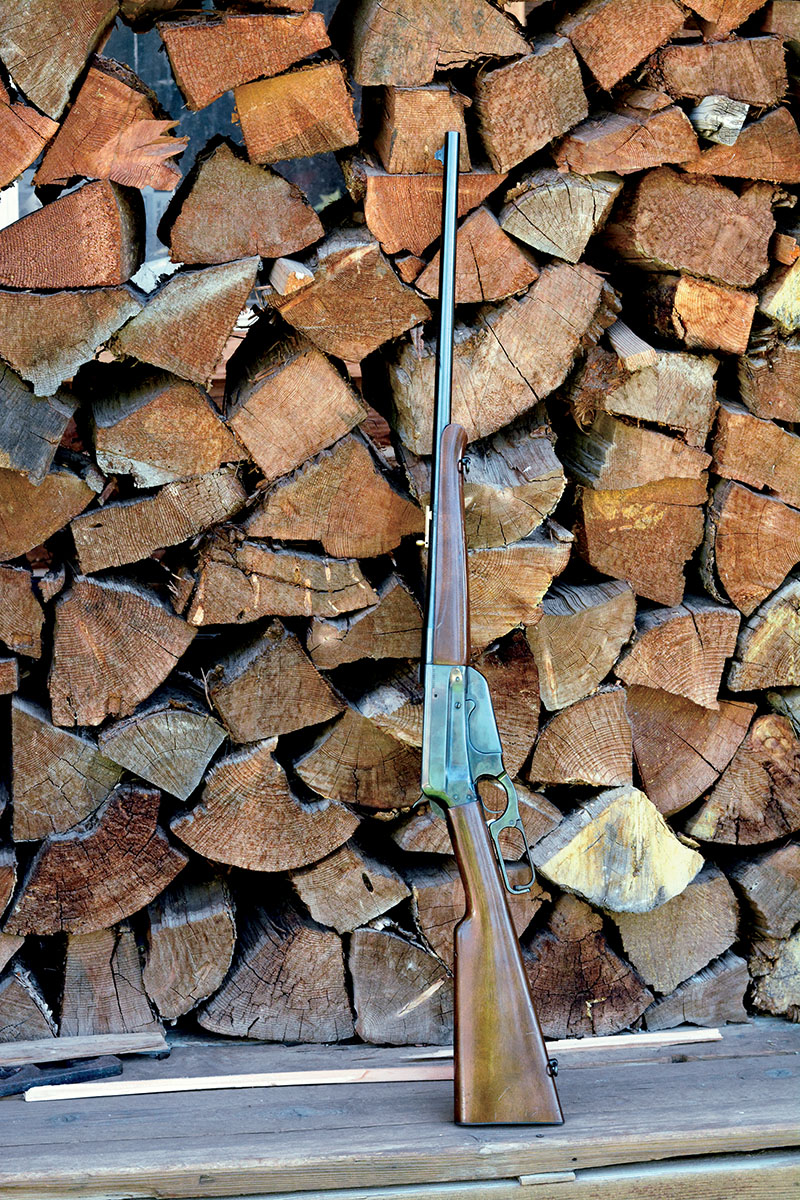
The Winchester Model 1895 with its box magazine was a rather unique lever-action rifle that was chambered for modern, high-intensity cartridges with spitzer profile bullets, such as the 30-40 Krag, 30-03, 30-06 Springfield and several other cartridges. However, with the economic factors of the Great Depression, followed by World War II, it was discontinued by 1940. Nonetheless, it remains in demand by collectors, modern shooters and hunters. As a result, Miroku (Japan) began offering reproductions in 1984 that were imported by Browning Arms, with subsequent guns imported by USRAC with the Winchester trademark. These are great shooting rifles that are accurate, made from modern high-tensile steel and can be obtained at reasonable shooters’ prices.
Original Model 1895 rifles were often ordered by savvy shooters and hunters with optional Lyman aperture rear sights. However, the Miroku produced rifles come standard with open, semi-Buckhorn rear sight and bead front that leave something to be desired in the field. Today, there are options to install good aperture sights from Lyman and Williams that mount to the left side of the receiver and extend over the top of the bolt; however, they require the receiver to be drilled and tapped before they can be installed.
Skinner Sights offers a bolt-mounted Express Sight ($95.00) for the Model 1895 that maximizes the sight radius and accepts all 5 of the Skinner Sight interchangeable apertures with hole sizes of .040, .070, .096, .125 and .155-inch. This is a great option; however, it requires the bolt to be drilled and tapped with two 6-48 holes.
There are two problems with drilling and tapping either the receiver or the bolt of Miroku Model 1895s. First, qualified local gunsmiths across the nation seem to be in short supply and are disappearing. In some instances, guns might have to be shipped to a gunsmith, which adds to the cost of drilling and tapping. Secondly, drilling holes in these rifles will generally decrease their value in spite of the modification improving the rifle’s usability.
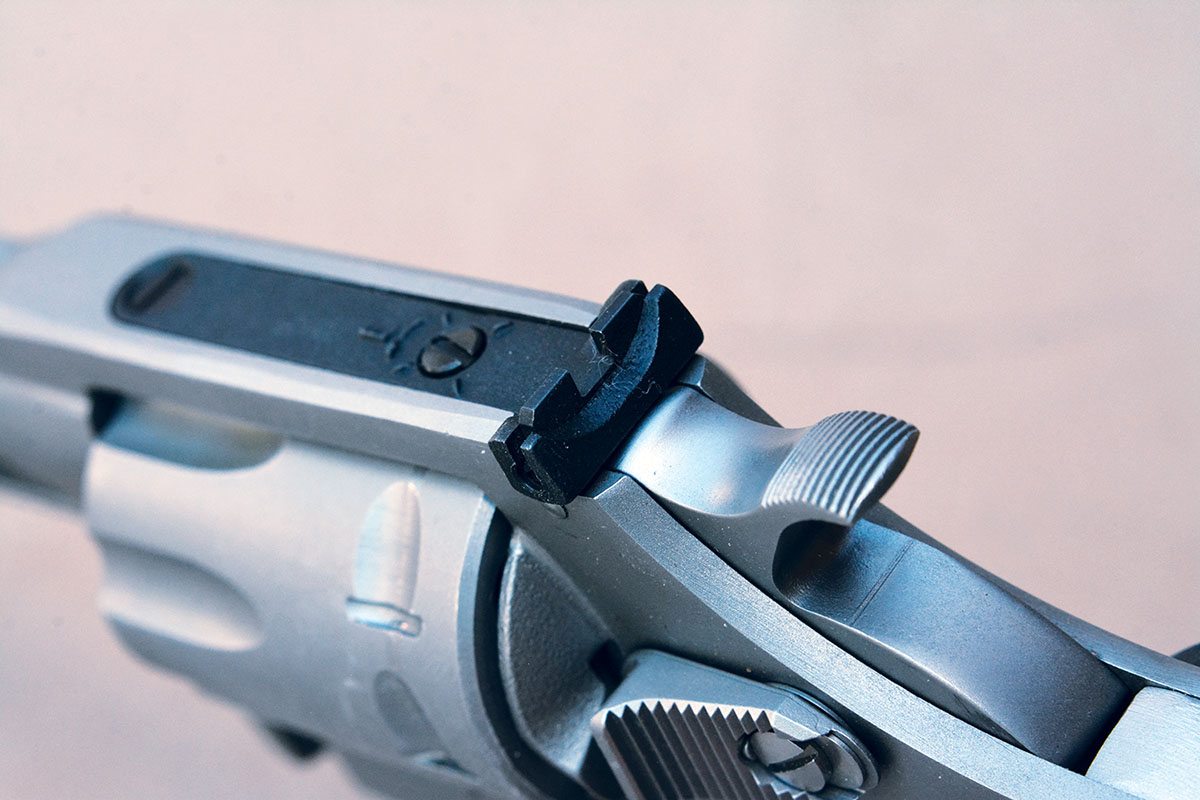
There is another option, which includes the Skinner Barrel Mount Peep Sight (see photo). This sight is available in blue steel, stainless steel and brass finishes and includes the .200-inch ghost ring without aperture installed, but comes standard with a .125-inch screw in aperture, which is about the smallest practical size considering the distance it is from the eye. It installs in the rear sight dovetail (.375-inch dovetail) and does not require any modification to the gun. Rather, the rear sight can be drifted out and the Barrel Mount Peep Sight installed. For windage adjustments, the sight is drifted left or right as needed, and the set screw is tightened to lock it in place. Elevation adjustments are made by loosening the set screw (on the right side of the sight base) and turning the peep on its threaded shaft up or down as needed, and then tightening the set screw, which is all very simple.
The Barrel Mount Peep Sight is lightweight, rugged and handsome, and offers the virtues of aperture sights that have proven time and time again their value on target ranges and in the field. Again, it does not require any modification to the rifle and at just $55.00, it’s a bargain. For more information, go to SkinnerSights.com.
Charter Arms Target Pathfinder
The Charter Arms Company was founded in 1964 by Douglas McClenahan, who had previously worked for Colt, Bill Ruger and High Standard,
where he engineered and designed guns. The first Charter Arms was the Undercover, designed to compete directly with the hugely popular Smith & Wesson Model 36, chambered in 38 Special. Naturally, it was a small frame, 5-shot, double-action revolver with a 1.85-inch barrel, and was produced in Bridgeport, Connecticut. However, it had some very unique design features that included a solid frame void of side plates, boasted of fewer moving parts than competing designs. Its transfer bar safety system would later be copied by Colt in their Trooper Mark III in 1969, Ruger in the New Model Blackhawk in 1973 and subsequently by many, many other companies. The trigger guard and backstrap are removed from the bottom of the frame to access the lock-work or disassemble the gun. The Undercover’s cost was notably lower than competing models, and sales were strong. The company soon introduced many new models and calibers, including the notable Bulldog and the Pathfinder.
By 1967, David Ecker became part-owner of Charter Arms, but became the sole owner in 1978 when his close friend McClenahan decided to retire. Ecker’s son Nick soon joined his father as a part owner. The company was sold in 1988 to Jeff Williams, but after filing for bankruptcy, the company closed its doors in 1998.
But the story does not end there. In 2000, Nick Ecker founded Charter 2000 and began producing guns in Shelton, Connecticut. The basic design remains the same, but there have been small improvements to the action and safety, along with more efficient manufacturing methods. Many additional models and calibers have been added, ranging from 22 Long Rifle to 45 ACP. Beginning in 2005, the company became Charter Arms.
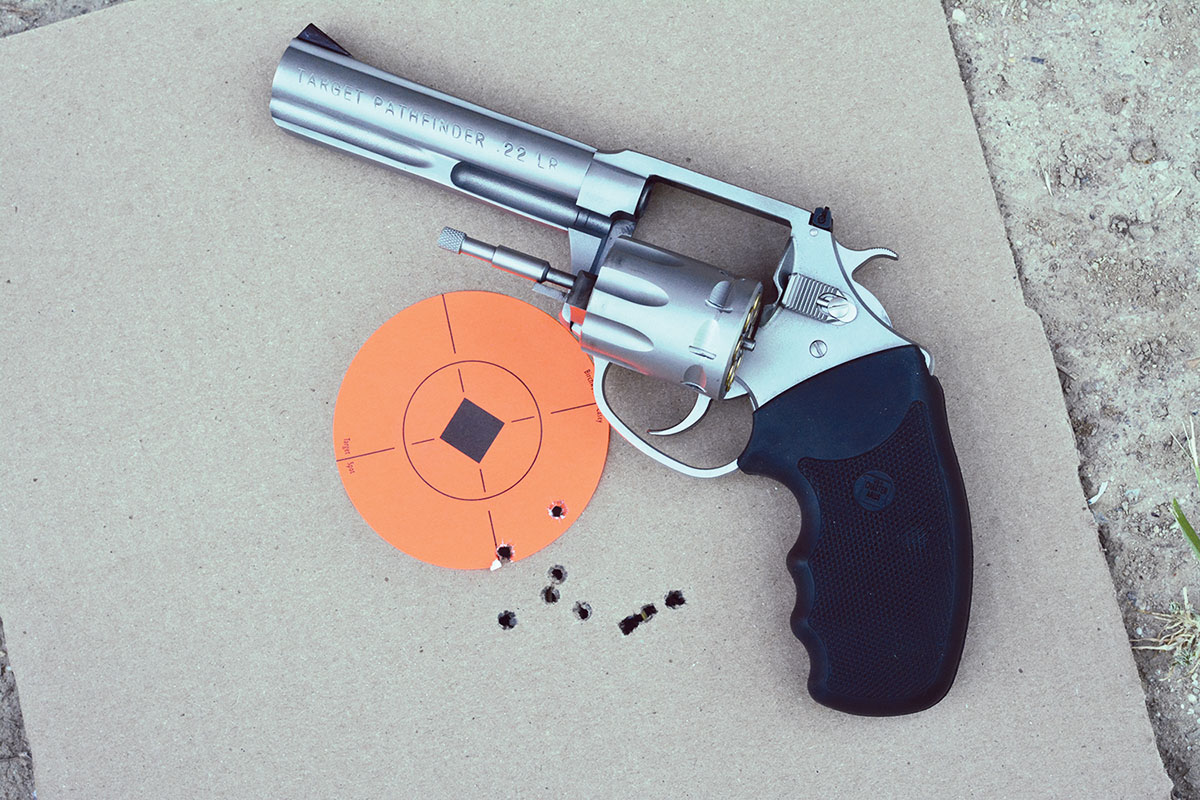
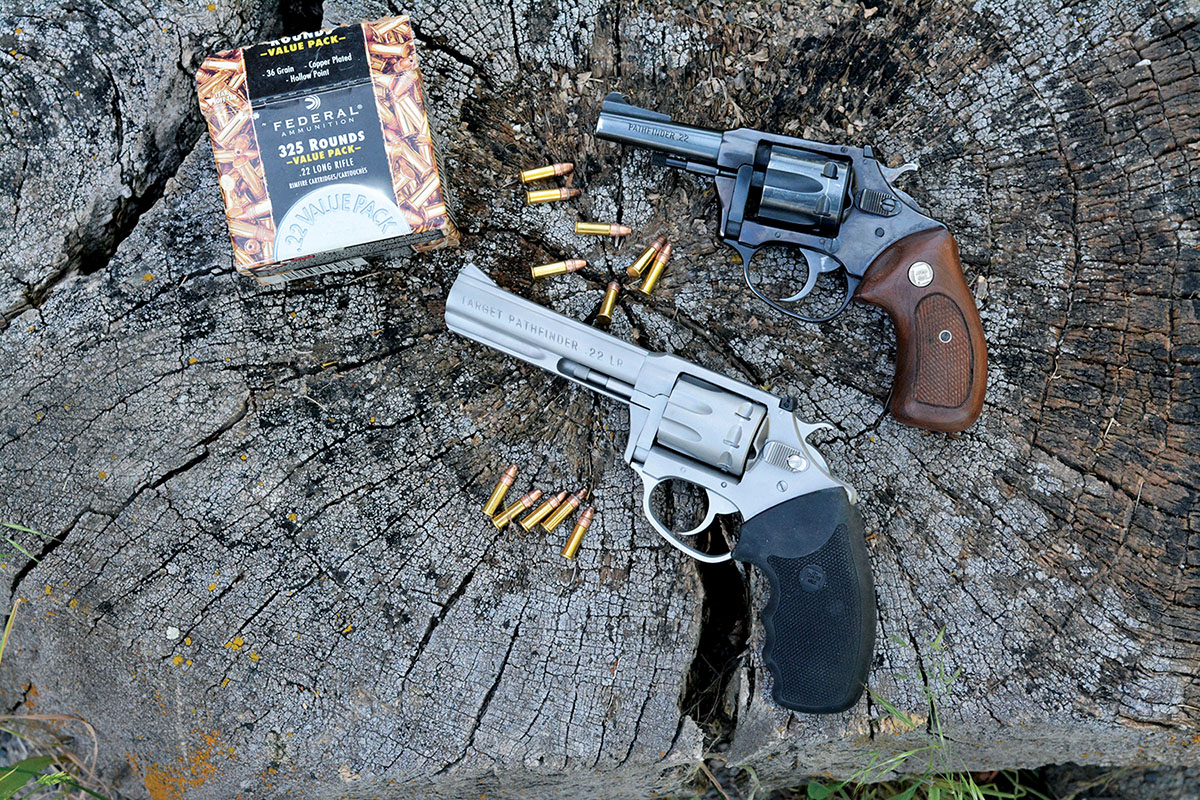
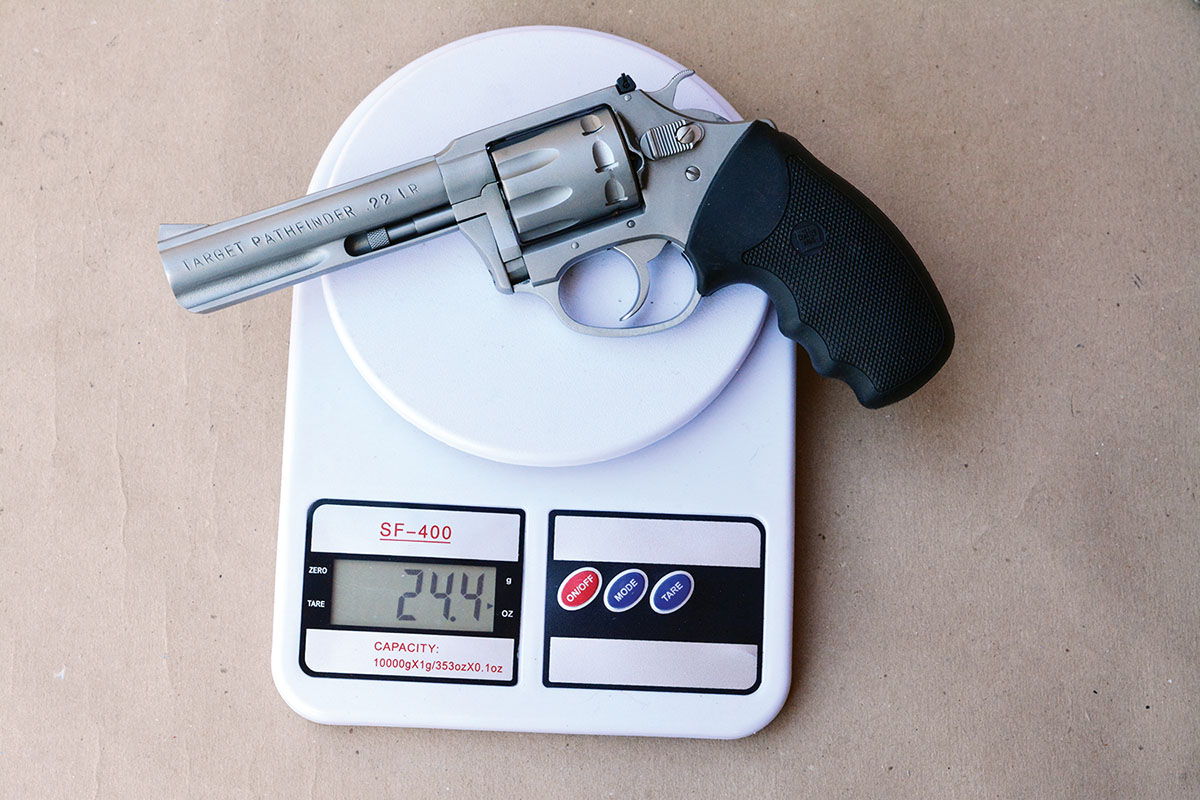
For today’s review, a new Target Pathfinder 22 LR stainless steel was purchased. It is based on the small 38 frame, with an 8-round capacity, adjustable rear sight, black rubber grips and has a 4.230-inch barrel with an under lug for increased muzzle weight. At 24.4 ounces (empty), it is a great choice for a kit gun, or for fishermen, backpackers, campers, etc.
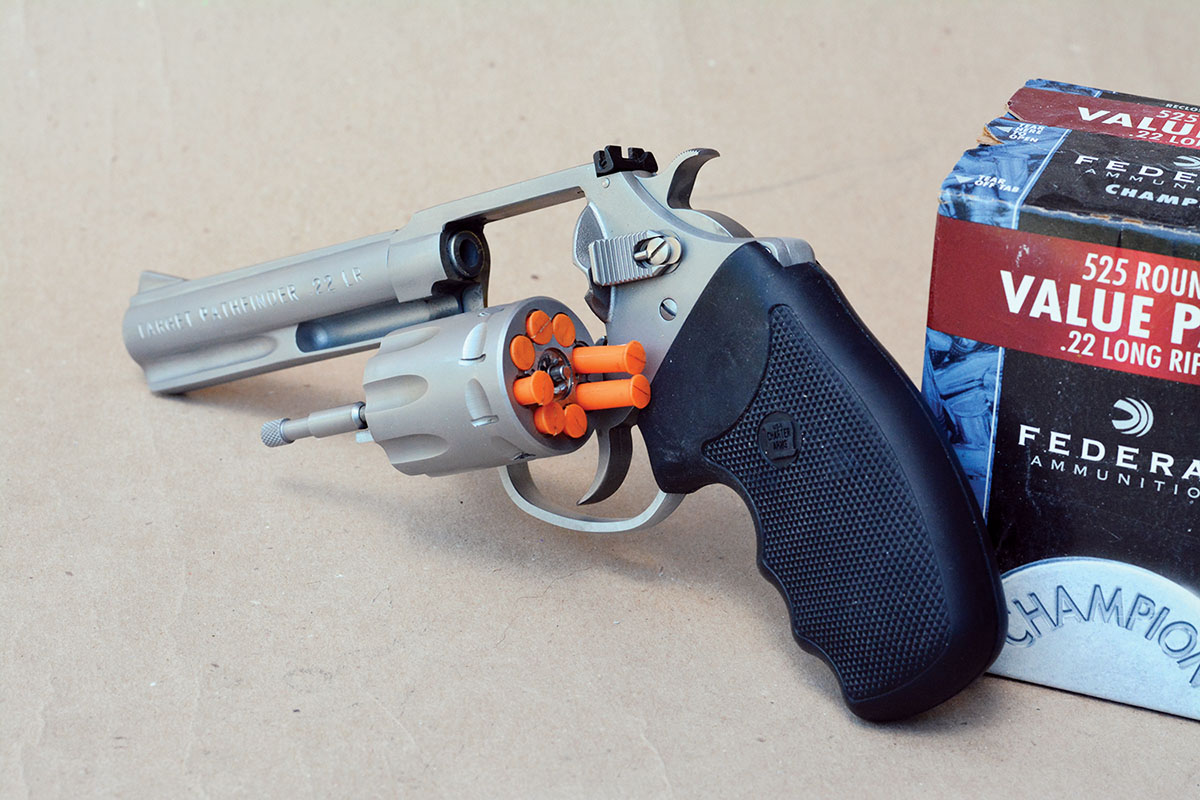
The action receives a C+ grade when worked in double- and single-action modes. The single-action trigger pull breaks cleanly at 54 ounces, or just under 31⁄2-pounds. Charter Arms strongly advises against dry firing this rimfire, as that can cause damage; specifically, chambers can develop burrs that will hinder cartridges from being chambered. Therefore, it includes 8 snap caps to help prevent the problem, and if you must dry fire but have misplaced the snap caps, the cylinder should be swung out.
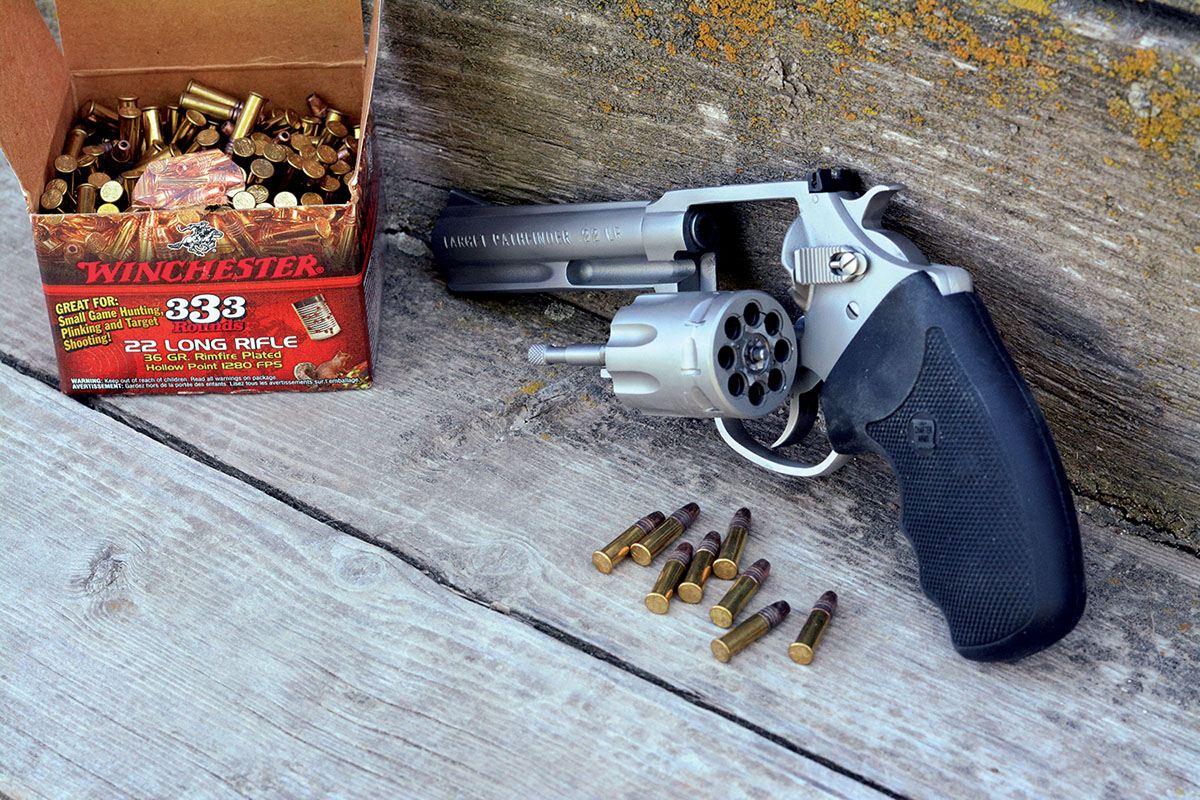
Overall, the quality of this gun is respectable, especially considering its modest price, which is generally less than $400, which in today’s inflated world is a modest cost for a double-action revolver manufactured in the USA.
I have had a fair amount of experience with Charter Arms guns, including the original company and the current manufacturer. There is one design feature that owners should be aware of, especially if they plan to fire their guns in volume, which is somewhat common with the 22 rimfires. The cylinder rotates clockwise, the same as Colt double actions, but opposite to Smith & Wesson’s cylinder. The hand slot cutout in the back of the frame is located on the left side of the ejector rod lock recess that serves to lock the cylinder at the breech. The ejector rod is spring-loaded, and each time the cylinder is opened and closed, the end of the ejector rod is dragged across the hand’s cutout slot. This cutout serves to let the hand slide up and down to rotate the cylinder with each shot. If the guns are run dry without lubrication, this cutout slot will eventually develop burrs and will hinder the hand from working freely. This is a relatively easy fix, and it’s best to keep a small amount of synthetic gun grease at this potential wear point.
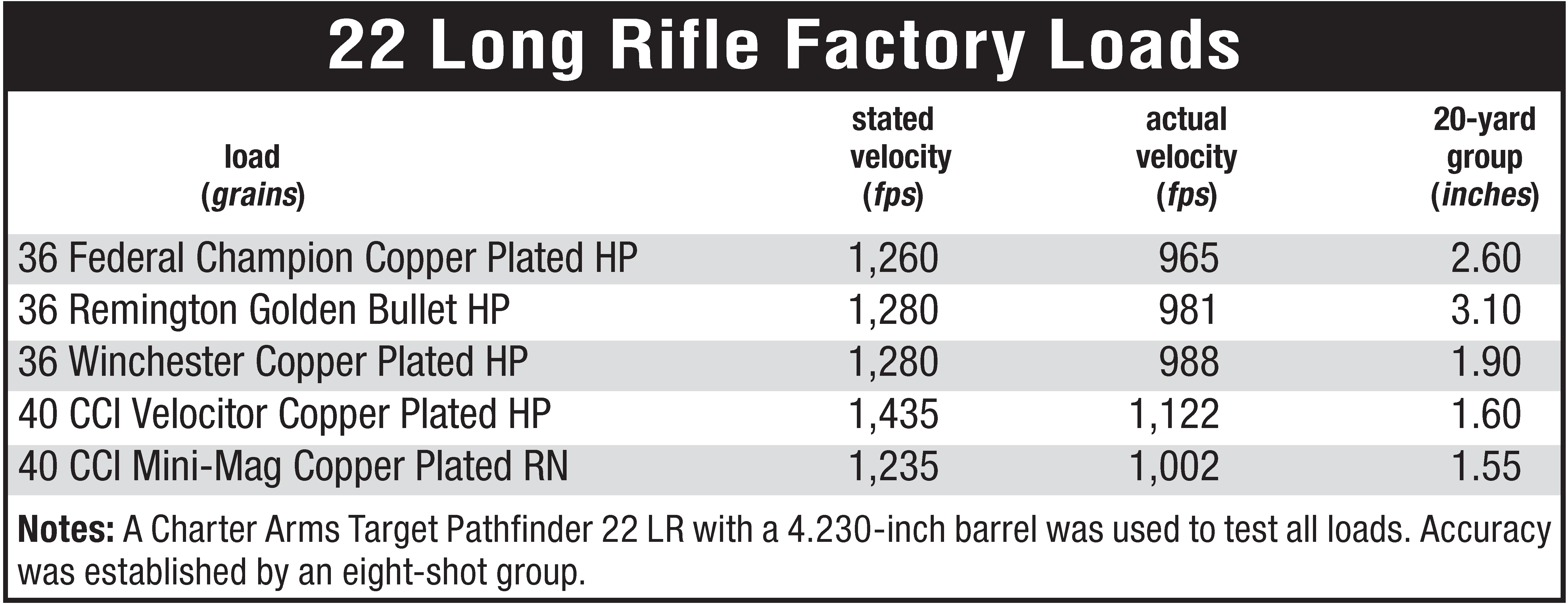
As can be seen in the accompanying table, the Target Pathfinder gave acceptable accuracy with several different high-speed 22 Long Rifle loads from Federal, Winchester, Remington and CCI. What is interesting is that there was a pretty significant swing in accuracy from one load to the next, even loads from the same manufacturer. Top loads generally grouped into 11⁄2 to 2 inches (8 shots) at 20 yards.
The gun worked well throughout several shooting sessions. However, some case brands would drag on the recoil plate area after they were fired. The gun seemed to function most reliably with CCI and Winchester loads. It is always recommended to clean the chambers regularly to allow cartridges to easily chamber. If chambers become excessively dirty and cartridges are not fully inserted or seated into the chambers, cartridge heads can drag as the cylinder rotates. Cartridges that are not fully seated can cushion the firing pin blow, resulting in misfires. Two misfires occurred during the firing of several hundred rounds.
The Charter Arms Target Pathfinder 22 LR is a useful gun, and with prices running from $360 to $425, it’s a good value.